
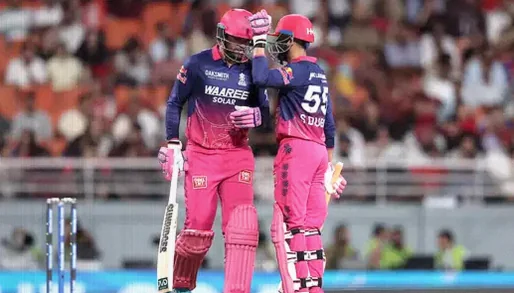
Punjab Kings’ run of unbeaten IPL 2026 form came to an abrupt end as Rajasthan Royals produced a ruthless chase in Mullanpur. Rajasthan’s batting at both the start and the finish of the innings set the tone, and they got over the line with 6 wickets to spare.
Punjab posted 222/4 in their 20 overs, with Marcus Stoinis striking with authority in the late overs and Prabhsimran Singh adding another fifty. However, the Royals’ response—anchored by their top-order and boosted at the death by Donovan Ferreira and impact substitute Shubham Dubey—proved too strong for Punjab’s bowling.
Quick facts
- Match result: Rajasthan Royals won by 6 wickets
- Punjab Kings: 222/4 in 20 overs
- Rajasthan Royals: 228/4 in 19.2 overs
- PBKS top contributions: Marcus Stoinis 62* (22), Prabhsimran Singh 59 (44), Cooper Connolly 30 (14)
- PBKS bowling highlight: Yash Raj Punja 2/41
- RR top contributions: Donovan Ferreira 52* (26), Yashasvi Jaiswal 51 (27), Vaibhav Sooryavanshi 43 (16)
- RR bowling highlight: Yuzvendra Chahal 3/36
Rajasthan’s winning formula was clear early: their top-three, led by Vaibhav Sooryavanshi in the Powerplay, kept the chase moving. Then, at the end of the innings, Ferreira and Dubey provided the acceleration that turned a target into a near-impossible one.
How did the openers shape the game?
The contest was expected to revolve around the two opening groups, and it delivered. Sooryavanshi, in particular, looked more dangerous than most—Jofra Archer struck early with pace and swing to test Priyansh Arya, but the early pressure didn’t quite translate into wickets.
Prabhsimran Singh, who had arrived after a staggering 76 off 26 in his previous outing, also couldn’t fully control the moment. Nandre Burger bowled quickly, yet his lengths were read well; Arya struck through the line while Prabhsimran kept stepping his front foot away, taking the South African on.
Burger ended up bowling half of the Powerplay overs, and the Royals conceded 45 runs off 65 in that phase. For Sooryavanshi, though, the start was far smoother—Arshdeep Singh managed two away-swinging full deliveries, and for a moment it looked like he might defend his line and length.
The plan unraveled as soon as Arshdeep switched to inswing; Sooryavanshi’s bat speed took over, and he struck his first six of the match. He then added two fours in the same over from either side of the wicket, sending a clear message that there weren’t any easy gameplans to slow him down.
Lockie Ferguson came on next and watched the ball go airborne as well. Ferguson went full and Sooryavanshi responded with a wristy flick for another six; Ferguson then changed pace with a knuckleball and the result was the same. Marco Jansen tried to disguise the delivery with a slower ball, but Sooryavanshi again cleared deep midwicket.
The breakthrough, when it did arrive, came from the angle rather than the pace. Sooryavanshi was dismissed when Arshdeep bowled around the stumps and steered the ball away from the left-hander—Sooryavanshi tried to punish a low full-toss aimed toward the straight boundary, but Shreyas Iyer took the catch. He departed after 16 balls for 43.
Rajasthan kept their Powerplay tempo intact after that. Yashasvi Jaiswal and Dhruv Jurel continued to find the boundary, and despite Harpreet Brar delivering a sharp first over—two singles and four dots—Rajasthan still surged to 84/1 after six overs, a platform that later proved decisive.
What happened during the middle overs?
Punjab’s spinners tightened the screws once the early acceleration had set the chase on track. Harpreet Brar kept it difficult to score off his bowling, allowing only one four across his next two overs.
Yuzvendra Chahal also started well, beginning with a five-run over. He then struck with a full-toss—Dhruv Jurel tried to smash it over long on, but the boundary rider was waiting. Jaiswal reached his half-century, yet the innings didn’t last long after: he was dismissed as Chahal delivered a tossed-up ball that carried to the long-off fielder.
Riyan Parag offered a late glimpse of a breakthrough into the chase, hitting reverse-sweep sixes and targeting the deep midwicket boundary. But on the final delivery of Chahal’s spell, Parag struck straight to deep midwicket and walked off after 16 balls for 29—his best score of the season.
Why did Rajasthan still win?
Punjab’s death-over bowling didn’t meet expectations. Arshdeep Singh produced two below-par overs around the final stages, and that was enough for Ferreira and Dubey to build momentum. With 58 required off the last 30 balls after a 14-run 15th over, Rajasthan looked to be in control.
Marco Jansen was then punished by the impact substitute for a boundary-heavy 15th-over sequence, costing 15 runs again. Ferguson gave away eight to slow the run rate slightly, but Ferreira and Dubey immediately attacked Arshdeep again, taking 17 off the next set of deliveries.
In the 19th over, Ferreira stepped up further—he struck a six high into the tiers and followed it with two fours, leaving Rajasthan just two runs away. He completed the job with a six in the last over, finishing on a sensational 26-ball 52*. Dubey, meanwhile, anchored the other end during a 77-run stand and finished with an impressive 31* off 12.
How did PBKS reach 222?
Punjab’s total was driven by an “Aussie carry job.” Prabhsimran reached a half-century, but the momentum truly surged when Cooper Connolly took on the Royals’ spinners, attacking both Yash Raj Punja and Ravindra Jadeja.
Connolly’s cameo was brief but impactful; he made 30 off just 14 balls before departing in the ninth over. Shreyas Iyer looked scratchy through his 27-ball stay, managing 30 runs, yet Stoinis’s raw hitting kept pushing Punjab toward a defendable total.
Rajasthan felt the pressure most during the final three overs, where Punjab’s batters piled on 55 runs. Stoinis spared no one—Nandre Burger returned and absorbed some more damage, finishing with 1/59 across four overs. Archer was also hit for a couple of sixes, and Stoinis then compounded the innings against Brijesh Sharma.
Brijesh Sharma, a young pacer, had started promisingly by conceding only 18 in the first three overs, but his figures ended at 0-42. At that stage, it looked as though Punjab had timed their resurgence well enough to give their bowlers a strong chance—but Rajasthan’s chase refused to stall.
What’s next for both teams?
Rajasthan Royals return to Jaipur, where they will face Delhi Capitals on May 1. Punjab Kings play Gujarat Titans in Ahmedabad on May 3.
