
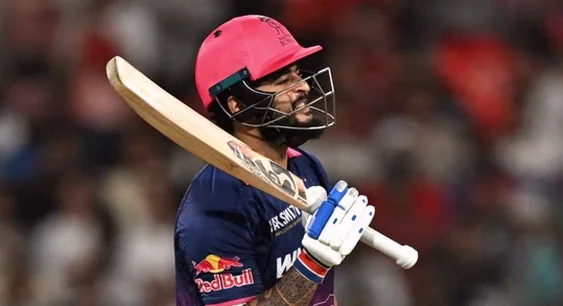
Rajasthan Royals began IPL 2026 with real authority, winning their first four matches and staking an early claim at the summit of the points table. Yet as the season moved forward, inconsistency crept in: they suffered three defeats in the following four outings, revealing weaknesses that had not been visible at the start. For a side powered by Vaibhav Sooryavanshi and Yashasvi Jaiswal, plus a steady influence from Dhruv Jurel at No. 3, the biggest concern quickly became the middle-order.
Across their first eight matches, Rajasthan’s batting slot from Nos. 4 to 7 produced an average of just 21.10, the second-worst among the league’s 10 teams. Their strike rate in that stretch was 126.35, adding to the sense that once the openers and No. 3 had done their job, the innings often lacked the acceleration required for a chase or a platform.
Rajasthan’s chase of 223 on a New Chandigarh wicket
- On Tuesday, Rajasthan were set a target of 223 while chasing on a New Chandigarh surface that played fairly to bat.
- Vaibhav Sooryavanshi and Yashasvi Jaiswal laid the foundation, building momentum that the middle order then had to convert into the finish.
- Captain Riyan Parag, who had been under pressure for his returns earlier in the season, found support in the chase as the innings moved deeper.
- The required rate at one stage climbed to 12, with Rajasthan needing 72 off the last 36 balls after Parag’s dismissal.
- As Punjab’s spinners were eventually forced out, Donovan Ferreira and Shubman Dubey took charge, turning the chase firmly in Rajasthan’s favour.
- Arshdeep Singh struggled in his final two overs, conceding 31 runs, before Dubey dealt a decisive blow in the 16th over by striking Marco Jansen for a boundary and a six.
- Lockie Ferguson also had a difficult period near the end, as Punjab were hit for 16 runs during his spell, and the match swung fully toward Rajasthan.
- Ferreira then sealed the job in the final over with a six over long-on, helping Rajasthan complete the chase with four balls remaining and move up to third place in the points table.
The turnaround was also tied to individual form. Parag had managed only 88 runs in his first eight games of the campaign, leaving him averaging below 15. But against Punjab Kings, he delivered a timely cameo—29 from 16 balls—featuring two fours and two sixes. From there, Ferreira and Dubey took Rajasthan across the line, with the fifth-wicket partnership guiding them to the finish.
Speaking after the match, Parag pushed back on the notion that the middle-order issues were something the team was forced to address in the dressing room. He suggested the chatter stemmed from others outside the group rather than from any internal doubt.
“The concerns were apart from us, was from everyone else. Everyone watching, everyone commentating. That was their concerns, not our concerns. We trust our players and their abilities a lot. When the middle-order doesn’t fire, the openers, number three and the lower order have to like pick it up. When the middle-order fires and someone from the top doesn’t get runs or goes at a slower rate, we pick it up. So as a team, I feel we have confidence and trust in every one of them. All the reasons and all the worries are outside, not for us,” Parag said in the post-match interaction.
What proved decisive was the way Ferreira and Dubey combined at the key stage. Ferreira finished unbeaten on 52 off 26 deliveries, while Dubey made 31 off just 12 balls. Together, they stitched a 77-run partnership that effectively took the contest away from Punjab.
Parag also highlighted how the two batters executed under pressure. “I think him and Don, the way they played, they took it away from Punjab. I honestly thought it was going to be a very neck-to-neck because they would bowl a little bit more slower balls after watching us bowl it. But yeah, I think the way they batted, immense, like commendable,” he added.
With Rajasthan’s chase built on the early momentum created by Sooryavanshi and Jaiswal, the job became easier—but the real test was maintaining tempo once the powerplay was over. Parag explained that after the initial acceleration, the side needed to keep climbing the scoreboard without letting the required rate spike.
“The plan was to keep wickets in hand, but not fall too behind the run-rate. The way the openers went, Vaibhav and Jaiswal, I feel it just made our jobs very easier as usual. But the tough part was after the powerplay, keeping that momentum, keeping going at 10 an over. I think right after the powerplay, we got like overs of five, eight and something like that. So we got behind a little bit, but then we picked it up again,” Parag said.
