
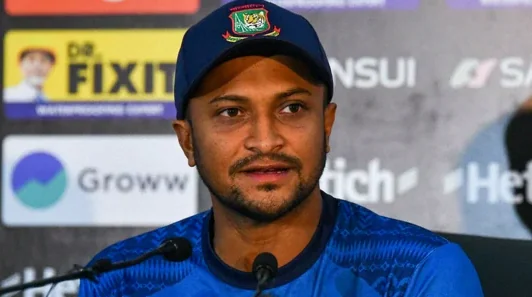
Bangladesh’s decision to miss the T20 World Cup 2026 has sparked a sharp reaction from within the country’s cricket fraternity, with former captain Shakib Al Hasan describing the move as a major mistake by the government. Speaking publicly, Shakib argued that Bangladesh’s passionate cricket audience has been denied the chance to see their team compete on the biggest global stage after an escalating dispute between the Bangladesh Cricket Board (BCB) and the ICC over venues and match conditions ended with Bangladesh being replaced by Scotland.
How Bangladesh were left out
- Bangladesh were scheduled to play their T20 World Cup matches in India for the 2026 edition.
- The BCB raised safety concerns and pushed for the games to be shifted away from India, seeking an adjustment to the original plan.
- As negotiations continued, the board reportedly explored alternate options, including Sri Lanka, but the ICC did not agree after multiple rounds of discussions.
- When the BCB was unable to confirm participation as originally expected, the ICC moved to replace Bangladesh and drafted Scotland into the tournament.
Shakib linked the World Cup fallout to a broader pattern of disruption, pointing to the way cricket administration and politics can combine to derail major opportunities. His comments came during the jersey launch of the EU T20 Belgium 2026, where he said Bangladesh’s non-participation represents a severe setback for the nation’s cricket culture.
Shakib calls it a “blunder” and a “big loss”
In his media remarks, Shakib did not treat the absence as a mere scheduling mishap. Instead, he placed the blame directly on the government for choosing not to send the team. He said Bangladesh, as a cricket-loving country, deeply values watching its players feature in World Cup matches, and that missing the tournament has been a major void for fans.
“I think that’s a big loss and big miss as far as Bangladesh cricket is concerned. We, as a country, love watching our players play World Cup matches. We are a cricket-loving country. A country like Bangladesh not participating in the World Cup was such a big miss. It’s a blunder from the government side that they took the decision not to participate in that World Cup,” Shakib said.
The criticism stood out because Shakib framed the situation as a deliberate outcome rather than an unavoidable cricketing accident. In his view, the decision deprived one of cricket’s most devoted communities of a place in the marquee event.
Sporting impact: Scotland drafted in
Bangladesh’s withdrawal also had immediate consequences for the tournament structure. Scotland, who were next in line, were added to the competition and slotted into Group C alongside England, Italy, Nepal and West Indies. For Bangladesh, the absence created a rare break from a major ICC event at a time when the side has continued to produce prominent players across formats.
The episode also came amid wider board-level tensions, with the background including Kolkata Knight Riders’ release of Mustafizur Rahman from their IPL 2026 squad in line with BCCI/IPL directives—an additional development that further highlighted strain between cricket administrations.
Shakib’s Test farewell still uncertain
Alongside the World Cup issue, Shakib also reflected on his own international future. The all-rounder last played a Test match against India in October 2024, and he has repeatedly indicated that he wants to stage one final red-ball appearance in Bangladesh before ending that phase of his career.
However, that farewell has not happened yet due to political tensions in the country and Shakib’s association with the Awami League. Even so, he said he remains hopeful that circumstances will improve and allow him to get the match he has been asking for.
“We will see that. Things will start getting better, sooner or later. With time, everything heals. So, I am hopeful that I can get what I want,” Shakib added.
For Shakib, both stories now sit within a single larger reality: Bangladesh cricket has repeatedly lost key moments because of complications beyond the boundary. One setback has already cost the national team a World Cup appearance, while the other could still determine whether one of the country’s most influential cricketers receives the farewell he has long been seeking.
