
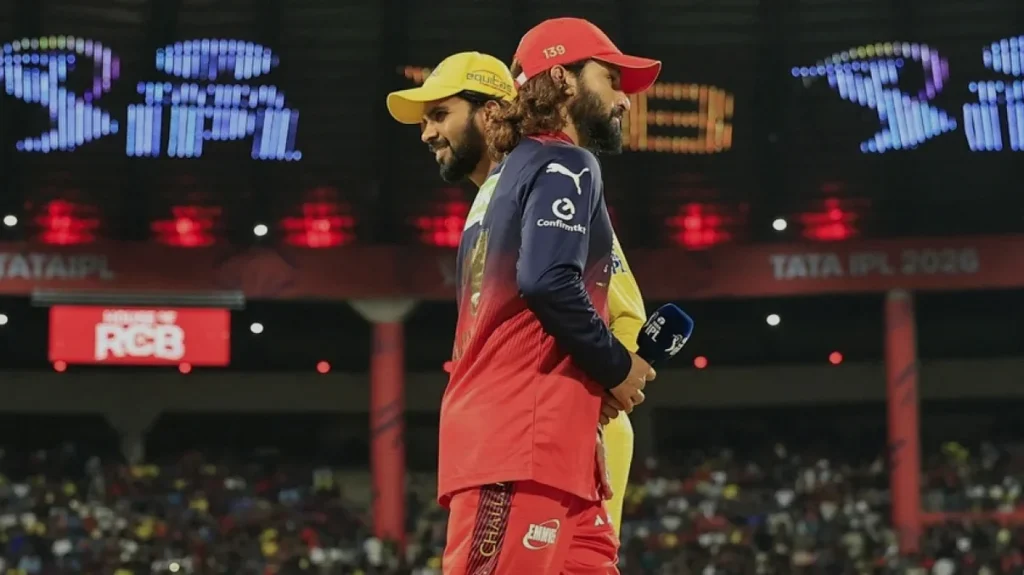
Royal Challengers Bengaluru (RCB) have made an emphatic start to IPL 2026, winning both of their matches in dominant fashion. Ambati Rayudu praised the side for “setting great standards for themselves,” while Chennai Super Kings (CSK) have endured a rough beginning, losing all three of their games so far—twice by a large margin and once slightly less severely. Aaron Finch summed up CSK’s situation with “worrying signs.”
Key takeaways
- RCB have won both of their IPL 2026 matches, doing so with considerable authority.
- CSK have lost all three games to date, including two defeats by wide margins.
- Aaron Finch said CSK’s issue was not only execution, but also the planning for death-overs bowling.
- Tim David’s impact was central to CSK’s collapse after being competitive for most of the first innings.
- Rayudu suggested CSK’s follow-up deliveries after big hits have not been sharp enough.
- Both Rayudu and Finch highlighted RCB’s decision-making and adaptability as major differentiators.
CSK’s first-innings control slipped away
On Sunday night in Bengaluru, CSK stayed in the contest for roughly three-quarters of the first innings. However, the momentum changed sharply, and they were driven into a heavy defeat by Tim David. Finch’s assessment pointed to a lack of visible clarity in CSK’s bowling approach during the late overs, where plans must be executed with precision.
Finch: the plan and the process both fell short
Finch reflected on whether the problem lay in the strategy or in how it was carried out. He argued that poor execution can sometimes be understood if the bowler buys into the plan, because the team can learn and correct issues that have been practiced repeatedly. But in CSK’s case, he felt both components were wanting.
“For me, as a captain, you can always understand poor execution. If the plan is right and the bowler has bought into it, and they mis-execute, that’s okay,” Finch said on ESPNcricinfo’s TimeOut show after CSK lost by 43 runs. “Because you know that’s something they have practiced over and over and that’s going to happen.”
He then questioned CSK’s decision-making structure going into the overs that followed. “Was the planning right? I don’t think it was. Was the execution right? No, it absolutely wasn’t. So when you’re missing both of them, that’s worrying signs,” Finch added.
Finch also believed CSK remained locked into a course of action that wasn’t working. “More than a bad plan, they just stuck to that bad plan,” he said. “There was nobody to intervene and to just take some time off, take those 20-30 seconds, just make it slightly more slow and then guide the bowler with a message. I think they should have slowed it down a little bit.”
What the death-overs numbers suggested
The 16th over began with RCB at 153 for 3. From there, CSK struggled to rein in the run flow: the next over went for 19 (Khaleel Ahmed), then 21 (Noor Ahmad), followed by 14 (Anshul Kamboj), 30 (Jamie Overton), and then 13 (Kamboj again). Finch’s wider point was that CSK did not show enough tactical adjustment when the situation demanded it.
“[Overton bowled] everything was around the wicket. Around the wicket, six, six, six,” Finch said. “At no point was there anyone go up to the bowler and say, ‘okay, maybe this plan is not working, let’s think of something else.’ What it is, is your head starts spinning in a situation like that.”
He continued: “I’ve been in that situation as a captain where you’re thinking: what’s happening? And before you know it, that over’s gone and you’ve forgot to rejig your plans.”
Rayudu: experience, follow-up balls, and execution after big hits
Rayudu attributed part of CSK’s struggles to “lack of experience” within the bowling group, though he acknowledged that the statistics do not fully support that explanation. He pointed to a specific pattern—how CSK responded immediately after conceding momentum.
“Their follow-up balls after a boundary or a six aren’t great,” Rayudu added. “Generally, as a bowler, you need to be aware that, okay, I have been hit for a six, but it’s the next ball that matters. Whenever you see good death bowlers, they always follow up with a very good ball. But their powerplay bowling and middle-overs bowling was much better than what it was last game.”
Around-the-wicket strategy and RCB’s control of scenarios
Analyst Gaurav Sundararaman highlighted that the around-the-wicket style of attack is something the Super Kings franchise has leaned on in other competitions such as MLC and SA20 over the last couple of seasons. However, Rayudu said CSK hadn’t consistently applied it at the death because, as he put it, “MSD didn’t approve of that sort of an angle at the death”.
On the other side, Rayudu credited RCB for being proactive rather than reactive. “RCB, meanwhile, are not ‘letting anything just pass by; they just want to control every scenario, every over,’” he said.
Finch agreed with the underlying theme of control and flexibility. “Yeah, they’re a team that’s making the right decision at the right time,” he said. “They are a team that’s been really flexible, and not just being rigid with their preparation and their planning and sticking only to that. They’re going beautifully.”
