
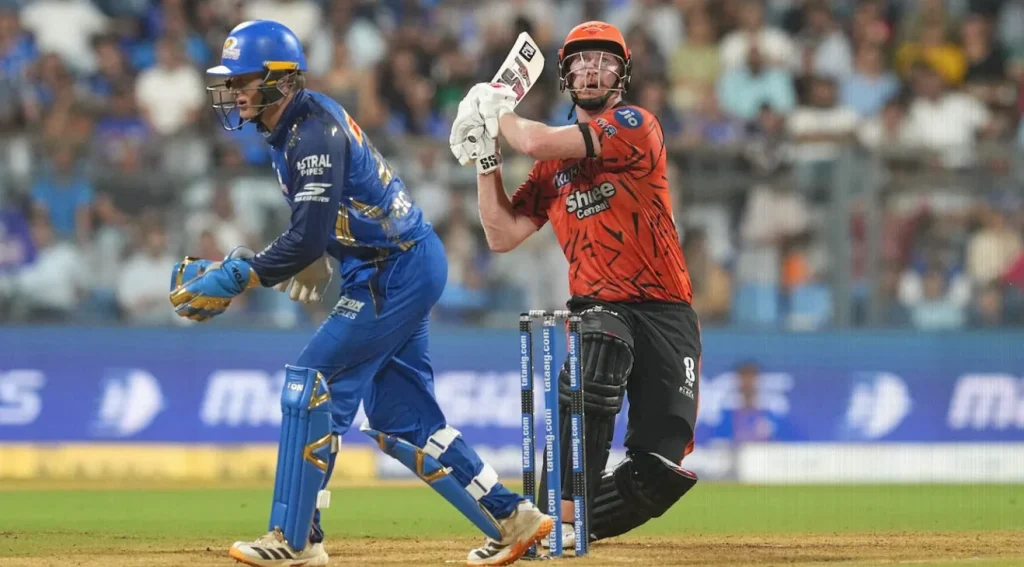
With batting milestones tumbling and strike-rate pressure showing no sign of easing, IPL 2026 continues to tilt firmly in favour of batters. Even a daunting chase of 265 has been reached comfortably, and on a day Sunrisers Hyderabad (SRH) made the successful pursuit of 244 against Mumbai Indians (MI) look routine, SRH’s spin-bowling coach Muthiah Muralidaran delivered a blunt message: bowlers can’t spend too long fighting the reality of being hit—they have to accept it, then adjust.
Speaking at the press conference after the match, Muralidaran said the modern opening mindset has transformed the early overs. “It’s very difficult for a bowler these days because every team, not only us [SRH], has an opening pair that doesn’t care about going in or out. They just attack the bowling,” he explained. He also pointed to how quickly scoring expectations have risen. “When we used to play, if you got around 40 to 50 runs with one wicket down in six overs, that was considered a good situation. Now the average is 70 to 80.”
Muralidaran linked that leap to the fearless approach of younger batters, using uncapped 23-year-old Salil Arora as a case study. He highlighted Arora’s no-look six off Jasprit Bumrah, arguing that the game’s psychology has shifted from survival to statement-making. The moment a youngster can play a shot like that—especially against a bowler of Bumrah’s calibre—captures how quickly confidence has spread across the batting ranks.
“Even a good bowler goes for a six. Even Bumrah goes for a six or one or two balls,” Muralidaran said. “Abhishek [Sharma], the way he hits, it’s unbelievable. But when a new boy like Salil hits a six, it’s unbelievable too—you don’t expect someone with the calibre of Bumrah to be dispatched like that, because you think, ‘How am I going to survive [Bumrah]?’ But nowadays it’s different. Now it’s about how am I going to hit a six. That’s their approach.”
He added that this attitude has been reinforced by what players have seen and learned. “Confidence levels have gone up because people have shown this is the way to play the modern game, and youngsters are following that.”
For bowlers, the coach’s prescription was straightforward: repetition, precision, and a willingness to absorb damage on days when conditions and rhythm favour the batters. “So for bowlers there isn’t much to say—they have to practise a lot and be as accurate as possible. On your day you might do well, but even if you do well sometimes you end up being on the receiving end because of the wicket and the conditions,” he said.
Muralidaran then turned to a wider development problem—how spin is taught at the grassroots. While he stressed that spin remains an important weapon, he suggested the coaching pathway for spinners needs a rethink because the modern game is producing fewer bowlers who can genuinely turn the ball. “Spinners only try to bowl quicker and not try to spin it,” he said. “Because they aren’t getting that ability from a young age, you can’t come to [Under-19s] and try to spin the ball. Their muscle memory is already there, so you can’t get that back.”
He argued that the focus should begin much earlier, around the pre-teen years, when technique can be shaped rather than corrected. “So when you are age 10, 11, 12, try to spin. We need to spin to beat the bat,” Muralidaran said. “But if you can’t spin, you see in training how batters [face] throwdowns and hit sixes. It looks like a throwdown bowler bowling at you, and batters are getting into the line and hitting.”
In his view, the visual cues matter as much as the deliveries themselves. “So if you spin, their eyes also open,” he added. “They say, ‘Oh it’s spinning, so I’m missing it.’ They start thinking about which way it’s going to spin.”
Asked how he and Shane Warne would have handled today’s pitches, Muralidaran offered perspective on both capability and limitations across eras. “We would have turned the ball, but we would not have made a big dent,” he said. “We would have turned it, we could have got like one or two wickets, maybe they would have scored 40 runs easily, because wickets are so good and you need about three or four bowlers like that to contain [the total] to less than 200.”
He contrasted the T20 era he played in with the present explosion in power-hitting. “I have played about 170 T20 games, but at that time the power wasn’t as great as now. When we bowled, I would have been hammered only two times over 60-odd games — maybe more than 40 runs. Shane also the same,” he said. “Nowadays, conceding 50 runs is a great deal for a spinner, 40 runs means you’ve bowled well. The game has changed, we can’t compare the eras.”
With so much emphasis on batting, the question becomes whether the IPL can strike a balance between bat and ball. Muralidaran acknowledged the challenge and pointed to the format’s commercial and entertainment foundations. He noted that SRH, who have produced top-four totals in the league over the years, are unlikely to abandon the style that has defined their recent success. “I don’t think pushing the boundary ropes, when the ball is flying over the ropes everywhere, will change things,” he said.
Instead, he suggested that altering the spectacle would come with a risk of backlash from fans. “I think if we give fair wickets, the spectators will say it’s become boring because T20 followers want entertainment, so they want to see fours and sixes,” Muralidaran explained. “That’s why the tournament is built like that—an extra player to come and bat [impact player]. It is a big business at the moment, sponsors and everything, so you will lose the sponsors and interest of the people if you change it.”
Looking ahead, he believes the contest will keep evolving rather than collapsing into a single solution. “I think this will continue, but over a period, bowlers will try to adapt. It will take some time,” he said. “Sunrisers started this [power-hitting] and now everyone is adapting, so now the bowlers will go back [from] this tournament and figure out how we can contain. They will come up with something, and the batsmen will find something else—this is the way the modern cricketers are going.”
