
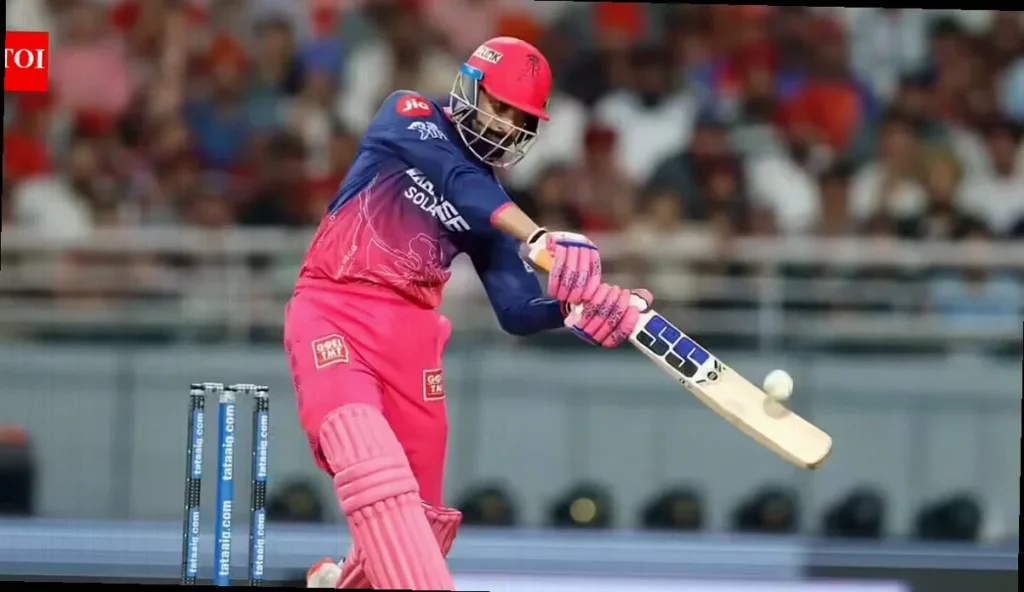
NEW CHANDIGARH: Shubham Dubey has spent years waiting for the kind of innings that forces everyone to take notice. He waited for recognition, for the right opening, and for the moment when the work he had quietly built would finally be tested under the brightest lights. On Tuesday night, with Rajasthan Royals looking increasingly likely to fall short against an unbeaten Punjab Kings side in Chandigarh, that moment arrived—and Dubey took it decisively.
Promoted to bat at No. 6 as an impact substitute, Dubey came in ahead of more established names such as Ravindra Jadeja and Dasun Shanaka. The situation could have overwhelmed a newcomer: Rajasthan still required 72 runs from 36 balls, the chase already wobbling, and pressure building with every over. Instead of getting dragged into the tension, Dubey seized control of the tempo and flipped the contest in Rajasthan’s favour.
Dubey remained unbeaten on 31 off just 12 deliveries, striking at an extraordinary 258.33. Alongside Donovan Ferreira, he stitched a rapid 77-run partnership from only 32 balls, turning what looked like a slipping chase into a six-wicket triumph. The result did more than secure two points—it snapped Punjab’s unbeaten run and transformed a faltering pursuit into a statement performance.
Dubey’s journey to that stage has been shaped by scarcity and persistence. Born in Yavatmal in Maharashtra’s Vidarbha region, he grew up with limited resources. About a decade ago, he struggled to even afford basic cricket equipment. His father, Badriprasad Dubey, ran a paan stall in Nagpur, and the family managed with whatever means they had.
His first major turn came through the belief of his mentor, the late Sudeep Jaiswal. When few others were willing to back him, Jaiswal stepped in and arranged Dubey’s initial proper cricket kit, including a new bat, gloves, and the essentials needed to compete properly. Just as crucial was the pathway that followed—Jaiswal helped him find a route into the Vidarbha setup, where his talent could finally be honed in a more structured environment.
From there, Dubey built a reputation in the quieter lanes of Indian domestic cricket. Competitions such as the Bapuna Cup in Vidarbha became his training ground for big-hitting roles, where he learned how to swing matches within a short number of overs. The broader spotlight came during the 2023-24 Syed Mushtaq Ali Trophy. Dubey amassed 221 runs at an average of 73.66, while his strike rate climbed to 187.28—production that was hard for IPL scouts to ignore.
Rajasthan Royals then acted on that promise, investing Rs 5.8 crore in him ahead of IPL-2024. Still, the early phase didn’t go smoothly. In his first four matches, he managed only 33 runs, though his strike rate of 173.68 suggested the intent was already there. Rajasthan released him, only to bring him back later, this time for Rs 80 lakh.
Kumar Sangakkara, Rajasthan’s head coach and director of cricket, described the mental challenge of being used as an impact player. “Dubey, coming in as an impact player, it’s one of the hardest things to do, because you don’t know if you’re playing or not. So mentally, he was exceptionally skilful. The way he was able to keep his focus and go in the middle and bring the game in our favour was outstanding,” Sangakkara said.
Sangakkara also stressed that Dubey’s value fits into the franchise’s wider batting depth. “The focus is a lot on Vaibhav (Sooryavanshi). But at the same time, when I look at my side and I run through my batters, there’s Dhruv (Jurel), Yash (Yashasvi Jaiswal), Riyan (Parag), Donovan Ferreira and now someone like Dubey,” he added, underlining how the team’s core strength is built across its batting options.
