
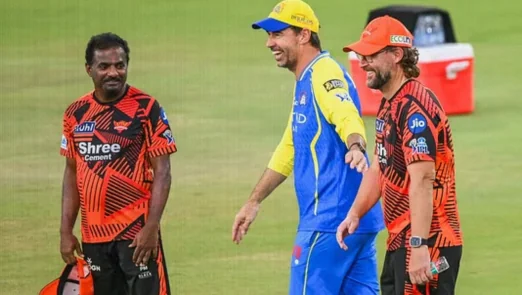
Sunrisers Hyderabad spin-bowling mentor Muttiah Muralitharan made a blunt assessment of modern cricket, saying the game has shifted heavily towards batters. He suggested that even he and the late Shane Warne—two names synonymous with domination—would have found it difficult to succeed in today’s environment.
Muralitharan, the only bowler to reach 800 Test wickets and the leading wicket-taker in ODIs with 534 scalps, spoke to reporters after SRH’s emphatic win over Mumbai Indians at the Wankhede Stadium on Wednesday night. The chase was set at 244, and Hyderabad finished the job with eight balls remaining, holding six wickets in hand.
Quick facts from the Wankhede
- SRH beat Mumbai Indians at Wankhede Stadium on Wednesday night.
- Target for SRH was 244.
- SRH chased it down with 8 balls remaining and 6 wickets in hand.
- Key batting contributions came from Abhishek Sharma, Travis Head, Heinrich Klaasen and Sahil Arora.
- Muttiah Muralitharan discussed how modern cricket increasingly favours batters.
Hyderabad’s batting was ruthless in the chase, with Abhishek Sharma, Travis Head, Heinrich Klaasen and Sahil Arora all making telling contributions. In his remarks, Muralitharan argued that contemporary batting mindsets and pitch/wicket dynamics have made the job for bowlers far tougher than in past eras.
He said the ball might still be turned, but the impact would not be as decisive as before. In his view, a bowler could at best pick up “one or two” wickets, while the batting side could still rack up runs comfortably—because wickets can be so favourable and the modern game demands multiple bowlers working in tandem to keep totals under control.
Why bowlers struggle now
Muralitharan also highlighted how every team now seems to start with batters who are not bothered about the line or length being offered. He said the opening pair’s approach is simply to attack, regardless of whether the ball is pitched in or out, changing the rhythm of innings from the earliest overs.
He compared eras by pointing to scoring rates: when he played, a score of roughly 40 to 50 runs for the loss of one wicket in six overs was considered a strong platform. Today, he said averages have moved to around 70 to 80, making it harder for bowlers to slow the game down early.
The discussion then turned to Jasprit Bumrah, with Muralitharan referencing how even elite bowlers are not immune to damage in modern T20 cricket. He noted that Bumrah can still concede—sometimes even after delivering well—because batters now see every over as an opportunity to hit.
Speaking about Abhishek’s hitting, Muralitharan described it as “unbelievable,” and added that the mindset is similar for young players too. He said that when someone like Sahil Arora launches a six against a bowler of Bumrah’s calibre, it reflects how youngsters often don’t frame their shots around “survival” but rather around execution and confidence.
In his assessment, confidence levels have risen across squads because the modern template has been proven repeatedly. That is why, for bowlers, the margin for error is smaller: they have to train hard, stay precise, and still accept that on some days they will end up on the receiving end due to wicket behaviour and conditions.
Entertainment over “balance”
Muralitharan further argued that achieving a workable balance between bat and ball is now almost impossible. He claimed the sport prioritises entertainment above all else, and that fairer wickets would likely be criticised by spectators who want frequent fours and sixes.
He said that if wickets are given in a way that makes it harder to score quickly, T20 audiences may label the contest as boring. He also pointed to the tournament’s structure—where an additional batting role is built into the format—as a sign of how central hitting big is to the business side of the game.
Wrapping up, Muralitharan said the financial ecosystem reinforces the approach, with sponsors and fan interest tied closely to high-scoring spectacle. In his view, losing that momentum would put commercial backing at risk, which is why the emphasis on batting entertainment remains front and centre.
