
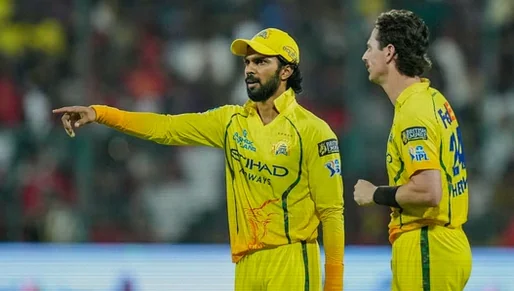
Chennai Super Kings are carrying the same burden into IPL 2026 that haunted them at the start of the previous campaign—only this time, the issues look even more entrenched. Three matches in, the five-time champions are still languishing at the bottom of the points table, still without a single win and still searching for answers as concerns mount across both innings.
After last season’s disastrous finish, which ended with CSK bottom of the table for the first time in their history, the franchise had promised a reset. The slide in IPL 2025 was blamed on stubborn decision-making, auction missteps, and tactics that never quite clicked. But even with a fresh season underway, the problems have not faded; they have simply shifted shape.
At the auction, CSK did try to change their approach, moving away from the usual “experience first” recruitment model and placing greater faith in uncapped players. Still, the campaign began with setbacks that were hard to ignore: MS Dhoni and Dewald Brevis both missed the opening matches due to injury. Even so, injuries alone cannot fully explain why Chennai have struggled to get momentum.
CSK’s death-over woes become a historic worry
In a match against Royal Challengers Bengaluru on Sunday, CSK conceded a staggering 250 runs in an innings—an IPL first for the franchise. Even more alarming was what happened at the end of the chase-building phase: 78 runs were scored in the death overs (17–20), creating another unwanted record for Chennai.
Across their first three games of the season, CSK’s death-over numbers read like an alarm bell. Their economy rate in overs 17–20 stands at 16.65, with 111 runs conceded from just 40 balls while taking only two wickets—by far the weakest death-over returns among all teams in the tournament this season. For comparison, even during CSK’s painful IPL 2025 run, their death-over economy was 11.
Those figures, though, do not capture the full story. In one game versus Rajasthan Royals in Guwahati, the chase finished inside 12.1 overs, leaving no extended death-over spell to evaluate. Against Punjab Kings, the late surge was limited as 33 runs were scored in just 2.4 overs at the back end. The contrast came most sharply against RCB, where Chennai’s issues were exposed in the clearest possible manner.
Tim David and Rajat Patidar punished a directionless bowling attack, smashing 78 runs in the final four overs. The situation was made worse by the fact that CSK had managed the contest for long stretches—until the finishing phase collapsed.
RCB looked comfortable early, posting 51 in the powerplay, moving to 98/2 after 11 overs, and reaching 153/3 by the time the 16th over arrived. From there, the execution fell apart. Khaleel Ahmed conceded 19, Noor Ahmad 21, Anshul Kamboj 14, Jamie Overton 30, and Kamboj again 13—an accumulation of runs that never allowed Chennai to claw the game back.
It was less a question of lacking experience and more about lacking clarity. There did not appear to be a Plan B, either in the field placements or in the options chosen when the batters started to take control.
Former RCB batter Aaron Finch summed up the problem with directness, pointing to both the planning and the in-game decision-making. “[Overton bowled] everything was around the wicket. Around the wicket, six, six, six. At no point was there anyone go up to the bowler and say, ‘okay, maybe this plan is not working, let’s think of something else,’” Finch said. “What it is, is your head starts spinning in a situation like that… before you know it, that over’s gone and you’ve forgot to rejig your plans.”
Chennai were also forced to deal with a personnel gap in their late-overs setup. Nathan Ellis—identified as their death specialist—missed the match after pulling out with a hamstring injury. His replacement, Spencer Johnson, is also unavailable, leaving CSK without a clearly defined finisher option in the most crucial phase.
Sanju Samson and the top order under pressure
While the bowling has been a major concern, the batting has not provided enough stability either. Sanju Samson, Chennai’s marquee signing and often viewed as Dhoni’s long-term successor, has struggled to impact matches consistently. He has scored just 22 runs across three innings so far.
Captain Ruturaj Gaikwad has also had a quiet start, accumulating 41 runs off 36 deliveries in three games. Ayush Mhatre offered a glimpse of what CSK could be missing, scoring 73 in one outing, but across the other two matches he has contributed only one run.
Ironically, CSK have managed to cross the 200-run mark twice this season. The middle order has carried much of the load, led by Sarfaraz Khan and supported by Prasanth Veer. Yet without consistent starts and reliable platform-building at the top, those totals have not turned into wins often enough.
Waiting for reinforcements
With the season still early but the pressure already rising, CSK are now looking toward reinforcements. Brevis is expected to return from a side strain as early as their next match against Delhi Capitals, which could add a needed boost to the batting. Dhoni, however, is not expected back until the end of the month, meaning Chennai may have to hold their structure together for the time being.
