
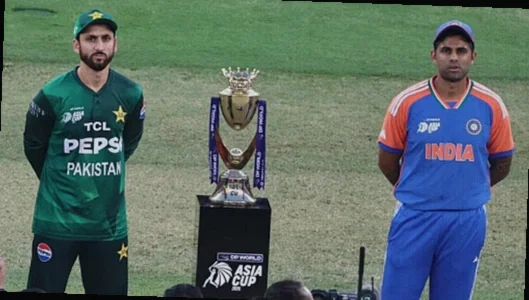
Pakistan’s T20I captain Salman Ali Agha has brought the Asia Cup 2026 handshake controversy back into the spotlight, revisiting an incident that began during last year’s tournament. The dispute centres on India skipper Suryakumar Yadav’s decision to refuse the traditional pre-match handshake with Pakistan’s captain, a move made in solidarity with the families affected by the Pahalgam terror attack in which 26 people were killed. The Asia Cup took place in the wake of Operation Sindoor, in a period of elevated political and sporting tension between the two countries.
The refusal did not stop at the toss. Indian players reportedly avoided handshakes not just before games, but also after the matches across all three encounters versus Pakistan, including the final. In each of those meetings, Suryakumar and his side came out on top.
Agha returned to the topic after being asked about it during a podcast appearance. The Pakistan captain said that handshakes had occurred earlier—at the pre-tournament press conference and again during the trophy-related photo session—so he expected a similar norm to continue at the toss. However, he said he was taken aback when the customary gesture was left out at the toss.
“Before the tournament, a press conference was held, during which a handshake took place. During the trophy photoshoot, we shook hands as well. So, when I went for the toss, I was completely normal. Of course, I had an idea that things wouldn’t be as normal, but I didn’t think it would escalate to the point where there would be no handshake. I didn’t expect that,” Agha said on the ARY podcast.
He went on to explain that he had been told in advance about what would be followed at the toss. Agha said the match referee briefed him beforehand, and he accepted the decision without turning it into a larger issue. After the game ended, he claimed that even when the teams moved toward Pakistan’s pavilion for the expected handshake, it still did not happen.
“I went for the toss with my media manager, Naim Bhai. The match referee—I don’t recall his name—took me aside and told me, ‘They are going to do this; there won’t be a handshake, so please keep that in mind’. I replied, ‘If there’s no handshake, then so be it’. It’s not like I was desperate to shake hands. So that’s how it happened; he told me beforehand there would be no handshake. After the match ended, we lost, and we were walking toward their pavilion for the handshake, they still didn’t shake hands,” he added.
Wrapping up his comments, Agha stressed that the right example should be set, particularly because players are seen as role models by younger fans. He suggested that avoiding such gestures can influence children watching the sport and that the impact can ripple into future settings, including club cricket.
“I’ve said this many times, I don’t think this is the right thing to do. When we represent a nation—and I play for Pakistan—people watch me. Children will pick up on this, and if it happens in a club game the next day, it will be because of me in some way, as I’m a part of it. When you are a role model, I believe doing these things is important,” he concluded.
India snub Mohsin Naqvi at Asia Cup final
Beyond the handshake controversy, the Asia Cup final also featured another striking moment during the post-match proceedings. India reportedly refused to receive the trophy from Asian Cricket Council chief Mohsin Naqvi, who also leads the Pakistan Cricket Board and serves as his country’s Interior Minister. Suryakumar Yadav and his teammates kept their distance, signalling discomfort with Naqvi’s involvement and his previous remarks directed at India.
The trophy presentation was delayed as officials attempted to proceed with the ceremony. When it restarted, Naqvi remained in the presentation area, while individual awards were still handed out. However, the trophy presentation never fully materialised.
In the days that followed, Naqvi reportedly left the venue holding the trophy. India has not yet formally received the title’s trophy despite winning the tournament. India also maintained the same no-handshake stance during the T20 World Cup as well.
