
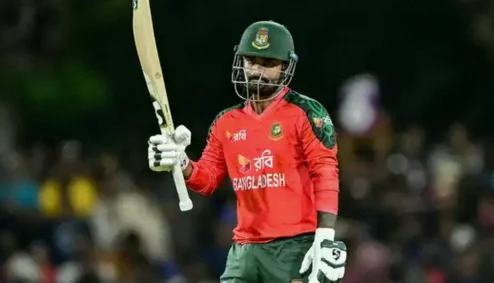
Bangladesh captain Litton Das has taken aim at the team’s lower-order, accusing the batters coming in late of repeatedly failing to convert chances. With T20 cricket offering little room for recovery, he argued that improved contributions from the tail are essential if Bangladesh want better outcomes.
New Zealand then levelled the series with a six-wicket victory over the hosts in the final match of the tour at Sher-e-Bangla National Cricket Stadium on Saturday. Bangladesh, after being 88 for 6 at one stage, were eventually bowled out for 102 in a rain-affected, 15-over contest—setting up a chase New Zealand completed comfortably.
Litton’s key message: lower order must deliver
- Litton Das criticised Bangladesh’s lower-order for consistent underperformance in T20s.
- Bangladesh were 88 for 6 before being dismissed for 102 in a rain-curtailed 15-over match.
- New Zealand won by six wickets in the series-concluding game at Sher-e-Bangla National Cricket Stadium.
- Das noted that batters ranked 8 to 11 have struck at 127.77 and averaged 17.155 in T20 internationals over the past year.
- He said Bangladesh are working in nets and expect improvements before the World Cup.
Das said the outcome could have looked different had Bangladesh’s innings produced more runs. He recalled telling reporters earlier that late-order batters carry responsibility and must offer batting input when the opportunity arises, but added that the chance presented itself again and was not taken.
He pointed to the match itself, suggesting that two batters had played prominent roles for Bangladesh during their innings. Das also referenced a potential turning point—if play had not been interrupted and if he had capitalised from a strong position—claiming that a score of around 60 to 70 could have shifted the narrative.
While he insisted there was no issue with the six players Bangladesh were selecting, he stressed that expectations remain. He singled out Rishad Hosein, Sheikh Mahedi Hasan, Tanzim Hasan Sakib and Mohammed Saifuddin—whoever is in the XI—to contribute with the bat, not only with the ball.
Why five bowlers matter in T20
Das also laid out the structural challenge of building an XI in T20 cricket. He argued that Bangladesh cannot function without a full bowling unit; if the side included nine batters, it would force the team to carry too few bowlers for the 20-over workload.
He explained the practical reality: in a T20 match, five bowlers must complete the full quota, since no single bowler can be expected to deliver five overs. In that context, Das said he has to play five specialist bowlers, and then asked for solutions—specifically whether anyone in Bangladesh could bat at No. 7 while still being able to bowl four overs.
Calling it a direct question to the wider cricket community, he challenged others to identify a player who could fit that exact role. He then added that the team would be willing to explore such an option if it exists.
Working hard, but improvement can’t happen overnight
Das said he was hopeful the lower-order would perform better in the near future, insisting the group is putting in work in the nets. He noted that coaching staff have been spending extended time with the batters, but also acknowledged that change cannot be instant.
Looking ahead, he expressed confidence that by the time the World Cup arrives, Bangladesh could see at least some improvement. He also described how practice sessions differ from match situations—everyone may appear fluent in the nets, yet the pressure of international cricket demands execution under real conditions.
Litton said confidence can grow if those efforts translate into performances during games. He suggested that when the batters start delivering in matches, their belief will rise and the gap between net form and match results should narrow.
He then discussed the skill sets of specific lower-order options, highlighting that Rishad, Sheikh Mehedi and Nasum Ahmed are specialist spinners. Das said every team typically carries a spinner who can also bat, while he contrasted that with the need some sides have for a left-arm wrist-spinner who might be used purely as a bowler. In Bangladesh’s case, he said Mehedi can bat, but international cricket performance needs to follow.
The captain added that the same expectation applies to Nasum and Rishad. He also backed the pace-bowling all-rounders to raise their batting impact, even while admitting that Bangladesh’s overall displays have been inconsistent.
Despite the criticism, Das maintained support for the top six batters. He pointed to their current form, saying the regular batters in that group are in good shape, and argued that T20 cricket often demands acceptance of failure on certain days.
He also noted that the match itself was different and that teams cannot always start striking from ball one. Das said one reason Bangladesh struggled was that the contest could have changed if his partnership with Hridoy had continued, reinforcing the idea that even with 11 players involved, typically two batters and two bowlers end up driving major portions of the game.
