
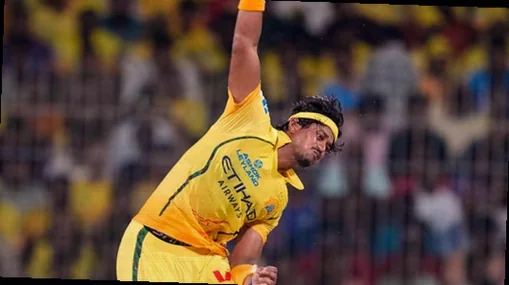
Ramakrishna Ghosh’s IPL introduction may not have grabbed the spotlight on the scorecard, but the financial picture told a different story. In CSK’s eight-wicket win over Mumbai Indians at the MA Chidambaram Stadium, his impact came in a compact, high-yield package: three overs, one wicket, and a catch—delivering a return that was close to ten times what his match price amounted to.
Chennai Super Kings chased down the target with Ruturaj Gaikwad and Kartik Sharma at the top of the visible narrative, yet the match’s quieter subplot belonged to the man making his debut. Mumbai Indians chose to bat first and finished on 159 for 7, pushing for a total that would test CSK’s chase. The middle overs were crucial for MI to stretch the innings beyond CSK’s comfort zone, and that is where Ramakrishna stepped in and disrupted the momentum.
Ramakrishna’s season price was ₹30 lakh, while his valuation for this game was set at ₹5 lakh under a dynamic appearance approach. From that cost base, the model assigned him match value worth ₹47.84 lakh. With that, the gap between contribution and cost translated directly into profit for CSK: ₹42.84 lakh, effectively turning a small-ticket debut into a major ledger win.
The recovery figure is what makes the story stand out. Ramakrishna recovered 956.8% of his match cost. Put simply, CSK spent ₹5 lakh in match costs and received ₹47.84 lakh in value contributions. After accounting for the cost, the profit percentage reads 856.8%—the excess return generated through his involvement on the field.
In ledger terms, the arithmetic is straightforward: ₹5 lakh cost, ₹47.84 lakh in value generated, and ₹42.84 lakh profit booked. Framed another way, if the investment were treated as ₹1 crore, his return would land close to ₹9.57 crore—an outsized operational win for a debutant.
The wicket that halted MI’s middle-overs push
The cricket behind the numbers matters as much as the numbers themselves. Ramakrishna bowled three overs for 24 runs and claimed the wicket of Suryakumar Yadav. It was not a late, cosmetic dismissal; it arrived at a moment when MI were beginning to look dangerous in the middle phase. Suryakumar had reached 21 off 12 and was entering the stretch where the batting unit could still push the total toward a more imposing mark. When MI were 99 for 2 in the 11th over, the innings still had the ingredients needed to force CSK into a tougher chase—wickets in hand, rhythm in the middle order, and time on the clock.
Ramakrishna broke that passage. His delivery drew a mistake from Suryakumar, Dewald Brevis completed the catch, and MI slipped to 99 for 3. From there, CSK managed to keep the chase within reach, with MI ultimately finishing on 159 for 7—never fully escaping Chennai’s control.
The catch that added early value
Ramakrishna’s influence was not confined to the ball in his spell. He had already made his mark in the field during the second over when Will Jacks miscued Anshul Kamboj. Ramakrishna Ghosh completed the catch, giving CSK an early incision into MI’s innings.
In the valuation model, fielding is treated as more than background noise. A dismissal is treated as a real event that removes a batter, shifts the state of the innings, and changes the value of what happens next. His fielding score was rated at 5.96, while his bowling score was 9.99. Together, they formed a core impact score of 15.95, and after rating adjustments, that core contribution fed into the financial return.
The profit did not come from a dramatic four-wicket burst or a headline-grabbing spell. It was high because his contribution overwhelmed his cost. This is the central logic of the money ledger: expensive players generally need major performances to justify their match price, while lower-priced players can generate striking profit by delivering direct, meaningful interventions at the right moments.
Ramakrishna’s cost base was tiny, but his cricket output was not. A wicket of Suryakumar’s value, three controlled overs, and one completed catch created an unusually wide gap between what CSK paid and what the match situation returned. That widening translated into CSK’s ₹42.84 lakh profit.
To be clear, the match’s loud heroes arrived later. Gaikwad’s unbeaten 67 and Kartik Sharma’s unbeaten 54 helped make the chase look smooth and naturally drew the main attention. Yet before CSK could settle into comfort, MI needed to be kept within a manageable range—and Ramakrishna played his part in that containment, ensuring MI’s push never fully gathered momentum.
He did not win the match by himself, and that is not the claim. What the valuation perspective highlights is more specific: CSK received a high-return performance from a low-cost slot. Over a long IPL season, those are precisely the kind of entries franchises hunt for—players who can turn limited opportunities into maximum impact.
Ramakrishna Ghosh’s IPL debut, in the final ledger, produced a clean money-sheet result. Match cost: INR 5 lakh. Match worth: INR 47.84 lakh. Profit generated: INR 42.84 lakh. Recovery percentage: 956.8%. Profit percentage: 856.8%. For CSK, it was not merely a tidy first outing—it was a low-cost asset producing an outsized return on the night. The scorecard may highlight one wicket and one catch, but the ledger remembers something sharper: ₹5 lakh spent, ₹42.84 lakh of profit uncovered inside Ramakrishna Ghosh’s first IPL night.
Method note: This valuation is based on a cricket impact model developed by the author. The approach studies batting, bowling, fielding, match situation, phase pressure, role difficulty, manual performance rating, and captaincy impact, then converts that contribution into a rupee value using the player’s auction/retention price and expected season usage. It is not an official IPL metric, a salary computation, or a franchise accounting figure.
