
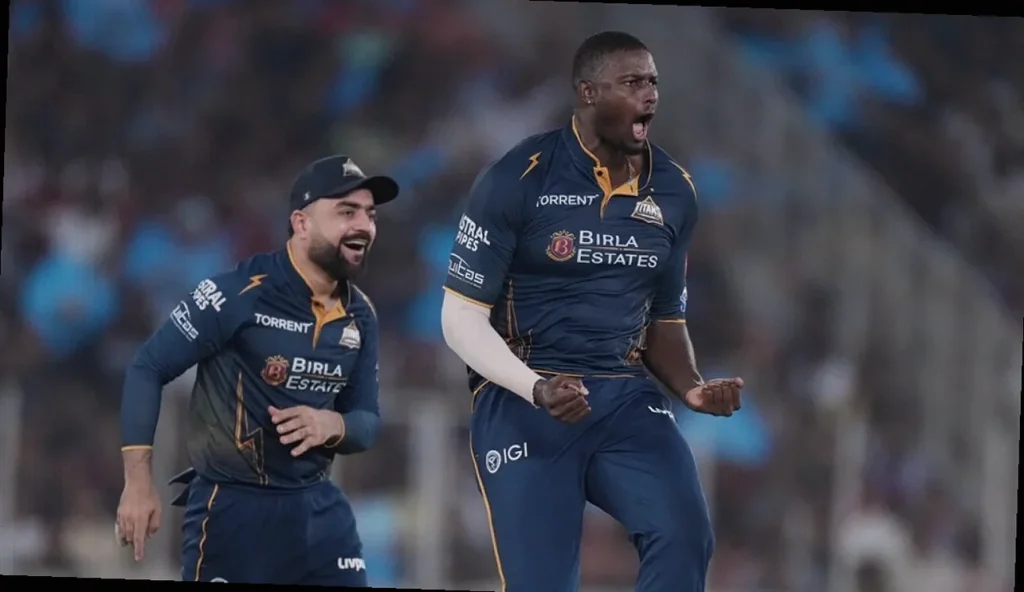
Gujarat Titans have arguably been the most successful franchise to debut in the IPL era, arriving in 2022 and nearly pulling off a remarkable double—falling just one delivery short of winning consecutive titles. Yet since the start of 2024, their performances have levelled into something more average, leaving them clearly behind the two consistently superior outfits in Punjab Kings and Royal Challengers Bengaluru.
The most visible shift—something that sparked plenty of discussion across squads and cities—has been the departure of captain Hardik Pandya. But the bigger issue isn’t simply leadership on the field. It’s the kind of player GT lost alongside him. Across the entire lifespan of the team, Pandya and Rashid Khan are the only two GT players who have managed to reach both milestones in a single IPL season: scoring at least 100 runs and bowling at least 120 deliveries.
Those benchmarks aren’t especially demanding for an allrounder, and that’s exactly why the situation matters. Over the years, GT have rarely had more than two players who come even close to those combined standards. The Impact Player rule—and the franchise’s preference for venues offering help to bowlers—has helped mask the lack of a genuine allround depth. Still, when a side repeatedly plays with thinner resources than its rivals, it starts to show in how it approaches match-ups, the level of risk it chooses to take, and ultimately the outcomes. Even with the Impact Player option available, there have been stretches in the past couple of seasons when Rashid has been promoted only as high as No. 7, which is not an ideal batting slot in T20s unless the team has the luxury of swapping roles through the Impact Player system.
Given how clearly GT have needed an allrounder, it has been surprising that they delayed bringing Jason Holder into the playing XI for as long as they did. Looking at the way Gujarat Titans have typically structured their T20 cricket, Holder would seem to fit naturally. Their head coach Ashish Nehra is known for steering clear of unnecessary complications. He places strong value on a bowler’s ability to hit the right length on demand, rather than chasing elaborate variations. That philosophy also shapes their batting approach: the bowlers create the setting, and their batters can afford to take fewer risks than they would in a more chaotic chase.
From a team-shape perspective, GT needed an allround presence urgently. In terms of bowling, they specifically required a pace option moulded by the demands of Test cricket—similar to the way Mohammed Siraj and Kagiso Rabada have recently been operating through the powerplay.
When it comes to simply holding a good line and length, Holder stands apart even from many more established West Indies teammates who are familiar with the craft. His accuracy, his physical height, and his ability to strike the ball give him a profile that matches GT’s needs closely. That fit is part of why he has come back to IPL action after a two-year absence. GT may have initially underestimated Holder’s batting value and tried Glenn Phillips first, but once Prasidh Krishna’s rhythm dipped, the team’s underlying model faced pressure. With the bowling unit needing reinforcement, GT had little choice but to bring in another weapon.
In the most recent stretch, Holder has played only four IPL matches across the past three years. Still, he has leaned on his Test-hardened skills to claim seven wickets and to be a meaningful factor in three wins.
“To be fair that is what we train for,” Holder said when asked about how challenging it is to keep landing the right length while T20 batters attack from ball one. “For me personally it is what I spend a lot of time on. I feel it is the hardest length to hit no matter the wicket, flat or placid…” The message could easily have come from Nehra himself.
With the bat, Holder has not yet displayed the full range of his capabilities, though he did begin with a quick 23 off 10 balls. He has looked more comfortable as a T20 batter than someone who is fed into the game at a predetermined entry point. In these four matches, his batting position has varied: in his first outing, the third wicket fell in the 18th over and he departed soon after. Since then, he has batted behind Rahul Tewatia, M Shahrukh Khan and Nishant Sindhu.
Even with two consecutive Player-of-the-Match performances to his credit, Holder admits he still feels slightly frustrated that he couldn’t fully lock in those opportunities as a proper allround force. “I am probably a little disappointed that I didn’t finish the last two games,” Holder said. “But I am still in a good frame of mind. That’s the most important thing for me. Just keeping a fresh mind, staying positive, understanding my role, and just trying to execute when called upon. Just try to make an impact and execute as well as I can under pressure.”
Holder has also explained that not being picked in the West Indies’ Test squad for the last couple of years gave him a chance to train for T20 cricket in more targeted ways. Even so, he believes the comeback he is making in the IPL is ultimately being powered by skills built during Test net sessions. It would be a pleasing storyline if this Test-inspired return in the IPL ultimately opens the door back to Test cricket.
Holder himself may be closer than it appears. “I would love to still play some Test match cricket,” he said. “I haven’t yet closed that chapter.”
