
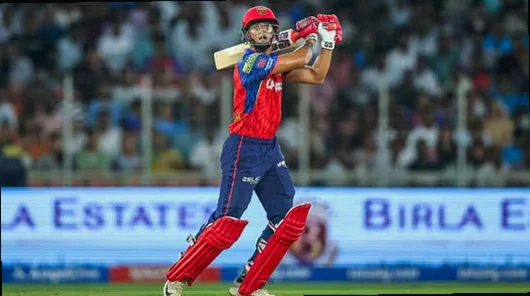
A ₹3.47 crore output usually tilts the balance firmly in a team’s favour, often turning the night into something close to a guaranteed chase-or-defend script. Suryansh Shedge produced that kind of value for Punjab Kings against Gujarat Titans, yet PBKS still could not convert it into two points. That contrast is what made the innings stand out: it wasn’t a typical “repair job” that merely prevents collapse—it was a sharper, higher-impact rescue that kept Punjab in the contest, only for Gujarat’s chase to finish with a ball to spare.
Suryansh Shedge’s comeback began at a wreckage point. Punjab’s innings looked like it had nearly run out of options before he really got hold of the situation. The top order gave Gujarat the start it wanted, with Priyansh Arya and Cooper Connolly both departing within the opening over. Prabhsimran Singh couldn’t take his early promise into a stabilising phase, while Nehal Wadhera was squeezed out by the pressure. Shreyas Iyer offered brief resistance with 19 runs from 21 balls, but once he fell, PBKS were left reeling at 47 for 5 in 8.4 overs.
That moment matters because it defines the task. A batter arriving when the team already has a platform has a different responsibility than someone entering after rapid wickets. With the score at 47 for 5, Punjab weren’t thinking about taking control—they were trying to avoid a below-par total that would leave the bowling unit with almost nothing to protect. Shedge changed the equation. His knock of 57 off 29 deliveries—featuring three fours and five sixes—didn’t just add runs; it arrived with the right timing, turning panic into competitiveness. Punjab weren’t chasing “comfort” runs; they needed survival first, then momentum. Shedge delivered both.
His approach started with composure rather than desperation. He didn’t swing at every pressure cue; instead, he stretched the innings long enough for PBKS to breathe. Once the rhythm was established, he shifted into acceleration and altered the tempo almost single-handedly.
The turning point came in the over against Manav Suthar, where Shedge effectively converted recovery into contest. Over five balls, he struck six, six, four, four and six — a burst that didn’t merely add boundaries, it broke the grip Gujarat had on the innings. From there, Punjab began to look like a team building towards something close to 160, not just surviving for the sake of a respectable number.
Just as important was the pattern of how the innings unfolded. The first stretch was about soaking up the collapse and keeping the scoreboard moving. The latter portion was about changing the speed. Shedge made 11 runs off his first 11 balls, then piled on 46 off the next 18. That split is a big reason the valuation rose so sharply: the knock absorbed pressure, carried it through the middle, and then caused high-speed damage in the same spell.
By the time Shedge was dismissed, Punjab had climbed to 126 for 6. Coming back from 47 for 5 is a major recovery in T20 cricket, and PBKS eventually finished on 163 for 9. The total looked far more credible than the early collapse would have suggested.
In the valuation framework used here, the innings was worth ₹3.47 crore. His match cost was only ₹3.75 lakh, which implies a net gain of roughly ₹3.43 crore tied directly to his impact, translating into a profit margin of over 9,100 per cent. In performance terms, he returned more than 92 times his match cost. That’s the sort of output franchises dream of when they’re hunting for hidden value late in an auction process. Shedge’s season price was ₹30 lakh, and on this night he delivered production valued at more than 11 times that full-season figure.
Why ₹3.47 crore still did not become two points
Punjab’s issue wasn’t that Shedge failed to save the innings—it’s that he didn’t finish the match. There’s a difference between turning a score from 47 for 5 into something defendable and building a total that becomes genuinely dominant. A rescue act can create a score the bowlers can protect, but it rarely guarantees victory unless another batter extends the damage deep into the final overs.
Punjab’s 163 for 9 was competitive after the collapse, but it wasn’t secure enough to remove doubt. That meant the bowling attack had to defend a total rebuilt from damage rather than one built with control from the outset. Gujarat’s chase gained the stability Punjab never fully managed to secure, and the result went against PBKS.
Sai Sudharsan’s 57 off 41 balls provided Gujarat with the platform PBKS couldn’t replicate during their own recovery. It kept the chase from turning frantic too early. Then Washington Sundar remained unbeaten on 40 off 23, settling the final stretch and taking Gujarat to 167 for 6 in 19.5 overs. Punjab stayed alive largely because Shedge made 163 possible in the first place, but they lost because Gujarat had the batting depth and the late-innings calm to close out the job.
The clean reading, then, is straightforward: Shedge’s value was real, and the result didn’t erase it—it only changed the label attached to the performance. This wasn’t a match-winning ₹3.47 crore display. It was a high-end rescue in defeat.
The correct value of the innings
Shedge’s contribution should be viewed as one of Punjab’s most profitable individual efforts of the season. Turning a ₹3.75 lakh match cost into ₹3.47 crore worth of impact is an extraordinary return, with the profit sitting around ₹3.43 crore. Cricket value-wise, the innings was equally clear: he gave PBKS a total, he forced Gujarat to chase under pressure, and he kept Punjab in a game that could have vanished before the halfway point of the first innings.
Still, the limitation was also obvious. Punjab needed one more decisive push—either another batter had to extend the total closer to 180, or the bowling unit needed to convert 163 into a winning defence. Neither requirement was met on the night.
So Shedge leaves Punjab with a strong personal ledger and a painful team outcome. His innings created value, added momentum, and offered evidence that PBKS could handle a severe collapse with a lower-cost player while still producing explosive scoring. What it didn’t deliver was the two-point finish. That’s why the final line carries both weight and restraint: Suryansh Shedge delivered a ₹3.47 crore performance for Punjab Kings, but even that wasn’t enough to take PBKS home.
Method note: This valuation is based on a cricket impact model developed by the author. The model reviews batting, bowling, fielding, match context, phase pressure, role difficulty, manual performance rating, and captaincy impact, then converts that contribution into a rupee value using the player’s auction or retention price and expected season usage. It is not an official IPL metric, salary calculation, or a franchise accounting figure.
