
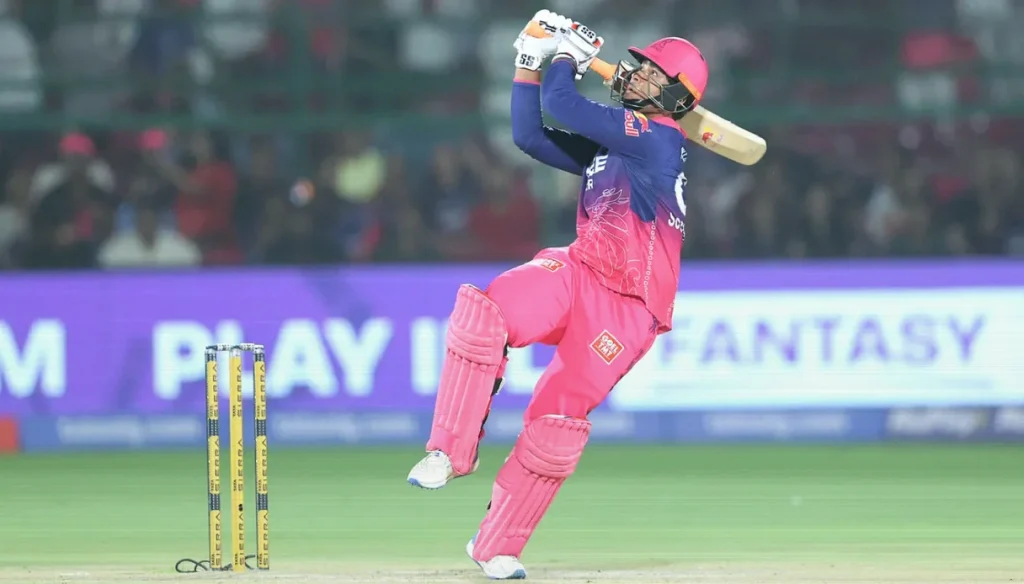
At the Narendra Modi Stadium, Gujarat Titans required three runs from the final two deliveries. Washington Sundar went after Marcus Stoinis, the ball sailed deep into the midwicket region, and Titans sealed the win. It was one of those moments that sounds like pure fireworks—but when you measure what it actually changed in the innings, the story becomes more nuanced.
The strike was also one of the 832 sixes recorded in IPL 2026 so far, and the season’s pace is rewriting the record books. The tournament is averaging a six every 12.3 balls, a sharp rise from the 16.3-ball rate seen in 2022—an increase of 32% across four seasons. In practical terms, the boundary rope has effectively crept closer, and teams have been finding more ways to turn singles and twos into sixes with regularity.
Yet the key point is that not all sixes carry the same weight. Some—like Sundar’s—arrive at a moment when they genuinely swing the contest. Others are “priced in” by the state of the innings before the ball is even struck. By the end of this piece, you’ll understand how one can describe each six as having a different value, including why this match-winning blow looks less extraordinary than it felt at the time.
Why a six can be worth less than six
The basic intuition is straightforward: a run-projection model looks at the score so far, the overs remaining, and how many wickets are still available. From there, it estimates where the innings is likely to finish. It is the same logic commentators use when they say a side is “on track” for a particular total—except it is turned into a live number that updates after every delivery.
Consider a situation where a team is 190 for 2 after 18 overs. The model projects a finish around 215. Now suppose a batter smashes a six. The scoreboard moves to 196 for 2, but the projection does not jump to 221. Instead, it rises only to about 219, because the model had already expected roughly two runs from that ball’s typical outcome. In other words, the six added six to the total, but it changed the projected trajectory by only about four — with two runs already accounted for in the baseline expectation.
Think of it like a share price reaction. If a company reports earnings exactly equal to what the market anticipated, the stock barely reacts. If it beats expectations, the stock moves—but the movement reflects the “surprise margin,” not the headline number itself. In this analogy, the six is the earnings report, and the “delta” is the stock’s response. What matters is how much the ball exceeded what was reasonable to expect in that precise context.
This is why a six in the death overs typically shifts the projection less than a six during the powerplay. In overs 16 to 20, the model already anticipates a faster scoring rate. A boundary there tends to confirm the expected pace. In the powerplay, however, the model has not yet built in the later acceleration, so a six can create a bigger change in the projected innings path—even though the scoreboard adds six in both cases.
That change is what we mean by “delta”: the alteration in the projected innings total that a ball produces, given the situation in which it was struck. If you have followed ESPNcricinfo’s Smart Stats, the underlying idea is similar—measuring how much a player contributed beyond what would be expected from an average player in the same scenario. Here, the framework is tuned for IPL data. The exact architecture is less important than the principle: runs do not all carry identical value, and context determines how much they really matter.
Two sixes from this year’s IPL highlight the concept clearly. M Shahrukh Khan was chasing 200 against Mumbai Indians. After nine overs, Gujarat Titans were 58 for 5 and drifting toward a collapse. Under the projection model, their innings was heading for only 136.
Then Shahrukh hit Allah Ghazanfar for a six over long-on with the final ball of the ninth over. The projection jumped to 147. That single delivery changed his team’s expected total by 11.4 runs—nearly double the raw scoreboard impact. The reason is timing: the Titans’ innings was already breaking down, so the boundary briefly reset the trajectory. (Titans eventually collapsed for 100, meaning the six was a flare of resistance rather than a true rescue. But the model couldn’t know that in advance, which is precisely why the delta at that moment was so large—delta measures how much expectations were altered at the time the ball was bowled.)
A day later, the same idea appeared in a different shape. In Sunrisers Hyderabad’s match against Delhi Capitals, a ball in the 19th over found the Sunrisers at 226 for 2 and cruising. The model already projected a final total of 240. Heinrich Klaasen struck Mukesh Kumar over his head for six, bringing the score to 232. But the final projection moved only from 240 to 242. The delta was 1.5 runs: the six added six to the scoreboard, yet it contributed only 1.5 to the trajectory because the model already expected heavy scoring from that exact situation. Sunrisers finished on 242, almost matching the pre-shot estimate.
The crowd reacted in the same way both times. The shots were not the same.
The shape of 832 sixes
By the time the data was pulled last night, IPL 2026 had produced 832 legal-ball sixes. The average delta per six across those hits was 4.85 runs. Half of the sixes generated between 4.1 and 5.5 runs of projected-total change. The broadest spread ran from 0.32 up to 11.4—showing that while most sixes land in the middle of the impact range, a small number of shots dramatically re-write expectations.
Two features stand out from the distribution. First, the “centre of mass” sits below six. Most sixes are worth around five runs of projected value, not six. That again comes back to the market logic: if the model expects roughly 1.5 runs from a typical ball and a six delivers six, the scoreboard gain is six—but the trajectory shift is closer to 4.5. The remaining gap is because about 1.5 runs were already expected before the hit, meaning the model only moves for the difference.
Second, the long tail is real, but it is thin. Sixes worth genuinely more than six tend to be struck when the innings is under pressure—during collapses, rebuilds, or tight chases. In those moments, a single boundary can jolt the trajectory upward. Roughly 30 sixes this season have produced deltas above seven, while another 30 sit below three. Most of the meaningful changes cluster around the middle, where expectations are neither collapsing nor exploding.
Death sixes are already priced in
There is a common belief that the death overs are where sixes matter most. On trajectory change, though, death-overs sixes are the least impactful category—not because they are ineffective, but because the model already assumes rapid scoring in overs 16 through 20. A six at the death often confirms the projection rather than challenging it. In fact, a dot ball at the death can hurt the trajectory more than a six helps it, because it contradicts the expected pace.
In IPL 2026, the average delta per six by innings phase reads like this: a powerplay six is worth 5.06 runs of projected total on average, middle-overs sixes are worth 4.94, and death-overs sixes are worth 4.29. That makes death sixes the least valuable group by a clear margin.
Last night’s winning moment fits that pattern exactly. Washington’s six off Stoinis produced a delta of 4.30—almost identical to the death-over average. The shot decided the match, but Gujarat Titans’ projected innings total barely moved, because the model already expected fast scoring in the 20th over. A six at that stage often delivers what has effectively been priced in. Match value and trajectory value are not the same thing, and the most decisive ball of the night was, through the lens of delta, an entirely typical death-over six.
It is also worth remembering that the death overs have the highest six rate per ball: 9.6%, compared with 8.5% in the powerplay and 7.4% in the middle. Batters hit sixes most frequently in the phase where each six tends to move the projection the least. That is not irrational—it is optimal when wickets don’t matter as much—but it also means the part of the innings that generates the most sixes per ball is the one where each six changes the needle the smallest amount.
Why does that happen? In the death overs, the model expects about 1.7 runs per ball—the highest of any phase because everyone is slogging. A six delivers six, so the “surprise” is roughly 4.3. In the powerplay, the expectation is closer to 1.6 runs per ball. The surprise is slightly bigger there, which helps explain part of the difference—but it is only half the reason.
A powerplay six actually produces a delta of around 5.0, larger than the simple arithmetic of “six minus 1.6.” The extra comes from compounding. After a six in the powerplay, the model revises its estimate for the remainder of the innings upward across all the remaining balls, because the batting side still has most of its match ahead. A death-overs six has no such future to build upon—the innings is nearly done. So a powerplay boundary earns a bonus from what comes after, while a death boundary does not.
The volume leaderboard
By raw count, Vaibhav Sooryavanshi leads the season. Thirty-seven sixes is a huge haul, and it is notable that Sooryavanshi is only 15 years old. He opens the innings for Rajasthan Royals and clears the rope in the powerplay against international new-ball bowling with striking regularity. The volume is real, and it is rare.
However, there is another column to consider: his mean delta per six stands at 5.05. That is comfortably above the league mean of 4.85, but it is not extreme. He is hitting plenty of sixes at a slightly-above-average leverage. Taken together, his sixes account for roughly 187 runs of projected match value across those 37 events. That leads the season for sixes specifically, but his per-six leverage looks closer to typical than the volume alone might suggest.
The sheer number is the headline for a 15-year-old. The more interesting insight comes from how often those sixes arrive in moments where the innings trajectory can genuinely be altered.
The leverage view
When the same group is re-sorted by mean delta per six, with a minimum of ten sixes to keep the comparison sturdy, the leaderboard reshuffles. Mitchell Marsh becomes the leverage leader with 11 sixes at a mean delta of 5.88. Cameron Green follows with ten sixes at 5.63. After them come Shubman Gill, Jos Buttler, Prabhsimran Singh, and Ishan Kishan. Sooryavanshi sits eighth, still at 5.05.
A fair challenge is that Marsh’s high per-six delta may not automatically mean he is a “better” six-hitter. It could simply mean his team is often in trouble when he strikes. The data supports that interpretation. When Marsh hits a six, the average projection at that moment is 173—well below the league average of 198. When Sooryavanshi hits one, the average projection at that moment is 209. Marsh’s boundaries move the needle more because there is more needle left to move: his innings is frequently behind, so a six from that position creates a larger trajectory shift than a six hit when the chase is already well set.
This is the honest version of the volume versus leverage debate. A high delta per six is not the same as “clutch.” It is “opportunity created by adversity.” Marsh and Sooryavanshi are both hitting sixes, but one is doing it while rebuilding and the other while stacking runs. Delta captures the context difference rather than a pure skill difference. Both forms of contribution are valuable—they are just valuable in different ways.
Three signature shapes
This season also provides three clear templates for where sixes can come from. Sooryavanshi is the powerplay specialist. Of his 37 sixes, 29 have been struck in the first six overs, with eight coming in the middle and none arriving in the death. The reason is role-based: he opens, hits, and departs before the death phase begins. His phase pattern looks almost nothing like Klaasen’s or Tim David’s, and instead resembles Travis Head’s—exactly the kind of profile you would expect from another opener in the same era.
Klaasen represents the middle-overs specialist. Thirteen of his 19 sixes have come in the middle phase, six have arrived at the death, and none have been hit in the powerplay. His middle-overs sixes average a delta of 4.45, while his death-overs sixes sit at 3.85—well below the league mean. Overall, Klaasen’s mean delta per six is dragged down by those death-over hits, even though those are the exact moments that typically build his fan reputation. The metric is blunt by design: a six in over 19 when the score is already around 235 often confirms what the projection had already absorbed.
David, meanwhile, is the death-overs pure-play. Twelve of his 16 sixes have arrived in the death. His mean delta is around 4.5. He is executing the role he is paid for, and the metric rewards that execution. Still, his per-six numbers land below what Marsh or Green generate in the middle, where the innings is still genuinely up for grabs.
None of these three patterns is “wrong.” Sooryavanshi leads in volume and his leverage is fine. Klaasen is built for middle overs, with his death hits arriving often too late to matter as much. David is doing his job at the end of the innings. The shared conclusion is that, despite very different responsibilities and phase profiles, all three are striking sixes that change the projection by roughly similar amounts per boundary.
What this isn’t
This is not an argument that some sixes are good and others are bad. Every six counts as six on the scoreboard, helps teams win, and earns its place in the highlights. The point is more careful than that: boundaries differ in how much they move the projected outcome of an innings, and that variation follows a systematic pattern tied to phase, score, wickets in hand, and the broader game state.
There are a few practical takeaways. First, comparing six totals across batters with different roles can mislead. It tends to inflate the value of sixes struck in already-dominant innings and undervalue sixes struck under pressure. Sooryavanshi versus David versus Marsh is not a like-for-like comparison, and the per-six delta makes that clear.
Second, “six-hitting” is not a single skill. Clearing the rope for six when the chase is 230 for 2 is not the same as doing it when the score is 90 for 5. The first reinforces an existing trajectory; the second can create a new one.
Third, the volume leaderboard measures opportunity as much as skill. Sooryavanshi’s ability is undeniable—no one expects a 15-year-old to hit 30-plus sixes against international bowling—but the precise claim is that he is the best volume hitter in the powerplay in IPL 2026. The broader label “best six-hitter” requires more context than raw counts alone can provide.
There is also a wider observation. Death-over sixes can look spectacular, but they often confirm what was already happening. Powerplay sixes may look routine, yet they can change where the innings is headed. Batters are right to look for sixes at the death because it is the optimal approach when wickets are less relevant to the immediate plan. But evaluating those boundaries should recognise that a death-over strike is typically confirming the trajectory, while a powerplay strike is frequently creating one.
In IPL 2026, six-hitting is not especially rare. Sixes that move the needle are.
