
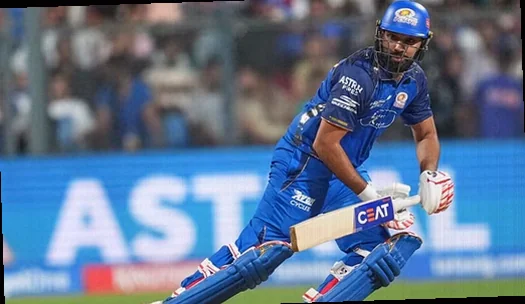
Rohit Sharma’s 84 off 44 deliveries versus Lucknow Super Giants was more than a key knock in a chase—it was a high-leverage return to the playing XI, and that added context shows up sharply in an impact-style valuation of the innings. In this framework, the Mumbai Indians captain’s contribution is mapped to both what he produced on the field and what his presence meant after missing earlier matches.
Key takeaways
- Rohit scored 84 runs off 44 balls in the chase of 229 against Lucknow.
- The innings is valued at about ₹4.75 crore for Mumbai Indians, with an estimated surplus of nearly ₹2.94 crore over match cost.
- His knock carried a dynamic boundary profile: six fours and seven sixes, with 66 of his 84 runs coming from boundaries.
- He maintained a strong scoring tempo across phases—36 off 20 in the powerplay and 48 off 24 after the field spread.
- Rohit shared a 143-run opening partnership with Ryan Rickelton, helping shape the early assault.
How the innings earned its “impact” premium
In the impact valuation model used here, Rohit’s knock is placed at roughly ₹4.75 crore for the Mumbai Indians—close to a ₹5 crore return for a single night’s work. The estimated dynamic match cost for his appearance in that fixture was around ₹1.81 crore, producing a surplus of nearly ₹2.94 crore.
These figures are not presented as a salary claim. They are treated as performance valuation: the model evaluates what Rohit delivered, how much pressure the innings carried, the level of damage created with the bat, and how that output compares to the cost of his specific appearance.
That comparison matters in this case because Rohit had missed a few games beforehand. When a high-value player is absent, the available chances to deliver a season-defining return shrink. After a return, each subsequent appearance carries greater weight in the ledger. Against Lucknow, Rohit did not merely cover the cost—he delivered close to three times the value of that match-specific expense.
Why 84 off 44 mattered in more ways than one
The chase of 229 naturally brings pressure, but the innings should not be viewed only through the lens of chase context. Rohit’s 84 was valuable because it represented a complete T20 batting display, combining volume, tempo, and boundary damage in the same innings.
His strike rate read 190.91, with six fours and seven sixes, as he produced 84 runs from just 44 balls. That kind of output is not only scoreboard dominance—it creates heavy batting impact by repeatedly turning scoring opportunities into match-shifting events.
The structure of the knock strengthened its worth. In the powerplay, Rohit struck 36 off 20 balls. After the field spread, he added 48 off 24 deliveries, continuing to score at pace even as Lucknow had more protection in the deep and more control options. That ability to sustain momentum across phases is what pushed the innings into the high-value zone; it wasn’t a single burst followed by a fade, but a long, damaging run of pressure.
Seven sixes and the boundary effect
A key driver behind the ₹4.75 crore valuation was the boundary profile of the innings. Rohit made 66 of his 84 runs via boundaries. Hitting seven sixes in a 44-ball spell meant he was not simply rotating the strike—he was also keeping the scoring rate under constant threat to the bowling unit.
In T20 cricket, such boundary frequency changes the match economy. A six adds runs, but it also reshapes bowling plans: captains are forced to protect certain areas, bowlers often adjust length and line, and the batting side gains tempo control. Rohit kept manufacturing that kind of pressure throughout his innings, which is part of why the knock is valued at close to ₹5 crore in this model.
Impact as a category: the innings “stood on its own”
There is a difference between posting a good score and delivering a high-impact innings. Rohit’s 84 falls into the second category.
Although Mumbai Indians were chasing a big target, the headline was not just the runs themselves. The innings had enough weight to stand as its own performance: 84 runs, a strike rate close to 191, and seven sixes. Just as importantly, Rohit played a major role in a 143-run opening partnership with Ryan Rickelton.
Rickelton’s 83 off 32 was the more explosive of the two, but Rohit’s innings carried its own value. It gave Mumbai a second high-output batter at the top, turning the opening stand into a two-man assault rather than a one-player surge. It also limited Lucknow’s ability to build pressure around a single wicket or a single quiet spell.
For Rohit, the innings had additional individual significance. A player of his stature is not judged only by availability—match output is the real measure. After missing games, he returned with one of Mumbai Indians’ most valuable batting contributions of the season.
The ledger view: cost, return, and what the model rewards
Rohit’s match cost is estimated at around ₹1.81 crore, while his performance is valued at about ₹4.75 crore, leaving a surplus of nearly ₹2.94 crore. That is presented as the cleanest value-based way to understand the innings: Mumbai Indians “paid” for the appearance of a senior batter and received an elite T20 batting return.
The knock was not valuable simply because it made the chase manageable. It was valuable because Rohit batted at high tempo, sustained his boundary production, carried the innings deep enough to maximize his contribution, and produced in a match where his return carried added season context.
For Mumbai Indians, it amounted to almost a ₹5 crore batting return. For Rohit Sharma, it served as a reminder that impact isn’t only about being in the side—it’s about making the appearance count.
Method note
This valuation is based on a cricket impact model developed by the author. The model studies batting, bowling, fielding, match situation, phase pressure, role difficulty, manual performance rating and captaincy impact, then converts that contribution into a rupee value using the player’s auction/retention price and expected season usage. It is not an official IPL metric, salary calculation or franchise accounting figure.
