
At the Wankhede Stadium in IPL 2026, Mumbai Indians faced a do-or-die kind of evening against the Lucknow Super Giants—one where a slip could have seriously dented their chances of reaching the playoffs. MI did not just survive the contest, they managed to push it firmly in their favour, with Rohit Sharma delivering a return that carried plenty of intent and Ryan Rickelton—MI’s leading batter for the season—providing the support needed at the other end. Even so, the biggest talking point from the night was not only the on-field turnaround or the momentum MI built with the bat; it was a moment that felt larger than cricket.
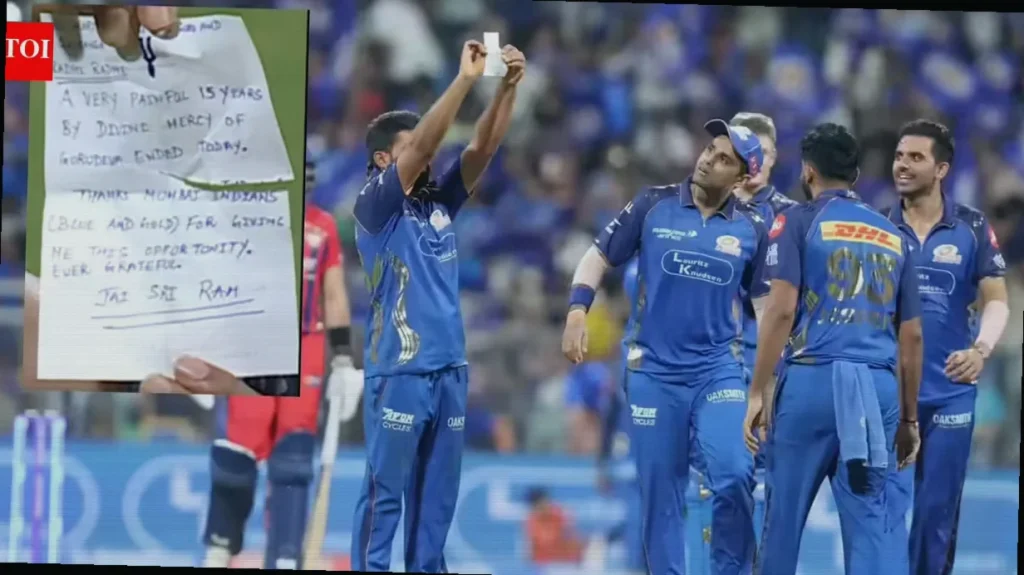
Raghu Sharma’s celebration after taking his first IPL wicket stole the spotlight. It was, by all accounts, a simple act: the ball was taken cleanly and the stumps were broken, and then Raghu paused in a way that suggested much more than a routine first dismissal. For Raghu, this was only his second appearance in the tournament, and he struck early by getting rid of LSG debutant Akshat Raghuwanshi for 11. But the manner of the celebration carried emotional weight—no exaggerated show, no instinctive flare. Instead, it was deliberate, personal, and clearly meant for somebody or something beyond the boundary.
After the wicket, Raghu Sharma lifted a note for the cameras to catch. The gesture immediately pulled at the memories of earlier IPL celebrations—there was the familiar echo of Dinesh Ramdin’s “Talk na Viv” message, and closer to home, the kind of heartfelt hundred celebration Abhishek Sharma produced last season. In the stands, the reaction was instant; on the field, Suryakumar Yadav, acting as stand-in skipper, even leaned in as if to decode the message, clearly trying to read what Raghu had held up. The clip spread quickly, but the meaning behind it had been anything but quick or accidental.
The note read: “Radhe Radhe. A very painful 15 years, by divine mercy of Gurudeva, ended today. Thanks, Mumbai Indians (Blue and Gold), for giving me this opportunity. Ever grateful. Jai Shri Ram.” Those lines summed up a long road—one that had taken Raghu through uncertainty, setbacks, reinvention, and a final return to the franchise that had once been a difficult place for him to crack.
The long wait behind one wicket
Raghu Sharma’s IPL journey began in a way that rarely fits the neat templates people expect from top-level cricketers. He was drafted into the Mumbai Indians setup last season as an injury replacement for Vignesh Puthur, and he was kept on for the 2026 campaign as well. After spending the opening phase of the season on the bench, MI finally handed him a debut chance a few days ago against Chennai Super Kings, where his figures came back as 0/24. That context mattered: it made the wicket against LSG feel even more like a payoff than a mere breakthrough.
When you trace Raghu’s path to the IPL wicket itself, it becomes clear why this moment carried such gravity. His route did not come through elite junior systems. In fact, he only started taking cricket seriously after turning 18. He began his early cricket life as a fast bowler, but a hamstring injury forced him to reinvent himself. He then shifted to leg-spin, largely learning through repetition—work done in the nets, experiments that took time, and lessons absorbed from studying others rather than relying only on formal coaching.
In a pre-season interview, Raghu described how he developed his leg-spin by going through videos repeatedly, watching them again and again and trying the ideas out during training. He also pointed to Shane Warne as the mentor who existed in his preparation, even if not in person—an example of how a “virtual” influence can still shape a player’s craft.
Still, starting late came with its own obstacles. Raghu later said that when he reached 25, he was told he was too old to make progress at the level he wanted. From there, his career moved across different places and kept demanding patience. After a promising domestic beginning with Punjab, he was dropped. His move to Puducherry did not immediately open consistent doors either. He then spent a full season of grade cricket in Sri Lanka, followed by club cricket in England, where he came into contact with senior players such as Imran Tahir. That exposure helped him refine his bowling—especially the need for variations and better control.
Selection did not come quickly after that, and fitness issues only added to the pressure. After failing fitness tests and being pushed out of selection contention, Raghu hit an emotional low. He stepped away briefly, reset mentally, and focused on rebuilding physically. When his domestic performances strengthened, he earned his way back into contention. Mumbai Indians—this same franchise that had once seen him fail trials—gave him another opening, and Raghu made the meaning of that clear when he spoke about returning after eight years: this time, he came back transformed.
Throughout the entire process, faith remained a steady thread. Raghu has spoken about believing that discipline leads to rewards, and that even failures can be part of the path. That belief is visible in the wording of his note: it begins with “Radhe Radhe” and ends with “Jai Shri Ram,” tying the cricketing milestone to a wider sense of journey, gratitude, and closure.
On paper, Raghu’s figures in the match read as 1 for 36 in four overs—nothing flashy by statistical standards. But the value of those numbers was far greater than the scoreboard suggested. They represented the end of a 15-year wait, a wicket that came after a late start, a difficult reinvention, and years of rebuilding.
For a wider look at Raghu Sharma’s progression, his career numbers show steady movement rather than sudden, one-off bursts. In first-class cricket, he has taken 57 wickets in 12 matches at an average of 22.03 and an economy of 3.27, including five five-wicket hauls and three instances of taking ten wickets in a match. In List A cricket, he has 18 wickets from 12 matches at an average of 27.50 with an economy of 5.22. In T20s, he has picked up 5 wickets in 6 matches, averaging 34.40 while maintaining an economy of 7.81.
As IPL 2026 continues, fans will now be watching how MI convert this survival-style win into momentum—especially with the playoff picture still requiring them to stay sharp. Keep tracking the latest IPL live score updates, IPL news, the IPL schedule, the points table, and the race for the Orange Cap and Purple Cap.
