
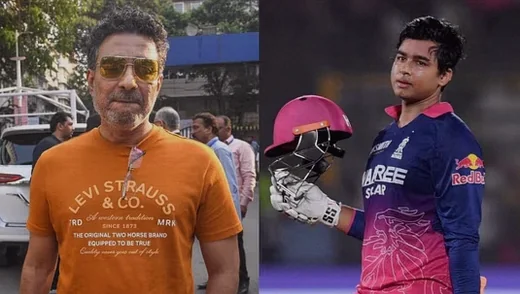
Former India batter Sanjay Manjrekar has backed Vaibhav Sooryavanshi as a ready-made prospect for international cricket, but he feels the conversation should, for now, remain centred on the shorter format. While praising the youngster’s explosive rise and fearless batting, Manjrekar also stressed that earning “respect” at the highest level will demand a shift in technique and mindset—especially if he is ever to make the jump to Test cricket.
Manjrekar’s case for Sooryavanshi—and his “respect” caveat
- Manjrekar argued that Sooryavanshi is more than prepared for international action in T20s, highlighting how the youngster has shown the confidence and impact that franchises typically look for in modern power hitters.
- He pointed to Sooryavanshi’s breakthrough last year, when the 15-year-old stunned world cricket with a century in his debut IPL campaign—an immediate statement of intent.
- Following that debut high, Sooryavanshi built momentum through domestic cricket and age-group performances, including a major show at under-19 level, where he struck a record 175 in the U-19 World Cup final earlier this year.
- In IPL 2026, Manjrekar said Sooryavanshi raised his game even further, scoring 404 runs across 10 matches at a strike rate of 237.64.
- Those numbers, Manjrekar noted, have inevitably fuelled talk that the BCCI may consider fast-tracking Sooryavanshi into India’s national set-up after the IPL.
- On the Sportstar Insight Edge podcast, he endorsed the idea of Sooryavanshi making a push for the Indian T20 team, adding that recent performances in the Syed Mushtaq Ali Trophy—where he recorded a hundred versus Maharashtra—signal he has done enough to stake a claim.
“If someone is lighting up this stage like this, then he’s ready,” Manjrekar said, tying the argument to both IPL impact and the consistency of his domestic form.
But selection for openers may not be simple
Even as he supported the youngster’s readiness, Manjrekar acknowledged a practical obstacle: India’s pipeline for the opening slots is already crowded. He pointed to established and emerging names such as Shubman Gill and Yashasvi Jaiswal, warning that a fast-track route is unlikely to be automatic.
“He might be ready, but are the others ready to make way? Because there is a huge crowd for the opening slots in India,” Manjrekar added.
The technical shift Manjrekar wants from T20 to Tests
Manjrekar then turned to a broader coaching lesson, explaining that Sooryavanshi represents a new breed of T20 batters who back aggression and boundary-hitting. He said this style often relies on creating room and freeing the arms—an approach that aligns well with the demands of T20 cricket.
However, Manjrekar believes the same strategy may not translate neatly to Test cricket. He illustrated the contrast with a specific batting principle: in T20s, Sooryavanshi can stay leg-side and play a delivery from the middle stump through the point region because the batter is shaping the shot with the space he creates. In Tests, the guidance is different—batters are expected to get closer to the ball, rather than rely on reaching room away from their hitting zone.
“In Test cricket, the advice is to get close to the ball. You won’t get runs in England, Australia or South Africa by staying away from it,” Manjrekar said.
He concluded that while T20 success can bring visibility and substantial financial rewards, the kind of recognition that truly matters—“respect”—comes from performing with the required technique under Test conditions. For that, he believes Sooryavanshi (and any young player following the same aggressive path) must be willing to make adjustments.
“If you want your kid to be famous and rich, T20 batting is for you. If you want him to earn respect from people like us, the critics, then he has to get close to the line of the ball,” Manjrekar said.
