
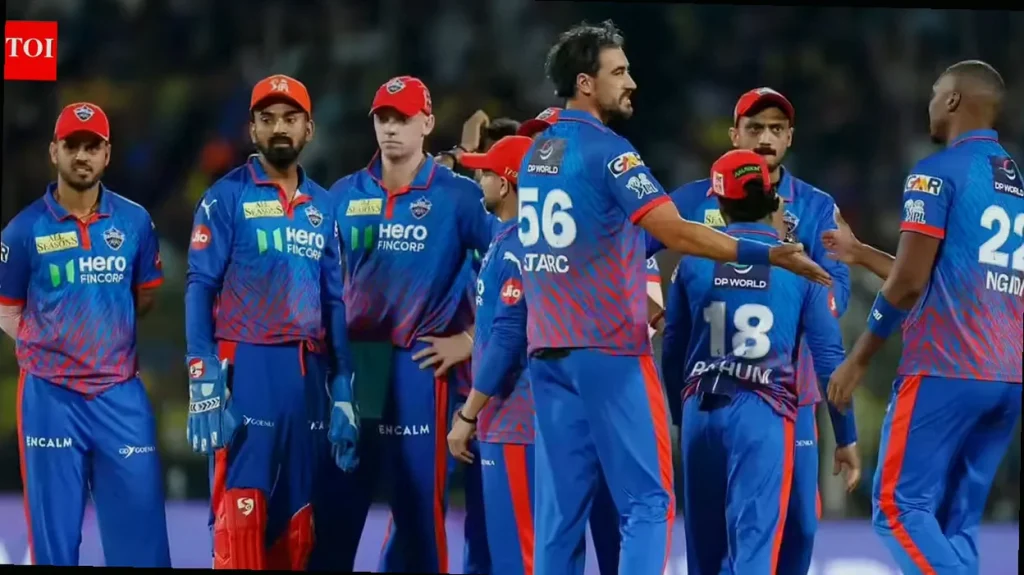
NEW DELHI: The Arun Jaitley Stadium atmosphere turned distinctly yellow on Tuesday evening, with supporters donning Chennai Super Kings colours in clusters and scattered pockets across the ground. The loudest echoes came when chants of “Dhoni, Dhoni” cut through the night. Yet there was a twist to the moment—Mahendra Singh Dhoni, fondly nicknamed “Thala” by CSK fans, had not travelled to the capital and was yet to play a match in the ongoing IPL season.
At the other end, barring a small group of DC fans, the stands did not carry much blue-and-red noise for Delhi Capitals. Match 48 of IPL 2026 offered the home side little momentum and even less reason to celebrate as Chennai Super Kings controlled the proceedings from start to finish.
Match outcome and key performances
- Delhi Capitals won the toss and chose to bat, but their innings never truly gathered pace.
- Only late resistance from Tristan Stubbs (38 off 31 balls) and Sameer Rizvi (40 off 24) helped DC reach 155/7.
- Chennai Super Kings, chasing with confidence, were powered by Sanju Samson’s 87 off 52 balls at the top of the order.
- Kartik Sharma then stayed unbeaten on 41 off 31 as CSK completed the chase with 15 balls remaining and eight wickets in hand.
With the result, Delhi slipped to seventh in the IPL standings. Their current form reads as one win in their most recent five matches, or two wins in their last eight.
At this stage, DC are only ahead of Kolkata Knight Riders, Mumbai Indians, and Lucknow Super Giants in the table.
Why Delhi’s season has stalled
Beyond the slim playoff possibilities, one common thread is the Capitals’ poor record at home. MI have managed just a 33.3% winning rate in their home games, KKR 25%, DC 20%, and LSG have yet to register a home win, posting a 0% record. That trend mirrors a wider struggle across the season.
Meanwhile, CSK—sitting sixth after successive victories—have built a far stronger home presence, with a 60% win record at their own venue.
For the teams currently in playoff spots, their home strength stands out even more: Punjab Kings (75%), Royal Challengers Bengaluru (80%), Sunrisers Hyderabad (60%), and Rajasthan Royals (60%).
Pitch and conditions: inconsistent for DC
Delhi Capitals’ campaign has also been shaped by the variety of surfaces they have faced, alongside uneven conditions created by unseasonal rain and cooler evening temperatures.
Earlier in the season, the afternoon clash versus Punjab Kings produced a high-scoring spectacle, finishing with 529 runs. Against Royal Challengers Bengaluru, the wicket behaved differently and DC were dismissed for only 75.
On Tuesday, DC skipper Axar Patel had expected a pitch that would slow batters on a surface that had not been used before. Instead, the opposite unfolded—well-set batters were able to play their shots and build partnerships. The clearest example came from the 114-run, unbeaten stand between Samson and Karthik, which effectively turned the contest in Chennai’s favour.
Hemang Badani on adaptation and what comes next
After the match, DC head coach Hemang Badani acknowledged that the team has struggled across multiple areas and needs to adjust more effectively to changing conditions and different pitches.
“We do not control the pitch. The surfaces are managed under BCCI guidelines to ensure neutrality,” he said during the post-match media interaction.
Badani added that the Capitals must accept what they are given, noting that their home ground has been slightly unpredictable. He pointed to the contrast between one match that turned into a very high-scoring affair and another that played more into spin.
“But that is the case for all teams. You have to adapt and find ways to win,” he said.
Looking ahead, Badani stressed that DC need to win all four of their remaining matches, including two at home. However, he believes the inconsistency must be tackled.
“One day, we bowl well but do not bat well. Another day, we bat well but fall short in another area,” he remarked.
He concluded by saying that at this level, teams need at least 60 to 70% of their players to contribute meaningfully in a given match-day, and that requirement has not been consistently met.
