
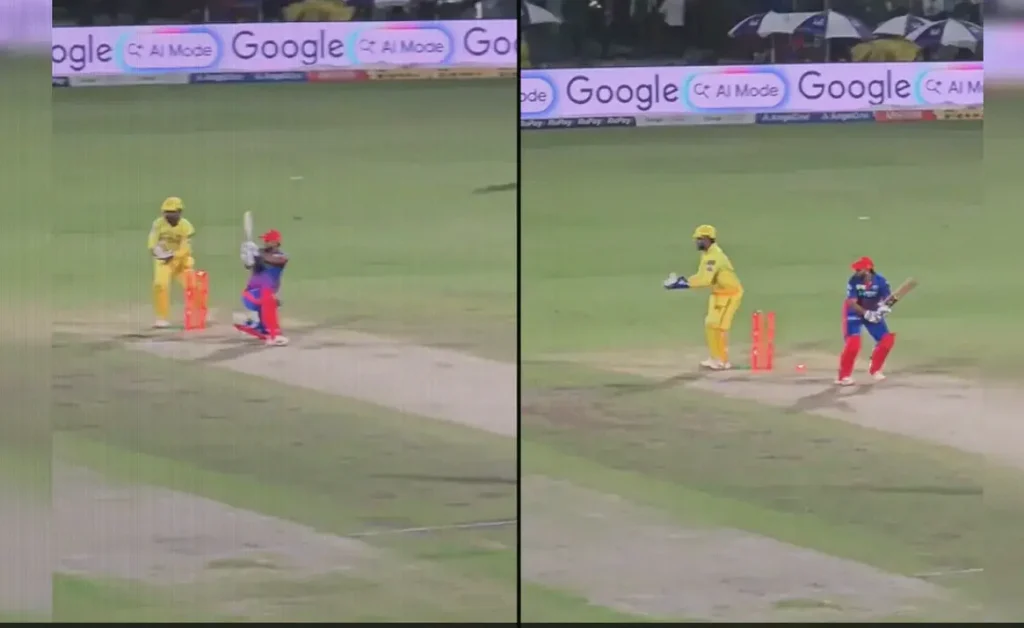
On a difficult Arun Jaitley Stadium surface, with wind gusts constantly swirling across the ground, Nitish Rana stood out as the one Delhi Capitals batter in the top order who looked comfortable enough to handle the conditions. The contest, however, turned suddenly when Rana went for a sweep against Chennai Super Kings’ Noor Ahmed and was caught at deep fine-leg, bringing an abrupt end to an innings that had been built around survival on a tricky wicket.
The dismissal has since sparked an online storm after a clip appeared on social media that raised doubts about whether the moment should have been treated as a dead ball. In the video, viewers argue that the bails come off the stumps before Rana completes contact with the delivery, which in turn led to questions over the decision-making from the officials. Some fans went further, wondering whether the wicket should instead have been recorded as hit-wicket, while others speculated that wicket-keeper Sanju Samson might have disturbed the stumps from behind.
Those theories, though, appear to have been complicated by the circumstances of the match itself. The most plausible explanation offered in discussion is that the strong wind at the venue may have been forceful enough to dislodge the bails at the wrong time. That would also fit the wider picture of the innings, where movement through the air and the unpredictability of the conditions had already made batting a high-risk task.
Not long after the dismissal, another viral video circulated suggesting the bails had become dislodged prior to Rana’s contact with the ball. Even with the debate gaining traction online, there was no visible intervention from the on-field umpires during the match, and the dismissal remained recorded in the game without any change to its classification.
Crucially, the outlet of the dispute did not become an official hit-wicket call, and there was no indication during the match that Samson had accidentally knocked the bails off. With the bails seemingly affected by the environment rather than by the batter or the wicket-keeper, the incident was widely viewed as a consequence of Delhi’s high wind speeds making the stumps and bails less secure than usual.
Under the Laws of Cricket, a hit-wicket dismissal can only be applied when the batter breaks their own wicket—either by playing the stroke or while starting a run—through the act of batting. In this case, because Rana was not found to have caused the stumps to break as part of his shot or his running, the hit-wicket provision could not be used.
For fans trying to decode the ruling, the key question became whether the delivery should have been declared dead due to the timing of the bails falling. The answer depends entirely on when the bails come off in relation to the bowler’s delivery and whether there was any distraction for the striker.
Under MCC Law 20, an umpire may call a dead ball in situations involving a significant distraction, or if the bowler drops the ball or fails to deliver it properly. The law further states that, as per Law 20.4.2.6, the umpires must call and signal dead ball if the striker is distracted by noise, movement, or any other factor while preparing to receive or while receiving the delivery.
In the sequence being debated, the bails were shown to have fallen after the bowler had already released the ball, and the striker was not presented with a distraction at the moment of receiving. With that timeline, the conditions required to treat the delivery as a dead ball were not met, leaving the on-field decision to stand despite the controversy that followed.
