
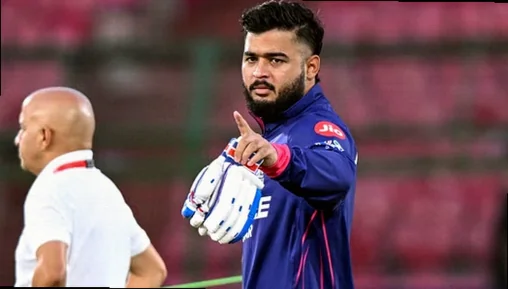
Former India batter Sanjay Manjrekar has criticised the way Riyan Parag’s vaping incident has been handled in public debate, arguing the Rajasthan Royals captain has been made an easy target in a sport where modern coverage has become relentlessly intrusive. While Manjrekar accepted that vaping is against Indian law and that the BCCI’s disciplinary action against Parag was appropriate, he urged authorities to look beyond the player and also take steps against the source of the e-cigarettes.
Manjrekar on why Parag is being treated as a “soft target”
Speaking in the aftermath of the controversy, the former batter said the intensity of today’s scrutiny often magnifies comparatively minor offences involving younger players. He also pointed to how the media and camera ecosystem can turn fleeting moments into major talking points.
- Manjrekar said Parag should not be judged too harshly simply because of who he is, calling him a “soft target” amid heightened attention.
- He argued that the scale of today’s microscopic coverage can amplify incidents that would otherwise be seen as smaller breaches.
- He stressed that players still must act responsibly and acknowledged that managing behaviour at a young age under heavy spotlight can be difficult.
Privacy concerns and the changing nature of cricket coverage
Manjrekar also broadened the discussion beyond e-cigarettes, linking the controversy to wider privacy issues around how players are filmed and monitored. He cited his own playing days, explaining that earlier broadcasting and camera practices were less invasive.
He recalled that in his era, Krishnamachari Srikkanth—his teammate—would smoke in the dressing room to unwind when match pressure built up. Manjrekar also referenced Shane Warne as another player who used similar ways to manage stress. However, he said the difference today is the sheer reach of cameras and broadcast technology, which, in his view, leaves almost no personal space.
- Manjrekar said vaping is illegal in India, but argued that the wider problem is the lack of privacy in modern cricket environments.
- He described how, earlier, cameras were not as intrusive as they are now.
- He added that today’s coverage can even capture a private moment—mentioning a “silhouette” of Mahendra Singh Dhoni—as an example of how little privacy players have.
- He opposed “stump mics,” saying that during his playing days, the area near the stumps was more contained, whereas the game has changed and the scrutiny is far greater now.
What the law says, and what action was taken
Manjrekar said once he understood the legal position, he supported the need for action. He noted that e-cigarettes were banned in India in 2019, covering production, sale and distribution, and that the law provides for imprisonment of up to one year and/or a fine of ₹1 lakh for a first-time offence.
He also made a key distinction: the response should not be limited to punishing Parag alone. In his view, supplying e-cigarettes is also illegal, and identifying the source should be part of the enforcement.
- Manjrekar said his first reaction was that vaping could appear similar to smoking, but he then realised it is against the law.
- He said the 2019 ban makes both possession and supply a legal concern, so enforcement should extend to the supplier as well.
- He maintained that action is necessary, but it should be broader than just the captain.
Incident details and Manjrekar’s broader perspective on discipline
Parag was caught vaping during an IPL 2026 match against Punjab Kings in Mullanpur over a week ago. The episode quickly drew attention on social media, intensified by the fact that e-cigarettes have been prohibited in India since 2019.
Following the breach, Parag was fined 25 per cent of his match fee and given a demerit point for violating the tournament’s code of conduct. The relevant clause relates to conduct that brings the game into disrepute.
Manjrekar urged fans to move on quickly while also insisting that the debate should be framed fairly. He argued that far more serious violations of the game’s spirit have occurred in the past, and that such incidents are no longer commonplace in recent years.
- He said there have been more serious breaches earlier, making Parag’s case a “soft target” in comparison.
- He cited examples from the past: a bowler deliberately running into an umpire out of frustration and players kicking stumps in anger.
- He also referenced physical altercations in international Test matches, adding that these were not seen in the last 15–20 years.
Concluding his remarks, Manjrekar pointed again to what he believes has changed most: coverage. He said everything is under a microscope now, and even an innocent remark can be misinterpreted and punished—leaving players to operate in an unusually difficult environment, both on and off the field.
