
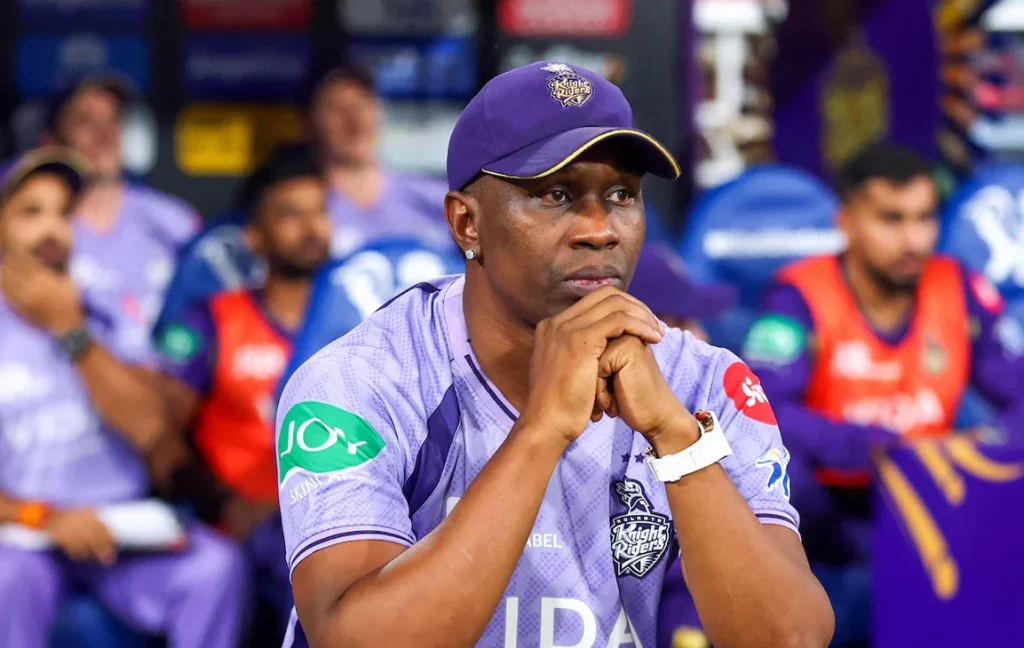
Dwayne Bravo’s influence on Kolkata Knight Riders this season often doesn’t show up in the usual places. There are no extra wickets for the scorecard column, no dramatic figures that capture what happens in the quieter moments—after training, in the brief one-on-one chats under lights, and in the calm self-belief young fast bowlers carry into the death overs. For years, the West Indian has mastered the slower ball in a way that has made batters uncomfortable across T20 cricket, and when Lungi Ngidi recently explained that the dipping version of the slower ball he uses now was something he learned from Bravo during their time together at Chennai Super Kings, it underlined the kind of “invisible” impact DJ Bravo continues to build.
At KKR, that mentorship has taken on a distinctly personal tone. Bravo has been hands-on with the pace group, approaching his work less like a checklist of bowling mechanics and more like a lesson in reading the game. “Yeah, I’m very hands-on, especially since Lungi talked about that. Everyone wants me to teach them that slower ball. Thanks, Lungi,” Bravo said with a laugh. For him, the craft was never only about how the wrist sits or how the grip is set, even though those elements are certainly part of what he once relied on as a player. “It’s one of my strengths when I used to play, but also what was my strength was my ability to read and understand the game. And for me, that is what I try to coach more than anything else.”
That approach makes Bravo’s coaching feel refreshingly grounded in human thinking rather than robotic execution. He isn’t just instructing bowlers to deliver a variation; he’s teaching them when it makes sense to use it, and how to set it up. “Because the slower ball is one thing, but it’s knowing when to bowl a slower ball, who to bowl it to, the build-up to bowling a slower ball. So all of these things are factors. They don’t just bowl a slower ball. So there’s a lot of thinking behind it and you have to practice it a lot.” In other words, the variation is only the visible part—what matters just as much is the decision-making process that sits behind it.
KKR’s bowling has benefited from that steady guidance, even as the team’s standing on the points table has shifted over the course of the season. With three wins in nine matches, the franchise’s results have not always followed a straight line, but Bravo has remained focused on protecting the bowling group—particularly during the middle and death phases, where KKR have repeatedly looked competitive. “The good thing is, if you look at the stats throughout the IPL season, KKR is one of the better bowling groups. Especially from overs 7-20 because of our spin attack. We have three of the best quality spinners in the tournament. And also our seamers.”
Alongside bowling coach Tim Southee, Bravo has helped shape training sessions that aim to mirror real match situations rather than simply repeating drills. The emphasis is on realism: what bowlers expect to face, how batters are likely to respond, and how to manage pressure when the game moves into its decisive stages. “We try to teach and coach real game-time things that they expect to happen in a game and get our bowlers to practice like that in practice, so that when game time comes, they are prepared for it.”
Perhaps the most noticeable change has been around the younger Indian quicks in Bravo’s orbit. There’s warmth in the way he talks about them, and it comes through in the details. About Karthik Tyagi, Bravo highlighted a mindset built for learning: “Tyagi is someone who loves to learn. He asks a lot of questions, a lot of energy. Sometimes you have to tell him as coaches, ‘Please rest, take it easy.’ He says, ‘No sir, no sir, I want to bowl, I want to bowl.’” Bravo also pointed to Vaibhav Arora’s impact late in innings, and he noted that Umran Malik is still “working very hard” even though the chances this season have not yet matched his talent.
Bravo even described a recent one-on-one session with Matheesha Pathirana. The focus, he explained, was on crafting “a specific one to dip,” reinforcing the idea that his work is tailored and deliberate rather than generic. For Bravo, that empathy is not a side element—it is central to what fast bowlers need if they are going to grow. “All these guys, all they needed was guidance and to feel loved and to feel appreciated. And that’s what my job is, to make sure that these guys are protected and they learn as they go along in the game.”
He understands that young pace prospects often need more than technical correction. They require reassurance, and they need someone who knows what it feels like to fail in front of intense home support—and who has survived that pressure personally. That’s why the slower ball, in a way, has become more than a tactic at KKR this season. It stands for something bigger: a culture of careful thought, confidence, and mentorship that helps bowlers believe they belong exactly where the game turns sharpest.
KKR are currently placed eighth in the league table, with every remaining match carrying knockout weight. On Friday, they take on Delhi Capitals.
