
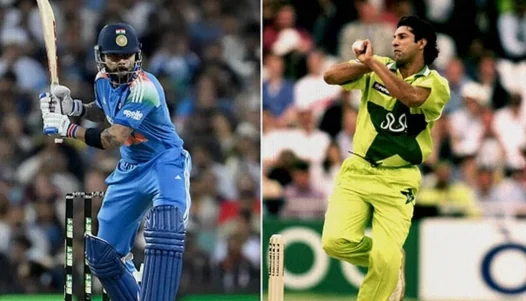
Cricket fans love to play out “what if” scenarios—fantasy head-to-heads that never happened but feel inevitable in the mind. Picture Mitchell Starc running in with Sunil Gavaskar set at the wicket in an India–Australia Test, or the sight of Jasprit Bumrah firing in to Brian Lara in the Caribbean. Imagine Rohit Sharma taking guard with Allan Donald bearing down from the other end, a matchup where timing and nerve would matter as much as raw pace. And then there are the dream duels that live in Ashes folklore: Shane Warne bowling to Joe Root, or Pat Cummins setting his run-up against Sachin Tendulkar. Tempting, isn’t it? Still, among all those imagined clashes, one pairing stands out as the kind of battle that could dominate a Super Over—Virat Kohli going toe-to-toe with Wasim Akram, left-arm pace’s greatest craftsman. The Master Chaser versus the Sultan of Swing. The top white-ball pacer challenging the most accomplished batter the format has ever produced. Add the pressure-cooker reality of a Super Over, and the stakes jump again. When Ian Bishop leaned into the contest and backed “Wasim bhai,” the temptation is to picture a one-sided script—but could it really be that simple? Let’s break it down.
A Super Over rewards bowlers who can execute quickly and batters who can explode on command, and Akram—at his peak between 1989 and 1999—had the temperament and tools to trouble the best. In that stretch of his career, he dismissed Desmond Haynes 12 times, Sanath Jayasuriya nine times, and Brian Lara on seven occasions. Against Indian batsmen, his record was equally sharp: he removed Mohammad Azharuddin and Sourav Ganguly five times each, while Kapil Dev and Rahul Dravid fell to him four times apiece. Interestingly, the reverse picture appears when the conversation turns to Tendulkar. Akram’s success against him was comparatively limited, taking him only three times across 24 innings.
Akram’s authority with the white ball becomes even more striking once reverse swing enters the equation—particularly in the late stages when batters are trying to accelerate. Even though ball-by-ball records from that era are not as complete as modern datasets, available archives point to a clear pattern in the final overs of ODIs: he conceded fewer than six runs per over between overs 45 and 50. Across 418 deliveries in that phase, Akram gave away 415 runs while claiming 21 wickets. For comparison, Glenn McGrath bowled 854 deliveries, conceded 923 runs and took 40 wickets, working out to an economy rate of 6.48. Donald, Waqar Younis and Courtney Walsh also struggled to match Akram’s combined balance of tight control and wicket-taking threat. In his prime, Akram was the sort of bowler who could make even elite batters feel uncomfortable within a single spell.
That reputation is not built on anecdotes alone. Akram’s spell in the final of the 1992 Cricket World Cup is still spoken about as part of cricket’s living legend. The next year, he added another milestone by taking 45 ODI wickets—better than his own 43-wicket haul in 1992, when he set a then-new benchmark for the most wickets by a fast bowler in a calendar year. Many pacers have since surpassed those figures, but Akram’s standard remains a reference point. And beyond the swing and menace, he also carried surprising pace at his best.
Kohli’s “death overs” advantage, and why Akram’s style still fits
Kohli’s record against left-arm pacers suggests that this specific angle isn’t a straightforward weakness. Across 338 dismissals in white-ball internationals, he has been out to left-arm quicks 54 times—roughly 16% of his total dismissals. That points to the idea that left-arm pace alone doesn’t explain his outs. When you move into the phases that matter most, though, the story becomes more nuanced—especially in the end overs. In T20Is, Kohli’s numbers are particularly impressive: he averages 54.3 and strikes at 192.5, scoring 1032 runs from overs 16 to 20. In ODIs, the returns dip but remain strong: 733 runs from 39 innings between overs 45 and 50, at an average of 28.2 and a strike rate of 170.9. These are the kind of statistics that underline a batter’s ability to decode field settings and execution patterns when the game is on the line.
Still, the key question is whether Kohli can consistently solve the very fastest, most skilled pacers at the highest intensity. Against the top tier of fast bowlers, Kohli hasn’t always dominated in a simplistic way—Kagiso Rabada, Trent Boult and Mitchell Starc have not exactly been helpless in his presence. Even so, when you narrow the lens to these elite pace threats, only Rabada has dismissed him twice across that group. And if Kohli manages to bat deep, he tends to do one thing reliably: he usually finishes the job and stays unbeaten. The closer you get to Super Over territory, the more relevant it becomes to ask how Kohli behaves when the innings compresses into a handful of balls. However, the sample is limited. Kohli has batted in Super Overs only three times—once for India and twice for Royal Challengers Bengaluru—scoring 16 runs off 10 deliveries. With such a small dataset, any conclusion has to be cautious.
The Super Over matchup: how Akram would attack, and how Kohli might respond
Now to the most thrilling part of the thought experiment: Akram bowling to Kohli under Super Over conditions. First, the spectacle itself is box-office. Anyone who has faced Akram at his peak would tell you that if a batter’s body language dipped even slightly, Akram would immediately tighten the screws and force errors. But Kohli isn’t a batter built for easy disruption—his career has been shaped by taking the contest by the scruff of the neck. Two strong personalities, two alpha figures. A quick word exchanged here and there, a Punjabi connection on both sides, and the kind of competitive intensity that makes the next delivery feel like a decision point rather than just a ball in play.
In this imagined six-ball sequence, Akram would likely look to angle his plan around the stumps from over the wicket. His preferred mix would revolve around two swinging yorkers, a cutter that changes the batter’s timing, a couple of half-length deliveries that move away after pitching, and a bouncer to test confidence and trigger reactions. The fuller options would matter because Kohli rarely leans heavily on the ramp or paddle. Yet Kohli’s power game is precisely what makes him dangerous even to length. The off-cutter would be a ball Kohli would want to put his stamp on, though Akram could still hold the upper hand with the bouncer—forcing the batter to decide early whether to commit to aggression or protect the shape.
Targets add another layer. If the equation is under 10, it would feel like Kohli’s kind of moment. Once the requirement climbs into the 11 to 15 range, however, the balance could tilt toward Akram, because the margin for timing errors shrinks and the bowler’s confidence grows. And this is where the contest becomes compelling rather than one-sided. Kohli is not merely a modern hitter; he has delivered moments that justify the “best of his generation” label. He produced 28 runs off eight balls in an innings that will be remembered for years at the MCG in 2022. A decade earlier, when he was still on the way up to becoming the player he is now, he also created that famous Hobart performance—an innings that showed he could shift gears even before the world fully understood his ceiling.
In a best-case scenario, Kohli would find a way to get on top of Akram—perhaps through a well-timed inside-out shot or by using the strength in his wrists to penetrate the leg side with precision. But Akram’s greatest weapon has always been the variety inside his control: he could out-think and out-execute in the same over. Kohli, for his part, is a learner by nature—someone who keeps refining his approach rather than relying on past answers. In a longer format, perhaps Kohli’s adaptability could nudge him ahead in a best-of-five kind of storyline. Yet in a first-time confrontation, Akram’s experience of pressure moments might still edge it—by the narrowest of margins, the kind that only a Super Over can manufacture.
