
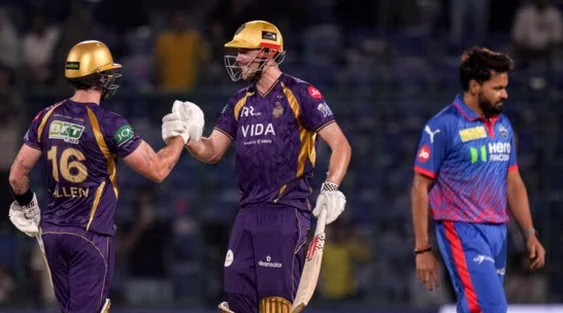
Kolkata Knight Riders kept their IPL 2026 playoff hopes flickering with an eight-wicket victory over Delhi Capitals, but the standout talking point was more than Finn Allen’s century. The match also underlined a specific pattern in KKR’s season—how they keep finding a way back after shaky starts.
KKR chased 143 at the Arun Jaitley Stadium, reaching the target in 14.2 overs. Allen carried the chase with an unbeaten 100 off 47 balls as KKR secured their fourth win of the campaign and stayed firmly in the playoff conversation after a difficult opening stretch.
Quick facts
- Kolkata Knight Riders beat Delhi Capitals by eight wickets in IPL 2026.
- KKR chased 143 in 14.2 overs at the Arun Jaitley Stadium.
- Finn Allen scored an unbeaten 100 off 47 balls.
- The win was KKR’s fourth of the season and kept them in the playoff race.
- KKR have won four matches without winning a powerplay.
- Against Delhi, DC were 55/1 after six overs; KKR were 43/2 in response.
- Delhi finished on 142/8 after scoring only 87 runs in the final 14 overs.
Ian Bishop spots the “powerplay” anomaly
Ian Bishop pointed to a deeper trend behind KKR’s results in IPL 2026. He noted that KKR were managing to win without taking the advantage in the first six overs, even though that typically sets the tone for the rest of the match. His view was that the team has benefitted from chaseable totals and strong work from the bowling unit.
The key point was that this wasn’t about one isolated performance. It was about how KKR’s victories are stacking up this season—often with the powerplay going in the opponent’s favour—yet still ending with KKR on top.
Against Delhi Capitals, the script began the way it often has for KKR this year. Delhi reached 55/1 after the opening six overs, while KKR made 43/2 in response. Even with DC holding the early edge, KKR still completed the chase with 34 balls remaining.
Four wins, zero powerplay wins
KKR’s four victories have come without a single win in the powerplay phase. Versus Rajasthan Royals, the opening burst belonged to RR: they were 63/0 after six overs, before KKR steadied the chase and moved to 51/3. Against Lucknow Super Giants, LSG were 37/1 in the powerplay, while KKR were 31/3 after matching it.
When KKR faced Sunrisers Hyderabad, the powerplay ended with both sides on 71/1, meaning KKR did not lose the phase there—but they still did not finish as winners in it. Against Delhi again, KKR once more found themselves trailing after the first six overs.
So the pattern is clear: in three of those four wins, KKR dropped the powerplay, and in the remaining game the phase was shared. Crucially, they have not won the powerplay in any of their four match victories.
In IPL 2026, powerplay performance has often been a reliable indicator of control. Teams that come out on top in the first six overs usually manage to carry that momentum. KKR, however, are getting results through a different route—one that depends on what follows after the early overs.
The post-powerplay shift
What changes for KKR is the period right after the powerplay ends. Against Rajasthan Royals, RR went from 63/0 after six overs to 155/9 in the full innings. KKR then responded by taking 9 wickets for 92 runs after the powerplay, tightening the game’s middle and back end.
Against Sunrisers Hyderabad, the trend looked similar at the start: SRH were 71/1 after the powerplay and were eventually bowled out for 165. KKR again applied pressure after those first six overs, taking 9 wickets for 94 runs in the remainder.
The squeeze was even sharper versus Delhi Capitals. Delhi were 55/1 after six overs but finished at 142/8. They managed only 87 runs and lost seven wickets in the final 14 overs, leaving KKR with a chase they could accelerate through once the match turned.
That is the recurring template for the three-time IPL champions in this edition. KKR often lose the powerplay, then reverse the outcome through wickets and control during the middle and late stages.
Allen turns the route into a statement
Before the Delhi match, KKR’s wins were largely built on containment—keeping targets within a manageable range, typically in the 155–166 band, and then finding a path through. Against DC, Finn Allen altered how forceful that path could be.
His unbeaten hundred transformed a chase into a dominant win. KKR didn’t simply recover from a powerplay deficit; they also picked up a significant net run rate boost, a vital ingredient for a team juggling playoff pressure.
KKR’s overall framework appears to need batting violence to push the ceiling higher. Bowling can keep them in games, but a batter in form can widen the margin for error and lift their finish to a higher level—something Allen delivered in emphatic fashion.
Bishop’s Gujarat Titans comparison fits neatly in one respect: KKR are currently winning through bowling control, chaseable totals, and rapid recovery after ordinary openings. Still, the comparison has limits. Gujarat Titans’ success has been built on a more repeatable structure, while KKR’s current run looks more fragile.
Repeatedly losing the powerplay is not a sustainable comfort zone, especially when the opposition’s batting units tighten the screws. A start like 55/1 can easily slide into 75/0, and a situation such as 45/2 can become 50/4 against stronger bowling attacks—small shifts that can decide games in T20 cricket.
So while Bishop’s tweet captures the story well, it also highlights the risk. For now, KKR have found a route that runs against the usual IPL pattern. Their bowling has been strong enough to erase early setbacks, and their latest win showed what happens when that control is followed by a match-breaking innings.
For the moment, the theory holds: KKR have four wins without winning a powerplay. It is rare, it carries danger, and it sits at the centre of their late-season push.
