
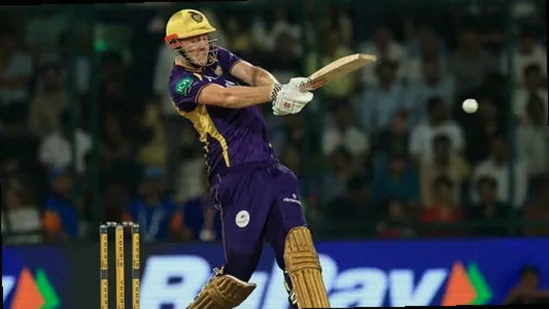
Kolkata Knight Riders’ chase against the Delhi Capitals carried two themes: a loud batting highlight and a quieter financial question. Finn Allen struck a century without losing his wicket, posting 100 not out from 47 balls to dismantle the chase and bring the required total down to 143. KKR finished the job quickly as they reached 147 for 2 within 15 overs, sealing the win by eight wickets. The result kept their momentum moving and added fresh urgency to their playoff push.
Allen’s century sets the chase tone
Allen’s unbeaten knock was the central story of the innings, turning KKR’s chase into a controlled demolition rather than a tense run chase. With the opposition target effectively neutralised, KKR were able to attack the innings in the powerplay and beyond without allowing Delhi to reset the pressure.
Green’s steady support—and why it still didn’t flip the ledger
Cameron Green’s contribution arrived in the shadow of Allen’s fireworks, but it mattered in a different way. Green walked out when KKR were 31 for 2, stayed unbeaten on 33 off 27 deliveries, and struck two sixes. While Allen accelerated the scoreboard, Green held one end steady and ensured the chase didn’t unravel at a crucial stage. His impact wasn’t limited to batting either: he bowled one over and added value in the field, making the outing a useful all-round support performance.
In cricket terms, it was a night that helped KKR. In the IPL valuation sense, it exposed how difficult it is to justify a premium price across a season, even when performances are genuinely helpful. Green’s match contribution still stopped just short of the break-even line—showing that “almost” can carry heavy weight when the cost is high.
Green’s Match 51 valuation vs his carrying cost
- Green’s output in Match 51 translated into a modelled match value of INR 1.67 crore.
- His running match cost, using a season price of INR 25.20 crore, came to INR 1.80 crore.
- The difference left him with a narrow shortfall of INR 0.13 crore on the account.
This gap doesn’t necessarily point to poor cricket. It highlights a measurement reality: the higher the auction investment, the more repeated, high-impact returns are required to keep the ledger balanced. A player bought for a smaller figure can sometimes turn one explosive night into a surplus. A player priced at INR 25.20 crore needs consistent match-changing performances just to remain level, and Green’s 33* plus his supporting bowling and fielding contributions came close—yet not close enough for the model’s break-even benchmark.
Why the chase context strengthens the cricket case
The innings situation makes Green’s value easier to understand. KKR had already lost early wickets, and while Allen’s strike rate was healthy, a third wicket at that stage could have forced the chase to stretch longer than ideal. Green didn’t chase attention; he stabilised the middle overs, kept Allen’s attacking rhythm intact, and helped build an unbeaten 116-run partnership. His 33 runs weren’t merely decorative—they helped prevent the kind of wobble that can transform an achievable chase into a difficult finish.
Still, the balance-sheet result moved against him by a small margin because his break-even threshold is extremely demanding.
Season finance: from pressure to a slower slide
Before Match 51, Green’s season ledger was already under significant strain. From nine appearances, his worth was modelled at INR 7.73 crore, while his charged cost stood at INR 16.20 crore. That left his season profit-and-loss at -INR 8.47 crore, with a recovery rate of 47.69%. In other words, he was recovering less than half of what his price required across the sample of matches.
After the Delhi game, his numbers improved slightly—but not enough to erase the deeper deficit. His worth rose to INR 9.39 crore, his charged cost increased to INR 18 crore, and his season P/L moved to -INR 8.61 crore. The recovery rate climbed from 47.69% to 52.17%, and the average loss per match improved from INR 0.94 crore to INR 0.86 crore. Match 51 didn’t rescue the account, yet it slowed the damage and pushed him above the halfway-recover line.
Where Green stands compared with what a cheaper player might get
For a lower-cost player, the same kind of performance would likely be seen as a clear win. For Green, the standards are higher because KKR’s investment demands a different level of return. His season includes flashes of value—particularly Match 25, where he generated INR 4.51 crore in worth and delivered a profit of INR 2.75 crore. That remains his only true surplus performance of the season.
Outside that standout, the campaign has been a mix of partial recoveries, useful contributions, and expensive shortfalls. The problem is not an absence of impact; it is the conversion of impact into enough monetary value to justify the cost at this stage of the year.
Overall season after Match 51
- In 10 total appearances, Green has scored 232 runs off 157 balls.
- His batting remains his strongest pillar of value.
- Fielding has provided important additional worth.
- His bowling has lagged overall, despite the contribution against Delhi.
KKR are not treating Green as a passenger. Instead, they have a premium asset whose returns have not consistently justified the acquisition price. Match 51 proved he can be useful, but it also showed why usefulness alone isn’t enough at INR 25.20 crore. A stabilising 33*, some fielding value, and a bowling touch can win games, yet still fail to turn the ledger green.
Allen’s profit surge vs Green’s balance-sheet repair
That makes Green one of KKR’s most compelling valuation narratives of the season: Allen’s century against Delhi was a profit explosion, while Green’s Delhi night looked more like balance-sheet repair. One player took a low base and turned it into a large surplus. The other improved his recovery percentage while remaining deep in the red.
For Green to change the season’s financial reading, KKR need more than supporting acts. They require innings and all-round spells that resemble the kind of impact seen in Match 25—performances that can move the model from “helpful” to “profitable.” His Delhi showing did help the team, shaping the chase and adding safety. It also nudged his recovery rate in the right direction, but the INR 25.20 crore question still remains unanswered.
Model note on the valuation numbers
This valuation is built on a cricket impact model created exclusively for this analysis. The model evaluates a player’s match contribution across batting, bowling, and fielding, while accounting for match situation, pressure during different phases, and role difficulty. It then converts that impact into a monetary estimate using the player’s auction price and an expected season usage pattern. These figures are not a salary calculation and are not an official IPL metric. They are analytical approximations intended to indicate whether a player delivered above or below their cost for a match or phase of the season. Treat the numbers as model-based valuations rather than exact financial earnings.
