
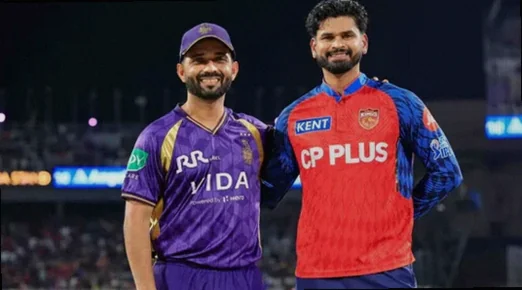
Kolkata Knight Riders were 25/2 in just 3.4 overs when rain forced an early pause at Eden Gardens on Saturday night, but the real damage had already been done. With the pitch showing signs of early movement under ominous skies, and Punjab Kings comfortable to lean into the conditions, Ajinkya Rahane’s choice to bat first after winning the toss quickly looked questionable. Xavier Bartlett struck twice in his opening spell, sending Finn Allen and Cameron Green back, leaving KKR exposed before the match had even properly taken shape. For a team already feeling pressure in the early stages of the campaign, the decision raised a tougher question: did KKR try to cut costs on leadership, only to end up paying a higher price in cricketing terms?
Key takeaways
- KKR were 25/2 in 3.4 overs when rain ended play at Eden Gardens.
- Ajinkya Rahane batted first despite a rain-affected setting and early assistance for bowlers.
- Xavier Bartlett dismissed Finn Allen and Cameron Green in his first over.
- Shreyas Iyer was bought by Punjab Kings at ₹26.75 crore in the 2025 mega auction, while Rahane was signed by KKR for ₹1.5 crore.
- KKR’s trophy-winning 2024 run highlighted Iyer’s strong match-up reading, including a toss call in the final versus Sunrisers Hyderabad.
The toss decision that sharpened the debate
The comparison with Shreyas Iyer is hard to avoid. After winning the 2024 title, KKR moved on from a captain who had already delivered silverware, and Punjab Kings moved swiftly for him at the 2025 mega auction. They secured him for ₹26.75 crore. Rahane, in contrast, was brought into KKR’s setup for ₹1.5 crore. On paper, that’s a striking ₹25.25 crore difference, which allows KKR to frame the move as financial prudence. Yet in a T20 context, especially where match-ups and momentum swing rapidly, the justification feels insufficient.
Why the “cheap vs expensive” framing misses the point
It’s tempting to reduce everything to a simple story of high price versus low price. But Ajinkya Rahane isn’t a bargain-bin option. He delivered a strong IPL 2025, scoring 390 runs at a strike rate of 147.72—figures that point to how his white-ball game has evolved over recent seasons. Still, Shreyas Iyer operates in a different bracket entirely. In IPL 2025, Iyer amassed 604 runs at a strike rate of 175.07, averaging 50.33, and he also guided Punjab Kings to the final.
In T20 cricket, that blend matters far more than raw totals alone. Runs without tempo can mislead, while tempo without enough innings weight can flatter. Iyer offered both—volume and acceleration—making him a uniquely valuable type of batter for the format.
Opportunity cost: what KKR may have traded away
That’s where the conversation turns to opportunity cost. Yes, KKR saved ₹25.25 crore on the captaincy fee. But the key question is what they surrendered in return: they gave up a leader who had already proven he could steer them through a title-winning season, along with a middle-order presence whose T20 value is simply higher. Indian batters who can dominate the middle overs, accelerate aggressively, handle both spin and pace, and also captain effectively are rare commodities in the league. In that sense, Iyer isn’t just paid as a batter—he is priced as a double-impact cricketer. Rahane’s experience and steadiness are assets too, but the market has clearly valued him differently. Saturday’s toss call is the kind of moment that brings that gap into sharp focus.
Why the contrast feels even sharper after KKR’s own evidence
There is also an irony here. KKR’s 2024 title run itself showed how valuable a sharp read of conditions can be. In the final against Sunrisers Hyderabad, Shreyas Iyer had said at the toss that he would have preferred to bowl first. KKR’s bowling then dismantled SRH for 113, and the chase was completed comfortably. That wasn’t merely a match result—it reflected a side that generally knew what plan it wanted on the day.
Saturday night at Eden Gardens felt like the opposite. With rain looming, early help for the seamers, an opponent prepared to strike with the ball, and KKR still choosing to bat first, the situation suggested a strategy working against the conditions rather than with them. The score at the stoppage only underlined that sense that the decision was misaligned with what the game was offering.
Saving money doesn’t automatically equal buying value
The strongest financial argument isn’t that KKR should simply have matched Punjab Kings’ bid. Instead, the issue is that by selecting a lower-cost captain, the franchise accepted a smaller margin for error. Moving from a ₹26.75 crore leader-batter to a ₹1.5 crore, stopgap-style option doesn’t just reduce spending—it also downgrades the premium associated with decision-making, role stability, and the batting ceiling that comes with a player of Iyer’s profile.
Over the length of a full season, one toss call will not define the overall trade. But on a night when KKR were 25/2 before rain had fully arrived, it served as a costly reminder of what they may have chosen to let go.
