
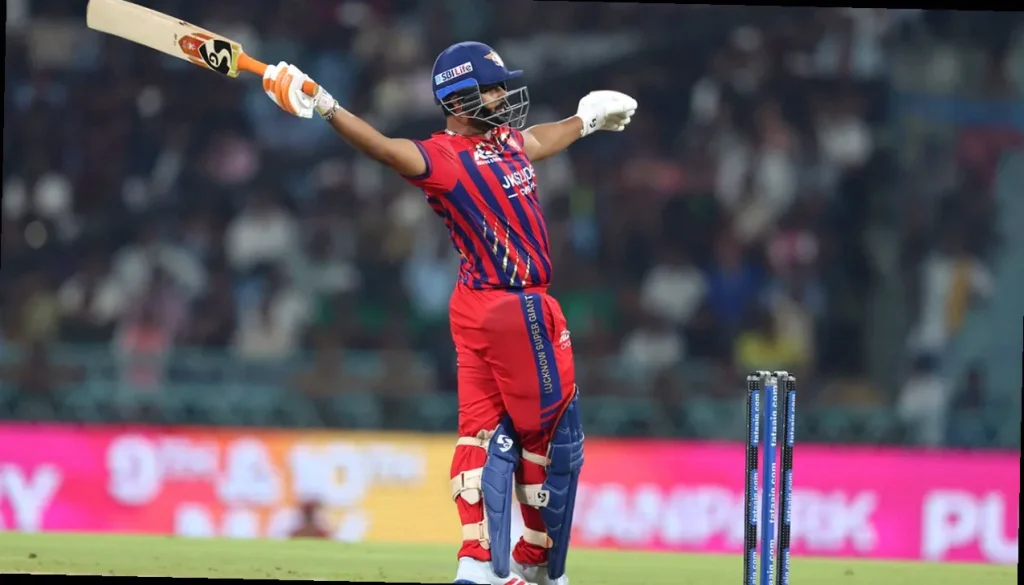
Rishabh Pant has built a reputation on T20 audacity—those audacious scoops that dip and sail, the one-handed hits that defy conventional timing, and the sort of boundary-making that often looks like it belongs to a different sport. While he has managed to bring a touch of that fearless flavour into his Test batting, his T20 form has remained a puzzle. The 10-year IPL veteran has still reached the 400-run mark in a season four separate times, and this year he tried to chase something similar by stirring up the batting order inside Lucknow Super Giants.
After LSG’s defeat to Chennai Super Kings on Sunday, head coach Tom Moody said the franchise deliberately made room for Pant to bat at No. 3. “Well, Rishabh was keen to bat [No.] 3 this year so we afforded him that opportunity,” Moody explained. The logic behind the move was rooted in how the game can open up when a batter gets in early. If Pant arrived within the first six overs, the boundary options could look more like Test cricket—fewer fielders closing space instantly, more value in his shot selection, and a clearer path to turning starts into sustained scoring.
That plan has been in place for much of the season. In eight of Pant’s 11 innings this year, he has walked out at No. 3 or higher. Yet the returns have not matched the ambition: he has made 189 runs at a strike rate of 127. The context has added pressure to the decision, too, because Pant’s preferred position has come at the expense of Nicholas Pooran’s role. Pooran had been LSG’s No. 3 in 2025, when he smashed 524 runs at a strike rate of 196. This IPL, however, Pooran’s output has dipped sharply—he has scored 184 runs at an average of 16.72 and a strike rate of 124.32. Moody pointed to a key reason behind that drop.
He said Pooran arrived with a sore wrist that needed careful management early in the tournament. “Nicky P came into the tournament with a sore wrist that needed some sort of management in the first week or two,” Moody said. “Generally around the world in T20 cricket, Nicky P bats anywhere from [Nos.] 3 to 5 and he’s been effective in all those roles. So I think for him, his season started slowly [was] more to do with his preparation and also the fact that he had a bit of a wrist injury. So we’ve managed that, he’s fine now.”
The debate around Pant’s batting approach has extended beyond team strategy. On ESPNcricinfo’s Time Out show, Ambati Rayudu—who has had considerable success as a middle-order batter in the IPL—questioned the consistency of Pant’s boundary-hitting. Rayudu said Pant can look uncertain about where the next scoring opportunity will come from. “Pant’s four-hitting has been quite questionable,” he stated. “He is not clear as to where he can get a boundary off, which gap, which area. As a middle-order batter, you should have at least four areas that you know you can score boundaries easily. Other than that, only if you have one area or two areas, you’re always waiting for that ball. When you don’t get it, you don’t have many options other than clear the field. And you don’t want to clear the field and get out at that point in time. And that is where I feel he is getting stuck. He needs to really work on [the four-hitting] side of his T20 game.”
There was also a question of whether the extra burden of captaincy—or the weight of being viewed as a marquee Indian player—has affected Pant’s rhythm. Moody’s response was that pressure is simply part of the IPL landscape. “I can’t speak for him about how he’s feeling about the expectation,” he said. “I think every player, particularly [high] profile player, has pressure coming into the IPL. It is the biggest tournament in the world so whether it’s Rishabh Pant or anyone that’s either captain or a senior player in the side that has got decorated careers at that point, they’re under pressure and that’s the beauty of the IPL. It’s whether you can embrace that pressure and rise or you find it difficult to get traction.”
For LSG, the larger issue has been team consistency, particularly with the bat. After 11 matches, they have managed only three wins, and their batting has repeatedly failed to give the kind of foundation required. Moody pointed to the middle order without singling out any one player. “Particularly our middle order hasn’t fired,” he said. “Particularly our middle order hasn’t fired,” without pointing fingers at any single player. “[They haven’t shown] the consistency that’s required to have that success on a consistent basis.” The numbers back that up: LSG’s batting positions from No. 4 to No. 8 are the lowest in the competition in both average (20.66) and strike rate (128.13).
Moody also addressed the impact of losing Wanindu Hasaranga for the entire season, explaining that it forced the team to rethink its balance and role structure well before the campaign had settled. He further elaborated on why LSG still went after Josh Inglis at the auction, even though it was widely known that Inglis would miss half of IPL 2026 due to his wedding. Moody said that while the short-term absence was understood, the long-term value of acquiring Inglis outweighed the risk.
“Well, Josh Inglis we knew was going to be missing, but we felt, and we saw it tonight, that he was too important a player not to pick up at the auction regardless of his availability this year from a long-term point of view,” Moody said. “Hasaranga is more of a significant miss for us because he was a really important key to the puzzle of how we were trying to stack up as a side, having that point of difference with a mystery-type spinner that’s got a great international record, a lot to prove in this tournament as well. And he just offers that little bit of depth and security at number 8, in someone that’s more than capable of playing a role there.”
He added that Hasaranga’s absence hurt the team’s overall structure more than the temporary gaps elsewhere. “So he was probably a bigger miss for the balance of the side. We’ve been battling with that balance ever since,” Moody continued. “What hasn’t helped is obviously our top order and our batting hasn’t fired, so we’re exposed down the back end of the innings.”
