
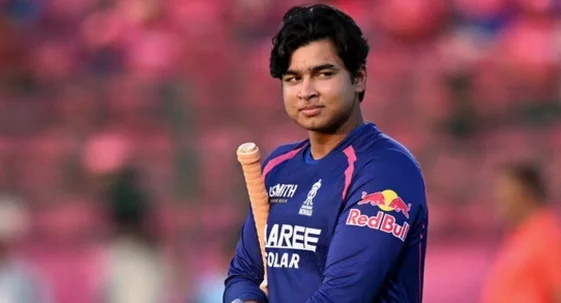
Vaibhav Sooryavanshi’s stock continues to rise game by game in IPL 2026, with the 15-year-old already piling up 440 runs for the Rajasthan Royals across 11 matches. What happens in the Royals’ remaining three league fixtures could be pivotal for their playoff hopes. Yet alongside the runs, one issue has drawn attention: Sooryavanshi’s use as an impact player rather than a regular presence on the field. The franchise’s approach—having the youngster come in to bat instead of taking his place in the eleven for full bowling and fielding duties—has not sat well with some observers.
Earlier, Royals assistant coach Trevor Penny had suggested Sooryavanshi was not fully satisfied with the arrangement, stating that the teenager would rather be out there on the pitch for longer spells. However, the Royals have continued to deploy him primarily as an impact batter. That has prompted fresh comments from former India batter Sanjay Manjrekar, who believes the setup may be limiting the youngster’s development, arguing that fielding is a specialized skill and a crucial part of a modern cricketer’s growth.
As calls grow for Sooryavanshi to be considered for India’s T20I playing XI, Manjrekar offered a clear viewpoint on how the Royals should be thinking about his role. Speaking on the Sporstar Insight Edge Podcast, he said the impact-sub concept should be reconsidered, not just for this case but as a broader principle—because it means players are not being assessed across all facets of the game.
“I’m increasingly thinking that we have to do away with impact sub for this reason as well. Is that what you want to see about Vaibhav Sooryavanshi—just the one side of him? Yeah. Isn’t a cricketer somebody who bats well and fields well as well?” Manjrekar said. “Earlier, we used to talk about Inzamam-ul-Haq mainly for his batting, but you also saw the other side of his as a fielder, and that helped you judge and evaluate the player properly. If you only use someone’s hitting to get him to face a handful of balls—just that—you never see the rest.”
Manjrekar added that while teams may not be demanding all “three dimensions” at once, greater exposure to pressure scenarios in the field is still essential—especially for a young talent. “You want to see him on the field and see what happens and put him under pressure too,” he said. “If he is a great batter but a slight weakness in the field, I’d like to see that tested and exposed. That’s also something we’ve experienced as fielders when you drop a catch—the tension that comes with it, where your batting rhythm and comfort are challenged. You don’t want the highest levels of the game to become that easy.”
He further argued that cricket at the international level expects players to be evaluated through batting, bowling and fielding rather than through one narrow contribution. “A cricketer can’t just be someone who bats or bowls,” he said, stressing that international cricket requires broader competence. In his view, Rajasthan are holding Sooryavanshi back by restricting him to an impact role. “Absolutely—having him play as an impact player is hampering his growth as a fielder. And that is an issue that’s going to be there,” Manjrekar said.
Manjrekar pointed out that even with the impact player rule present, India still managed to win the T20 World Cup, highlighting that the rule does not prevent teams from using players more comprehensively. He referenced Shivam Dube’s tournament campaign—where Dube did not bowl—while still contributing strongly. “India won the T20 World Cup despite the impact player rule being there, despite a guy like Shivam Dube not bowling at all, but still doing well,” Manjrekar noted. “So things are happening. But I believe that a cricketer shouldn’t just come in, do the quick hitting, take a break, and enjoy life. I want it to be more challenging for every player—not only if he is a good bowler and bowls his four overs. I’d like to see him in the field as well.”
Manjrekar also drew attention to how the impact-sub model has been used by established stars, citing Rohit Sharma as another example. In recent times, Rohit has been operating as an impact substitute, and Manjrekar emphasized that this was not a new trend—though the reasoning in 2026 was different. He noted that Rohit’s role as an impact player in 2026 came after he sustained a hamstring injury, which kept him out of five matches for the franchise.
Using Rohit’s recent batting as evidence, Manjrekar argued that the financial and incentive structures tied to short bursts can create a “too easy” model, which he believes is not sustainable for long-term success. “When I saw Rohit Sharma bat in the last game, he got 22 runs in 15 balls. I mean, I’m not somebody who wants to focus too much on how much money he’s getting, but for 15 balls, he’s going to get paid the entire match fees or whatever,” he said. “So when there is easy money to be made and a reward for very little effort, you’ve got to start worrying about that model because that’s never going to be a long-term, successful model.”
