
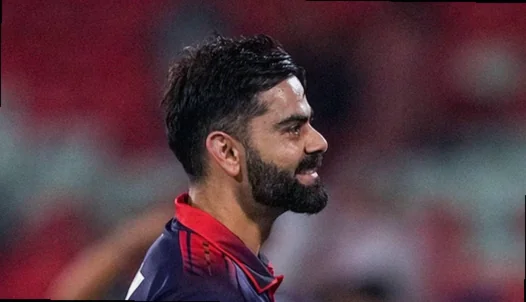
Virat Kohli landed in Raipur with more than just two scores missing from his recent record. For Royal Challengers Bengaluru, it also meant walking into the game with a financial deficit stretching across his prior outings—an impact-model ledger that had pushed his “value” into negative territory after consecutive failures. The pressure was immediate, but Kohli responded in the most decisive way possible: an unbeaten 105 off 60 balls as RCB chased 193 against Kolkata Knight Riders, winning by six wickets and leaving his season account dramatically corrected.
Kohli’s turnaround: from back-to-back ducks to a match-winning rescue
- Kohli arrived in Raipur carrying a two-match monetary hole in RCB’s season ledger.
- In the two games before Raipur, his combined match allocation was ₹3 crore, yet his adjusted output had fallen below zero—creating a total loss of ₹3.15 crore in the model.
- Against KKR, Kohli produced an unbeaten 105 (60 balls) in RCB’s six-wicket win, which the model valued at ₹4.75 crore.
- His match fee was treated as ₹1.50 crore in the same framework, turning his performance into a ₹3.25 crore profit for RCB on the night.
- When the three-game span is viewed together, Kohli shifted from a liability to a marginal positive of ₹10 lakh—effectively erasing the full financial damage from two earlier failures with one innings.
The cricket story begins with the chase itself. RCB were chasing 193, and KKR had laid down a strong base thanks to Angkrish Raghuvanshi’s 71 off 46, Rinku Singh’s 49 off 29, and Cameron Green’s 32 off 24. The target was high enough to test RCB’s batting depth, and the pace of the chase made early hesitation costly. Kohli ensured there was no slow start to invite pressure.
- By the end of the second over, Kohli had moved to 17 off six balls after taking on Vaibhav Arora.
- RCB finished the powerplay at 66/1, with Kohli already on 30 off 14—an opening burst that steadied the chase’s momentum.
- The required run rate stayed manageable, RCB’s batting group avoided panic, and KKR couldn’t use Kohli’s earlier ducks as psychological leverage.
After the early control, Kohli extended the innings into something heavier and more durable. He didn’t treat the start as a brief cameo; he built it. The partnership with Devdutt Padikkal became the platform RCB needed, and Kohli reached his fifty off 32 balls as RCB moved to 101/1 after 10 overs. At that stage, RCB’s equation was 92 required from 60 balls—demanding, but realistic with wickets remaining and set batting.
From there, the innings became damaging for KKR and increasingly rewarding for RCB. Kohli absorbed the chase through the middle overs and then struck at key release points. The model highlights his biggest scoring moment in the 17th over: he cleared Anukul Roy for six, shifting RCB’s requirement from 30 off 21 to 24 off 20. The impact was immediate—KKR’s defensive window narrowed and Kohli’s match value spiked.
The next major blow arrived against Kartik Tyagi. Kohli struck a six at 17.3 overs that reduced the equation from 20 off 16 to 14 off 15. By then, the chase had slipped further away from KKR’s control.
Kohli finished unbeaten on 105 off 60 balls. RCB reached 194/4 in 19.1 overs, sealing the win with five balls to spare. There was no late wobble, no tail-end scramble—he completed the job in full.
Why the recovery looks so large in the numbers
In the model, Kohli’s raw batting impact was recorded at 143.97, with his batting score capped at 95. His manual rating stood at 12, reflecting the innings’ context: RCB chasing 193, Kohli’s century, the unbeaten finish, the immediate backdrop of two prior ducks, and the table pressure weighing on both RCB and KKR. That combination pushed his final impact score to 267.80.
The monetary conversion then followed. The innings translated into ₹4.75 crore of rating-adjusted worth. With a match cost of ₹1.50 crore, Kohli generated a profit of ₹3.25 crore. His recovery percentage for the game was calculated at 316.67%.
The turnaround sharpens further when compared with his previous two outings. Before this century, Kohli had produced two damaging returns. In “Match 50,” his worth was – ₹0.12 crore against a cost of ₹1.50 crore, leading to a loss of ₹1.62 crore. In “Match 54,” his worth was – ₹0.03 crore versus the same cost, resulting in a ₹1.53 crore loss. Combined, those two matches left a total deficit of ₹3.15 crore—Raipur changed that ledger in one stroke.
Looking at the two earlier matches side-by-side with KKR: across the previous pair, Kohli was treated as costing RCB ₹3 crore while returning – ₹0.15 crore in adjusted worth. Against KKR, he cost ₹1.50 crore and returned ₹4.75 crore. Over the three-game block, the total shifted to a cost of ₹4.50 crore and a value of ₹4.60 crore, leaving a net profit of ₹10 lakh.
The essence is straightforward: Kohli had been running below his cost, and this century dragged the entire three-match segment back into profit.
RCB’s need met Kohli’s timing
Timing played a crucial role in the innings’ worth. RCB needed the result to stay positioned at the top of the table, while KKR required the outcome to keep their own playoff campaign alive. Kohli’s hundred created a double effect—protecting RCB’s upward climb and pushing KKR deeper into trouble.
The bowling match-ups also underline how controlled the innings was. Kohli took 36 off 16 balls from Vaibhav Arora, including seven fours. Against Anukul Roy, he made 22 off 13, with the decisive 17th-over six. Versus Kartik Tyagi, Kohli scored 18 off nine balls, including two sixes. He also faced Sunil Narine without getting stuck, striking 13 off 12 against him.
That spread matters: the innings wasn’t built on one lucky over or a single scoring spell. Kohli hit the new ball, managed the middle overs, and closed the chase—so the value came from owning the innings end to end.
For RCB, the recovery was both numerical and competitive. A player with Kohli’s salary burden cannot afford long stretches of under-recovery in this model framework. Each dip widens the gap between cost and return, and the two ducks had already driven his season ledger deep into negative territory. The Raipur century not only repaired the immediate damage, but also softened the broader season narrative.
In short, the two ducks made Kohli’s slot expensive, and the Raipur hundred made it productive again. In this chase, he recovered the full ₹3.15 crore deficit, delivered a ₹4.75 crore performance for RCB, and flipped a damaging three-match run into a net gain.
The century did more than win RCB a game—it restored value to one of their most scrutinised investments.
Method note
The monetary values referenced here come from an impact framework created for this analysis, converting player influence into match-level financial value. Each participant is assigned a match cost based on season valuation and expected availability. The model then factors in batting, bowling, fielding, match context, and a manual performance rating to compute adjusted match worth. Profit or loss is calculated by subtracting match cost from adjusted worth. This is not an official IPL statistic or a salary calculation; it should be treated as model-derived interpretation.
