
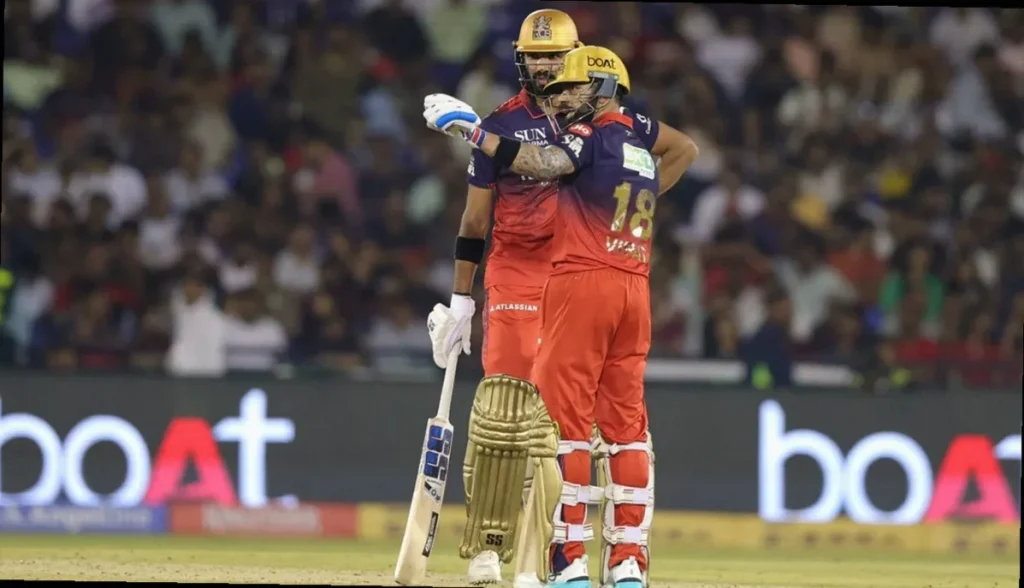
Virat Kohli’s century in Raipur came with a peculiar twist: at the non-striker’s end, even the batter at the other side seemed to lose track of the match for stretches, such was the ease with which Kohli took control. Royal Challengers Bengaluru then completed a comfortable chase of 193 against Kolkata Knight Riders, moving to the top of the IPL 2026 points table.
RCB chase 193 to seize top spot
After Kolkata Knight Riders set a target of 193, RCB reached it in a manner that suggested the plan had been clear from the first over. Devdutt Padikkal, who spoke after the win, highlighted how Kohli’s innings felt almost effortless—so fluent that it made the entire pursuit look like it was running on rails.
- Padikkal said the viewing experience was “incredible,” adding that he felt he had “the best seat in the house.”
- He praised several of Kohli’s shots as “simply remarkable.”
- RCB’s victory over KKR helped them go top of the IPL 2026 points table.
Kohli’s response after two ducks
Kohli walked into the contest after enduring two consecutive ducks, a rarity for the batter who had previously gone through the same situation only once in IPL history. Despite the form setback, the start of the chase reflected confidence rather than hesitation—an approach Padikkal felt was evident even before Kohli faced a ball.
Padikkal said that after watching Kohli train hard on match eve, there was little sign of any mental baggage when the star batter walked out. At the same time, Kohli acknowledged he was carrying some nerves.
- Padikkal noted Kohli had intent “right from the outset” and looked ready to dominate.
- Kohli admitted to feeling “a bit nervous” while coming into the match.
- Padikkal stressed that it was never easy to arrive after two ducks, but Kohli “showed why he is who he is.”
Partnership control and the chase blueprint
Padikkal felt the calmness and calculation behind the chase mattered as much as the runs Kohli scored. He maintained that there was no sense of pressure at any point during their pursuit. In particular, he pointed to the way RCB managed the second-wicket stand, building momentum without forcing the issue.
Padikkal explained that their intention was not focused on simply “anchoring,” but rather on reaching a stage where the rest of the batting order would find itself in a comfortable position.
- RCB put together a second-wicket partnership of 92 runs off 59 balls.
- Padikkal was dismissed for 39 off 27 deliveries.
- At the time of his dismissal, RCB were on 129 for 2 in 13.1 overs.
He added that in the games leading up to this one, RCB had suffered early wicket losses and struggled to stitch partnerships together. Against KKR, he said, once he entered the batting, both he and Kohli discussed making the partnership last as long as possible—then shifting gears from there.
When asked about Kohli’s mindset coming into the match, Padikkal returned to the simple principle that his first IPL captain lived by. He said that the two ducks did not change anything in Kohli’s thinking: cricket careers are built on the understanding that not every game brings runs, and the best players treat every outing as a fresh chance to perform.
Conditions, target philosophy, and Padikkal’s impact rhythm
Padikkal also described how the pitch and outfield played differently from recent struggles. He said the surface was not the same up-and-down track as the one RCB faced against Mumbai Indians, where they had scraped home off the last ball.
He felt the wicket offered something early for the pacers with the new ball, but that the swing reduced quickly, leaving a better batting surface soon after.
- Padikkal believed there was a little help for pacers initially with the new ball.
- He said once the swing died down, the pitch became “a pretty good wicket to bat on.”
- He felt they did not need to fix a rigid target in advance, since anything under 200 is generally chaseable in the modern game.
Padikkal said the plan was straightforward: during the chase, RCB aimed to secure at least one boundary per over, placing them in a strong position as the innings progressed. With RCB’s batting depth, he felt it was important to keep chases comfortable—and he believed they managed that well on the day.
On his role, Padikkal noted that he has often been deployed as the Impact Sub, but RCB have also frequently brought him into the fielding innings after a main bowler is substituted, helping him get match rhythm. He believes this approach is beneficial compared to coming in cold purely to bat.
- Padikkal said fielding before batting “definitely” helps.
- He explained that coming in straight to bat can require time to gauge the pace of the game, the pitch, and the angles.
- He added that being on the field early shows which areas batters are looking to hit and the general tempo of play.
Padikkal concluded that it is better not to arrive “cold” when batting, and he hopes to field more often. He also said the experience of fielding is enjoyable rather than something that should be endured—because sitting and watching can become mundane at times.
