
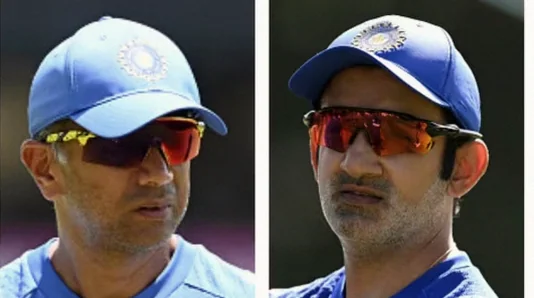
Former India head coach Rahul Dravid has pushed back against Gautam Gambhir’s view of how Indian cricket should move away from “superstar culture.” Gambhir has repeatedly argued that individual milestones should not take centre stage and that collective success must be treated as the priority. Dravid, however, believes the two ideas can’t be separated—individual excellence, in his view, is often the foundation that allows teams to win big.
Dravid vs Gambhir: the debate over “superstar” culture
Dravid explained that the desire to be remembered as a hero or legend in India can’t be achieved without strong performances. He pointed out that in a cricket-mad country like India, players receive both admiration and harsh criticism, with constant attention placed on their every move. In that environment, he argued, becoming a true superstar is tied to doing the right things on the field—helping the team along the way.
- Gautam Gambhir believes individual achievements should be downplayed in favour of team outcomes.
- Rahul Dravid feels individual success acts as a key building block toward bigger team goals.
- Dravid argues heroes are not created without performances, especially in India where scrutiny is relentless.
- He believes a player becomes a legend or superstar only after consistently getting things right and contributing to team victories.
Dravid’s era and the Indian “core” he helped shape
Dravid drew a line back to his own playing days, when Indian cricket was packed with high-profile names. He described himself and peers such as Sachin Tendulkar, Sourav Ganguly, VVS Laxman, and Virender Sehwag as the celebrated group that lifted the national team to remarkable heights. While that side may not have collected as many trophies as the current generation, Dravid still views it as a legendary unit in its own right.
He also stressed that earning superstar status in India requires major effort and personal sacrifice. In other words, he doesn’t see the rise of a star as something that happens automatically—it is earned through consistent execution under pressure.
Test struggles under Gambhir: results, retirements and format juggling
Moving to India’s recent Test performances, Dravid noted that the red-ball side has not been in the best of form during Gambhir’s tenure. He contrasted that with the white-ball team’s progress, highlighting back-to-back tournament triumphs—India winning the Champions Trophy in 2025 and the T20 World Cup in 2026. In the same period, though, the Test team faced severe setbacks.
- White-ball cricket has improved steadily, with India winning the Champions Trophy (2025) and the T20 World Cup (2026).
- In the last two years, India were whitewashed twice at home in Tests.
- The home defeats came as a 3–0 loss to New Zealand in 2024.
- The other whitewash was a 2–0 defeat against South Africa last year.
Dravid maintained that red-ball cricket is still crucial and that players’ passion for it remains strong. He also pointed out that India have been missing several key figures, with major names having recently retired—Rohit, Virat, and Ashwin. He stressed that replacing players of that calibre is not easy.
Despite the current challenges, Dravid expressed confidence that India will remain competitive across formats. He suggested recovery may take time, and he hopes the situation can change as the season progresses.
Red-ball preparation and the modern workload problem
Dravid further explained why the transition between formats has become harder for today’s players. While many cricketers still want to play red-ball cricket and view it as the toughest challenge with deep personal satisfaction when they succeed, the sheer volume of modern cricket can make it difficult to find the balance required for Test preparation.
He argued that players in the current era often don’t get the same amount of time to prepare for red-ball cricket that his generation did. Dravid suggested that the number of formats has increased compared to earlier years, and that difference impacts how much preparation and rhythm players can build before long Test assignments.
- Dravid says passion for red-ball cricket is still present among players.
- He believes the format is widely regarded as the toughest, offering strong personal satisfaction when mastered.
- With white-ball cricket dominating calendars, switching focus to Tests is increasingly difficult.
- Modern players juggle multiple formats and often lack the preparation time for red-ball cricket that earlier generations received.
- Dravid’s view is that because of workload and format volume, current players may struggle to maintain the same balance as before.
On the whole, Dravid’s message ties back to his central disagreement with Gambhir: while team-first thinking is important, individual performances still matter deeply—both for careers and for the team’s ability to deliver, particularly in the demanding world of Test cricket.
