
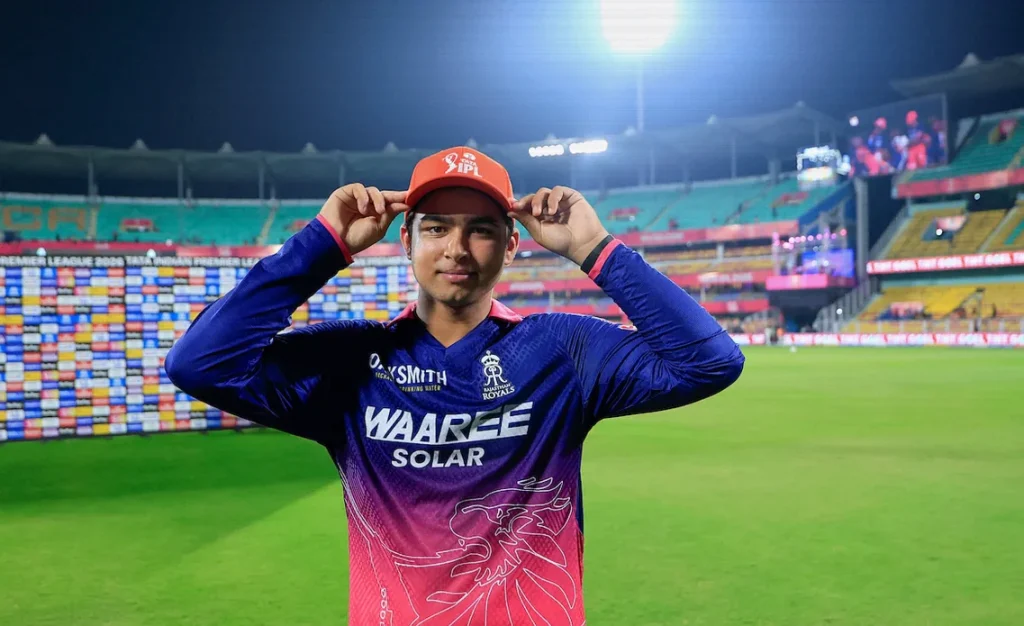
Former Australia captain Aaron Finch has urged India to move carefully when considering an early international outing for IPL sensation Vaibhav Sooryavanshi, arguing that established performers who are already delivering for the national side should be treated with respect even as excitement builds around the 15-year-old. Sooryavanshi has been in striking form during the current IPL season, and his name has also appeared among 35 T20 specialists shortlisted by national selectors as potential candidates for the T20I portion of the Ireland tour in June and July.
Finch suggested that while there could be a case for bringing the youngster into the squad, it should be done at the right moment and without undermining players who are fulfilling roles consistently. “Maybe it’s the right time to introduce him around the group, give him some time, but it’s also really important that you respect the players that are doing the job game in, game out for India,” Finch said during a virtual interaction. “Playing cricket for India is the highest-pressure situation you could possibly face. They’re coming off a World Cup win… these guys have already done it on the biggest stage.”
Continuing his point, Finch said India should only debut Sooryavanshi if conditions justify the step, such as form or fitness giving a clear opportunity. “So I think you still have to respect that and wait for an opportunity to present itself. If there’s form or if there’s fitness issues… why not? Give it a crack. But also just let the kid play, let him continue to learn the game.” Finch added that, if Sooryavanshi does get his debut, he would become India’s youngest senior men’s team player, breaking Sachin Tendulkar’s record—by being only months short of turning 16.
Finch also highlighted that the selection panel is weighing where the debut opportunity might fit best within India’s schedule. The question on the table is whether Sooryavanshi’s introduction could come during the Ireland tour in June, or whether India might consider the trip to Zimbabwe after that, or instead include him during one of the West Indies home T20 matches. The Asian Games in Japan are also listed for September, leaving multiple windows for the selectors to consider.
On Sooryavanshi’s development, Finch described the teenager as someone who absorbs information quickly, both technically and tactically, while still needing time to grow. “He’s an incredibly fast learner, whether it be technically, tactically, but he’s still got so much to learn and I love the fact that he seems to come with different plans a lot of the time. That shows his growth as a player, as such a young person,” Finch said. “That’s a really incredible skill and no doubt that the opportunity will come. But just don’t put too much pressure on the youngster. Just let him play.”
Finch then turned his attention to IPL bowling trends and discussed Punjab Kings pacer Arshdeep Singh, suggesting he has lost some of his ability to bowl inswing deliveries to right-handed batters. However, Finch felt the absence of early breakthroughs does not necessarily signal a major concern at this stage. “Yes, he hasn’t got the power play wickets. To me, that’s a good sign… if Arshdeep isn’t getting power play wickets and they’re still winning games comfortably,” the Australian said.
Finch elaborated that Arshdeep may be relying more on out-swing options than he previously used against right-handers, changing the attacking angle and perhaps the mindset behind his spell. “He’s probably just lost his ability to bowl the inswinger to the right handers as much as what he used to… he was a big swinger of the ball both ways. I feel, he’s probably going more to his outswinger, that’s a bit more of a defensive mindset.” Finch added that a broader team context matters: “But, it’s a good sign if they’re still winning games and your number one trump card still hasn’t fired… that would give me a huge amount of confidence as a captain.”
Finch also assessed Mumbai Indians’ approach with the new ball, arguing that the franchise needs to fine-tune its combination and that Jasprit Bumrah could be positioned more effectively in the middle overs. “I think their new ball bowling is probably something that they would want to get right really quickly… if Trent Boult hasn’t been at his best, he needs to start swinging the ball again… at times, you have to be prepared to fight fire with fire, you might as well attack,” Finch said.
He then explained why Bumrah’s influence remains significant even when his results are not immediately visible, noting that opponents adjust their plans around him. “You think that Bumrah hasn’t been as effective but that also comes down to a real respect that teams have for him … teams identify that his overs are so crucial to the outcome of the game. So they’re almost prepared to take their foot off the gas to just deny Bumrah a wicket because once he gets access to a new batter, he’s so successful.”
Finch said he would like Bumrah to have a more direct role with the new ball, but suggested that rotating options—and potentially taking him out of the power play—might help create a bigger impact during the middle overs. “I’d love to see Bumrah with the new ball, but maybe it’s time to say we’ll just keep throwing different options at teams and take him outside the power play to really try and have a big impact in those middle overs where we know if you get wickets, you stem the runs right towards the back end.”
Finch then raised concerns about Kolkata Knight Riders’ structure, pointing out that the team has struggled for results. Kolkata Knight Riders are yet to win a match and are sitting at the bottom after four defeats from five games. Finch felt the issue is not about dramatic overhaul but rather about getting roles and planning aligned. “It’s not about wholesale changes, it’s about just tinkering with the roles There’s just been a bit too much confusion on what the best structure is… maybe, get a youngster in with some fresh energy,” Finch said.
He also discussed the usage of Green, who was brought in for a record fee of Rs 25.20 crore. Green has produced 56 runs and taken one wicket across five matches, and Finch suggested that his best fit could be as an opener who then bowls through the middle overs. “I think his best spot would be to open and then bowl through the middle, there hasn’t been a huge amount of T20 cricket so he’s still searching for the best recipe…,” Finch said. “Is he underutilized? Maybe slightly but they were focused on using him and it just hasn’t worked out so far.”
Finch also reflected on leadership in T20 cricket, arguing that the “art of captaincy” is being diluted due to the Impact Player rule, which removes tactical trade-offs that used to define decision-making. “The impact sub, I don’t mind it, what I would like to see is teams have to name their 11 before the toss. It provides just too many ways that a team can fix up the holes…,” he said.
He added that a major part of T20 leadership involves balancing bowling and batting options in advance—often choosing between five specialist bowlers and a larger number of batters. “One big part of T20 cricket is captaincy, you generally have to make a decision whether you’re going with five frontline bowlers and six batters, so now you don’t really have that … I think the art of captaincy… is lost slightly.”
Even so, Finch acknowledged that the rule change may still benefit the competition overall, especially for teams that carry genuine all-rounders. “But overall, it’s still good for the game, teams that have got genuine all-rounders seem to be able to bat to number eight, have six bowling options…so the impact of the all-rounders is probably as strong as it has been.”
