
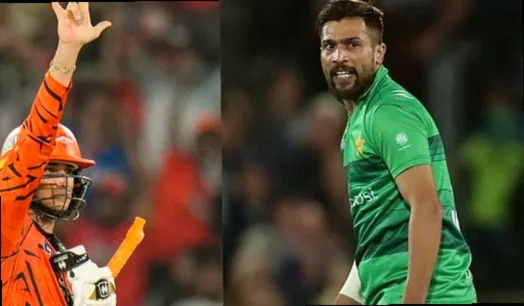
Not long after the T20 World Cup earlier this year, former Pakistan quick Mohammad Amir found himself in the centre of a controversy that followed him onto the public radar. Once linked to a notorious match-fixing scandal and later banned, Amir publicly dismissed India batter Abhishek Sharma as nothing more than a “slog hitter,” insisting he lacked sound batting credentials and arguing that a bowler could dominate him if the right plans were executed. His sharply worded comments landed during a moment when Abhishek’s returns with the bat were also under pressure, turning the debate into a talking point across cricketing circles on both sides of the border.
However, Abhishek did not take long to answer. In the tournament’s key stages, he produced two innings that mattered immensely. Against Zimbabwe, when India required a big win to boost their net run-rate, the left-hander struck 55 off 30 balls and helped set up a total of 256—marking the second-highest score ever recorded in T20 World Cup history. India got the result they needed and, as a result, secured qualification for the semi-finals.
Then came the title match, where the stakes were at their highest. Abhishek raised his tempo again, smashing 52 from just 21 deliveries as India posted 255. The final ended with a comfortable 96-run victory over New Zealand, allowing India to defend their crown successfully. Amir’s narrative attempt at undermining Abhishek was effectively crushed after those back-to-back performances, with the batter’s runs leaving little room for further argument.
Yet for Abhishek, the “lesson” has continued into the IPL. Currently representing Sunrisers Hyderabad (SRH), he has been putting on performances that make Amir’s earlier comments feel increasingly irrelevant. SRH have played seven matches so far, and in four of them Abhishek has delivered standout contributions—one century, two half-centuries, and a best output of 48 in other contexts—numbers that hardly fit the label of a player who can only contribute through brute force. The contrast between Amir’s criticism and Abhishek’s consistency has become the storyline of this phase.
A couple of days ago, Abhishek added yet another statement innings against Delhi Capitals. He went on a destructive run, scoring 135 not out off 68 balls. With Delhi finishing on a losing total of 242, they were never able to chase down SRH’s batting effort, and Abhishek’s 135 came with an aggressive balance of power and timing—10 sixes and 10 fours during a long, boundary-heavy spell. In T20 terms, it was a century built largely through big hits: 100 runs driven by boundaries rather than merely surviving the contest.
While Abhishek has been thriving in the IPL, Amir’s IPL-era spotlight has shifted toward his current assignment in the Pakistan Super League (PSL). Playing for Rawalpindiz, Amir’s side has endured a miserable run, losing all eight of its matches so far. The former bowler has had moments of quality, but with the team struggling so badly, he has not been able to spark the kind of turnaround that keeps attention on the individual. In more than one game, Rawalpindiz was forced to contend with opposition batters who made the most of the chances they were given.
For many fans, the situation has started to look like a mix of timing and karma. They point to Amir’s earlier gloating—especially when India were not at their most convincing in the opening stretch of the T20 World Cup. Amir repeatedly suggested that India would not reach the semi-finals, and after India’s first Super 8s game ended in a heavy defeat to South Africa, his celebration appeared to reach a peak. The image of him grinning broadly and showing off his teeth stayed with supporters in India, and it has resurfaced every time his comments come back into discussion.
Just as those remarks seemed to linger, Abhishek’s reply has also become hard to ignore. The way his recent innings have unfolded feels like a direct rebuttal: it is not simply about scoring runs, but about doing so in ways that keep the earlier criticism in the spotlight. Every time Abhishek produces an innings with real impact, Amir and the earlier “slog hitter” narrative return to the conversation, turning the debate into something more personal and more memorable for fans. In cricket, nobody forgets—especially when the scoreboard keeps providing the comeback.
