
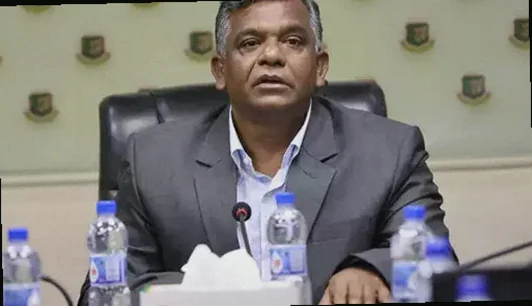
Aminul Islam, a former president of the Bangladesh Cricket Board (BCB), has reacted sharply to the National Sports Council’s (NSC) move to dissolve the Aminul-led board and replace it with an ad hoc structure. In his statement, Aminul suggested the NSC’s inquiry into the board’s leadership was driven by improper intent and was aimed at removing him from office, rather than serving any legitimate legal purpose. He said the NSC’s actions followed a probe that concluded he was guilty of corruption connected to the most recent election cycle that had brought him to the top of the BCB.
Following that probe, the NSC dissolved the Aminul-led board and set up an 11-member ad hoc committee chaired by Tamim Iqbal, who Aminul said is now focused on rebuilding the BCB’s credibility. Aminul’s response, however, was direct and forceful, arguing that the NSC’s findings should not be treated as valid. “I unequivocally state that the report submitted on April 5, 2026, is a defective, whimsical, and legally untenable document that holds no standing in the eyes of the law or the constitution of the BCB,” he said.
Aminul also denied every allegation tied to the BCB elections held on October 6, 2025. He rejected claims of corruption, manipulation, or misuse of power, insisting the election was handled in an open and lawful manner by an Election Commission consisting of three members. According to him, this commission was established by the BCB on September 6, 2025, and the election process followed the BCB’s constitution strictly.
He further argued that objections raised during the lead-up to the vote—including issues involving the 15 clubs and Tamim Iqbal’s role as councillor—were heard and settled through quasi-judicial proceedings on September 24 and 25, 2025. Aminul said attempts to portray the process as “election fixing” were misleading and motivated by political ambitions, adding that such a narrative was designed to destabilise the board. He maintained the election went ahead exactly as scheduled on October 6, 2025, in line with an announcement he made in early September.
Aminul then challenged the NSC’s jurisdiction, arguing that the body had no authority to investigate a finished electoral process within an autonomous, self-governing federation like the BCB. He claimed that the removal of the elected leadership based on the NSC’s report indicated government interference, pointing to the principle that member boards under the ICC framework must operate without political intrusion. “The National Sports Council (NSC) has absolutely no authority to investigate a closed, concluded electoral process of an autonomous, self-governing federation like the BCB. Under the ICC’s constitution, member boards must operate free from government interference. The NSC’s probe, initiated by State Minister Aminul Haque, is a politically driven vendetta, not a legal process. The report is quo non judicibus (void for lack of jurisdiction),” Aminul said.
He described the dissolution of the elected board and the creation of the “Ad-hoc Committee” under Tamim Iqbal as an unconstitutional step. In his view, the move amounts to a “constitutional coup,” arguing it is illegal and beyond the powers allowed under the BCB constitution, while also violating ICC rules related to government interference. Aminul insisted the NSC cannot dissolve an elected body unless extremely limited circumstances—specified in the NSC Ordinance—are met, and he said none of those conditions apply. He also called the ad hoc committee a “sham” and said the board does not recognise its authority, adding that he has urged the ICC to intervene so that the illegal body is not allowed to function.
Aminul’s comments went beyond the immediate legal argument, widening into concerns about governance and confidence in Bangladeshi cricket. He claimed that when authorities disregard popular votes and the rule of law, it can push the sport into a period where trust becomes difficult to restore. He warned the action could damage Bangladesh cricket’s international standing, questioning how investors would respond to uncertainty and how hosting rights could be affected. He said the international community must recognise what he described as the government “holding a knife to the throat” of cricket’s autonomy in the country.
He also linked the controversy to broader developmental risks, arguing that the instability could harm player development and weaken the pathway for youth cricketers. Aminul suggested that while political issues dominate the discussion, the future for U-19 players remains uncertain. He cited that GDP growth has slowed to 3% and industrial output has declined, asking how political intervention in sports could support the economy or benefit young people.
In closing, Aminul called for immediate intervention from the ICC to safeguard the sanctity of the elected board, reiterating that the ad hoc committee is illegal and that the probe report itself is illegal. He argued that the legitimacy of the October 6, 2025 election—conducted by a neutral, three-member commission including a Supreme Court advocate and a senior CID officer—cannot be questioned after the fact by any government body. “We call upon the International Cricket Council (ICC) to intervene immediately to protect the sanctity of our elected board. The ‘Ad-hoc Committee’ is illegal. The probe report is illegal. The legitimacy of the October 6, 2025 election conducted by a neutral, three-member commission including a Supreme Court advocate and a senior CID officer cannot be questioned by any government body after the fact,” he concluded.
