
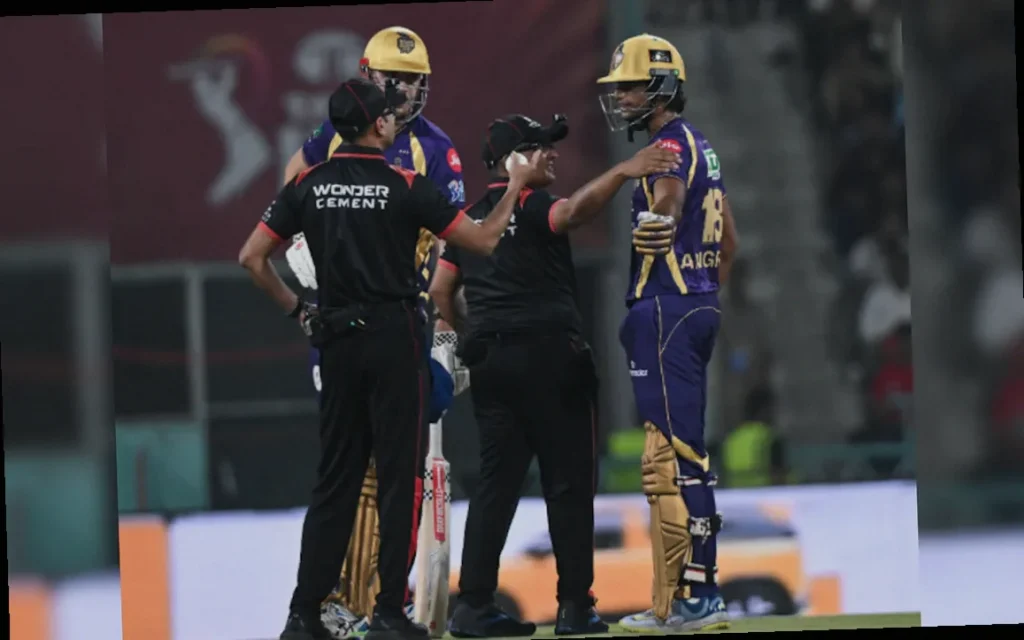
In one of the rarest ways to lose a wicket in cricket, Kolkata Knight Riders’ Angkrish Raghuvanshi was ruled out for obstructing the field during their Indian Premier League match against Lucknow Super Giants on Sunday. The 21-year-old, dismissed for 9, became only the fourth batter in IPL history—and the first three were all Indian batters—to be given out in this manner. Raghuvanshi disagreed with the verdict, arguing with the on-field officials, but ultimately had to accept the decision. KKR were left in trouble after the call, slipping to 27 for three in the fifth over.
How Raghuvanshi’s dismissal unfolded
The turning point came on the last ball of the fifth over, bowled by Prince Yadav. Raghuvanshi nudged the ball towards mid-on and set off for a run. After a few strides, Cameron Green told him to go back.
- As Raghuvanshi attempted to turn, he stepped into the “danger zone” on the pitch.
- That movement brought him in the line of Mohammed Shami’s throw.
- Raghuvanshi’s body was struck as he dived in an attempt to reach his crease.
Third umpire Rohit Pandit reviewed the incident and upheld Shami and LSG’s appeal. The batter was declared out for obstructing the field. The decision triggered visible frustration on the KKR side, with head coach Abhishek Nayar seen arguing with the fourth umpire near the dugout as Raghuvanshi threw his helmet in anger.
What the obstructing-the-field law says
The incident drew attention to the specific wording of the rule. The framework, as used in match officiating, is built around whether a batsman—while running between wickets—has made a significant change in direction without a probable reason and in doing so has interfered with a fielder’s attempt to run-out.
- If an umpire believes the batter has significantly altered his path and effectively obstructed a fielder’s chance to complete a run-out, the batsman should be given out after an appeal.
- The rule does not depend on whether a run-out would have happened or not.
- If the change of direction involves the batter crossing the pitch, the relevant clause on that scenario—Clause 41.14—also comes into play.
- It also references paragraph 2.2 of Appendix D for additional clarification.
Previous IPL dismissals for obstructing the field
IPL history has seen only a small number of such decisions, making this one stand out even more. The first time the “obstructing the field” dismissal was recorded came in IPL 2013.
- IPL 2013: Yusuf Pathan was given out for obstructing the field while batting for KKR against Mumbai Indians on 72.
- After successfully defending a yorker in the blockhole from Wayne Parnell, Pathan was judged to have prevented Parnell from collecting the ball as he ran alongside it towards the non-striker’s end.
The second instance arrived in IPL 2019, in the Eliminator, involving Delhi Capitals.
- IPL 2019 Eliminator: Amit Mishra was dismissed for obstructing the field against Sunrisers Hyderabad while playing for Delhi Capitals.
- With two runs required off the last three balls, Mishra missed a delivery from Khaleel Ahmed and set off for a run.
- Wriddhiman Saha gathered the ball and threw it to the bowler at mid-pitch.
- Khaleel attempted a shy at the stumps, but struck Mishra, who was ruled to have changed the course of his run.
- Delhi Capitals went on to win the thriller by two wickets.
The third batter to be dismissed in this fashion in IPL came during IPL 2024.
- IPL 2024: Ravindra Jadeja was ruled out for obstructing the field while playing for Chennai Super Kings against Rajasthan Royals.
- He cut a delivery from Avesh Khan to third man and completed a single.
- When attempting a second run, Ruturaj Gaikwad signalled him to turn back.
- Sanju Samson’s throw then found Jadeja coming in between the ball and the stumps.
