
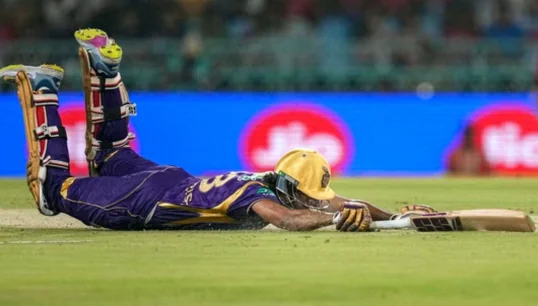
Former International Cricket Council (ICC) umpire Anil Chaudhury has weighed in on the controversy surrounding Angkrish Raghuvanshi’s dismissal during Kolkata Knight Riders’ IPL 2026 clash with Lucknow Super Giants at the Ekana Stadium on Monday. The batter was later fined by the BCCI after publicly reacting angrily on the field to the decision.
Raghuvanshi was ruled out for obstructing the field after Mohammed Shami’s throw struck him as he dived in an attempt to reach the crease. Lucknow’s side appealed, and the on-field officials sent the matter to the third umpire for a review. Rohan Pandit reviewed the footage and concluded that Raghuvanshi had altered his running line while backing up to the striker’s end, after Cameron Green had refused him the single, which led to the obstruction call.
IPL 2026 Playing Conditions, Clause 37.1.4, states: “If a batter, in running between the wickets, significantly changes direction without probable cause and thereby obstructs a fielder’s attempt to effect a run out, the batter should, on appeal, be given out. It is irrelevant whether a run out would have occurred.”
While the rule is clear on significant, unjustified direction changes that obstruct a fielder’s attempt, Chaudhury argued that the review should have focused more sharply on intent. Speaking on his social media account, he said Pandit needed to verify whether Raghuvanshi’s change in movement was deliberate.
“There are a couple of important things. Number one, change in direction. But simply a change in direction does not mean the batter is out. It is about ‘willful’ change in direction. This must be deliberate, because there are many cases where the batter runs straight without changing direction yet still obstructs the field. You have to look at intent, the impact and whether it was deliberate. The batsman ran, stopped and turned, and he went in that direction using the same momentum. The batsman has very little time. For a batter to run in a straight line, that’s not possible under pressure,” Chaudhury explained.
On the question of probable cause, Chaudhury accepted that Raghuvanshi likely watched the ball—since he had played the shot in front of him, something he noted is instinctive for a batter. However, he maintained that at the moment of diving, Raghuvanshi would not have been tracking the incoming throw. “When playing in front, they often see the ball. Also, keep in mind that when he dived into the crease, he wasn’t watching the ball,” he added.
Out or not out, Chaudhury suggested that such decisions should be judged with a real-time lens rather than relying solely on replay angles. He said the obstruction offence often appears harsher on video, and that the live view provides a more accurate sense of what the batter did and why. “I think it’s beneficial to watch in real time. An obstruction in the field replay will always make you feel it was out. You will get a better sense of it watching it in real time. It’s an opinion call. TV umpires don’t even have the help of soft calls these days. I personally felt ‘not out’ was a better call,” he concluded.
