
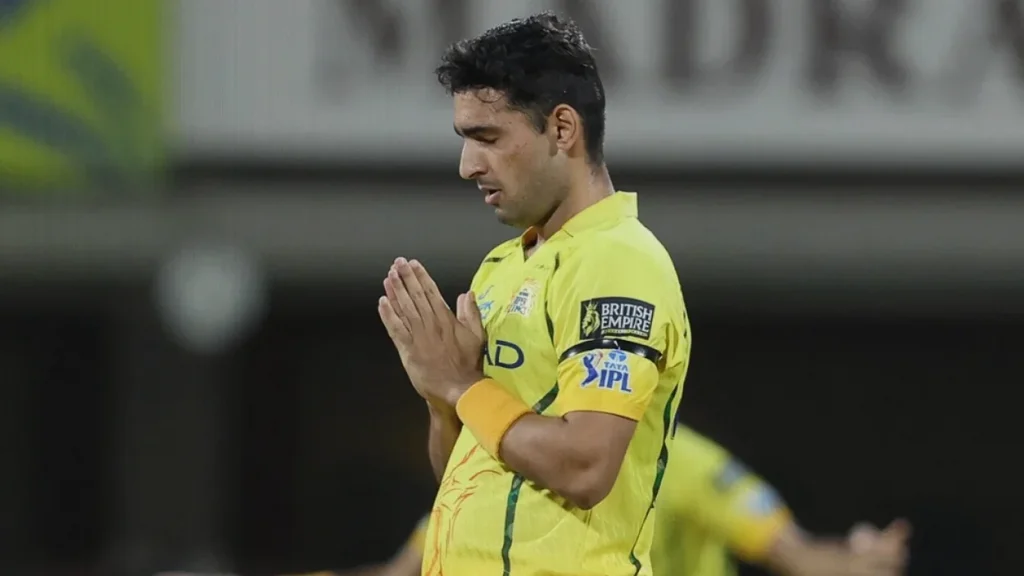
Chennai Super Kings captain Ruturaj Gaikwad sounded upbeat minutes after CSK’s match against Delhi Capitals ended, even as Anshul Kamboj admitted it was not his day. The seamer had conceded 49 runs across four overs without taking a wicket, and Gaikwad noted that the bowler is already frustrated and keen to bounce back quickly.
Kamboj has built a reputation in IPL 2026 for unsettling right-handed batters with an around-the-wicket plan, but Tuesday offered a clear reminder that batters can adapt. Ashutosh Sharma countered the angle by stepping across, lowering his stance, and meeting the ball on the full—forcing the question now facing CSK’s right-arm option: can Kamboj find an answer to that counter?
Quick facts
- Anshul Kamboj conceded 49 runs in four overs versus Delhi Capitals and finished wicketless.
- He sits atop the Purple Cap standings with 17 wickets, level with Bhuvneshwar Kumar.
- Ten of Kamboj’s wickets have come between overs 15 and 20, with no one taking more in that phase.
- CSK’s bowling has the second-best economy rate in IPL 2026 at 9.02.
- Simons said the bowling group has focused on clarity and accepting even “hit for six” deliveries as part of the right plan.
Kamboj’s wicket haul is concentrated where games often tilt: ten of his 17 scalps have arrived between overs 15 and 20. He is also still early in his IPL journey, in only his third season, yet he is delivering a role typically expected from established campaigners such as Bhuvneshwar Kumar, Jasprit Bumrah and Jofra Archer.
For all the spotlight that usually follows MS Dhoni during CSK matches and training, Kamboj drew a different kind of attention in pre-season. Almost the entire CSK support group, including head coach Stephen Fleming, bowling coach Eric Simons and assistant bowling coach S Sriram, gathered around as they watched him land wide yorkers repeatedly from around the wicket.
New-ball beginnings, around-the-wicket evolution
Kamboj’s background traces back to swing bowling for Haryana in conditions that supported movement, and his earliest identity in T20 cricket was as a new-ball operator. That profile carried into IPL 2025 as well, when CSK used him as a powerplay specialist—126 of his 129 deliveries came in the first phase of innings.
Before IPL 2026, Kamboj had bowled only six balls from around the wicket in the league. This season, the numbers tell a different story: he has already delivered 75 balls from that angle, with all of them coming between overs 15 and 20. The shift has made him a key face of a wider trend against right-hand batters, and it has been delivered with unexpected execution—one of the reasons CSK, previously viewed as having a less potent bowling unit, now own the second-best economy rate in IPL 2026 at 9.02.
Eric Simons, speaking at a press conference in Delhi, described the thinking behind CSK’s plans as a response to the “chaos” that batting has become. He said the bowling unit spent a lot of time aligning on what they wanted to do, deliberately reducing over-reliance on too many variations, so the bowlers step onto the field with clarity. His point was simple: if a good ball is struck for six, it can still be the correct ball to follow up with next.
Simons also outlined how “Project Kamboj” started at CSK nets and then developed further during the most recent domestic season. In the 2025-26 Syed Mushtaq Ali Trophy, Kamboj was entrusted with a top-to-tail responsibility and finished with 21 wickets as his team reached the final. Only Jharkhand’s Sushant Mishra and Rajasthan’s Ashok Sharma—both with 22—took more wickets than Kamboj.
“It started last year” — CSK’s bowling blueprint
Simons said what fans see now is not something limited to the current campaign. “Anshul, what you see today is not this season… it started last year,” he explained, adding that Kamboj worked through the domestic stretch on different angles, his approach to the crease, and—specifically—being more accurate with yorkers.
He noted that the around-the-wicket work is now well established, and that Kamboj has already shown the ability to take wickets while also tightening the run-rate. But the coach framed the bigger difference as professionalism—how Kamboj prepares, trains, and understands the matchups. In modern T20 cricket, Simons argued, a bowler must be clear about what he wants to do, and Kamboj is clear about his tactics and the field he sets.
CSK’s history with death overs offers a telling contrast. In earlier seasons, the franchise had one of the world’s premier finishers wearing No.47 on the yellow jersey, using dipping yorkers to make batters look uncomfortable. Now, CSK have a rising bowler in No.47, taking on the heavy lifting for a younger attack during the most demanding overs.
