
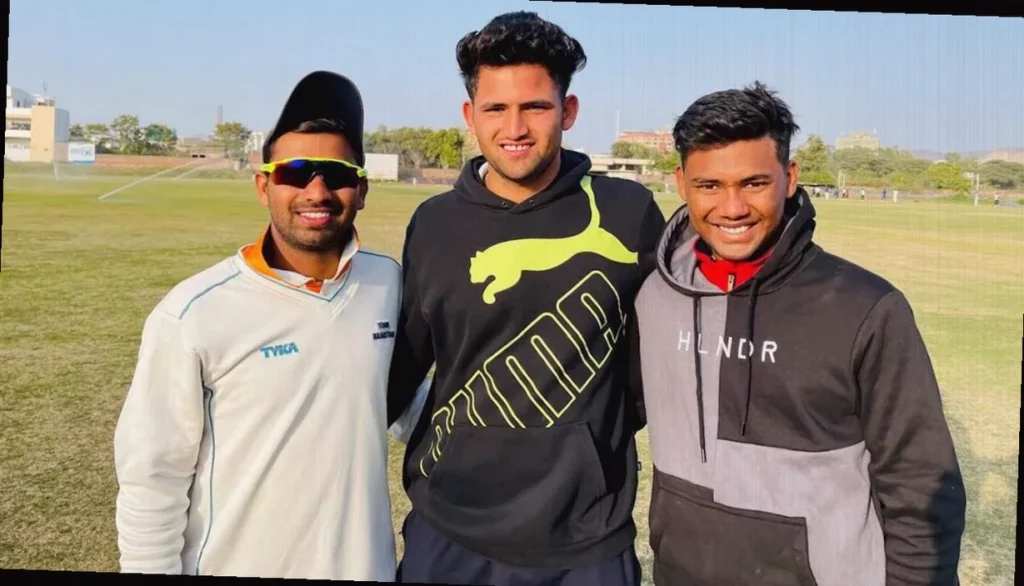
A striking cutout of Akash Singh and Ashok Sharma greets visitors as they drive towards Hathod, a Jaipur neighbourhood that has shifted from quiet lanes to a steady stream of under-construction apartments and new commercial spaces.
From a school ground to a player pipeline
The Aravali Cricket Club traces its serious beginnings to 2018, when Akash and Ashok first started taking cricket pursuits seriously in the area. After the pandemic, Mukul Choudhary and Kartik Sharma also joined the academy. By 2026, the four names stand as living proof of how the Aravali setup has quietly developed into a route that connects Rajasthan talent with the IPL.
That modern pathway was not built overnight. The academy had started back in 2001 at a smaller school ground, driven by a passion project from former Rajasthan batter Vivek Yadav. However, it was only in 2012—after consecutive Ranji Trophy titles with Rajasthan and following a two-season spell with the Delhi Daredevils—that Yadav gained the backing needed to give his passion a more solid structure.
In 2018, the academy faced another turning point when the land on which it operated ran low on groundwater. That forced a relocation, and the club eventually found its way to Hathod. Over time, it expanded into a fuller training base featuring two full-sized cricket grounds, more than a dozen practice nets, and hostel arrangements for 300 trainees.
Vivek’s legacy and Vikas stepping in
Vivek Yadav’s long-term ambition was to ensure respect—izzat—for the region’s cricket talent. After he passed away in 2021, his younger brother, Vikas, took over the academy and has continued pushing for it to remain a strong training hub for young aspirants.
“Seeing four of our players in the IPL would’ve made bhai (brother) proud,” Vikas said. “Even though he had been part of Delhi Daredevils for two seasons, he couldn’t get on the field, but he was intensely passionate about developing youngsters.
“But even after he passed [due to cancer and Covid in 2021], none of the boys left. Akash, Ashok, Mukul…they were already here, and they stayed.”
For Vikas and the Aravali Cricket Club, that staying power is what defines the culture—different arrival dates, the same commitment, and the same belief in love and care as a daily practice.
Akash, Ashok, Mukul and Kartik: how the academy shaped them
Akash, now part of Lucknow Super Giants (LSG), was one of the earliest arrivals. His progress began through the state’s age-group system, then moved to the India Under-19 setup, and finally led to the IPL. One of his best-known moments came when he was included in Chennai Super Kings’ title-winning squad in 2023.
Ashok joined the academy in 2018, arriving with raw pace and quick movement off the bat—often unsettling batters as they struggled to stay set. Vikas explained that they did not have modern measurement tools at the time. “We didn’t have a speed gun, nothing to measure,” he said. “But you could see he was fast.”
A key shift came when a link to the Red Bull Speedster appeared on the academy’s WhatsApp group. Ashok participated and won the competition in 2023, catching the attention of both Kolkata Knight Riders (KKR) and Rajasthan Royals. He has since broken through for Gujarat Titans, and his recent form included finishing as one of the leading wicket-takers in the 2025-26 Syed Mushtaq Ali Trophy.
Even this season, Ashok’s pace drew attention; he reportedly reached 154.7kph on the speed guns.
Vikas also recalled the emotion surrounding Ashok’s breakthrough moment. “That day, so many people came,” he said. “Kids who had left came back and restarted their journey with us.”
Long commutes and hostel rooms built for training
Ashok first arrived as a 15-year-old. He would travel almost 40km each way daily from his village, Rampura, to train at the academy. Kartik and Akash came from Bharatpur, while Mukul Choudhary travelled from Jhunjunu.
To support players making such long journeys, Vikas gradually built hostel rooms inside the set-up. These rooms are functional, designed mainly to let players rest after demanding sessions.
As Vikas guided a tour of the facilities, he pointed out the practical realities of Hathod’s heat. “It’s very hot here,” he said. “Rooms with tin sheds [due to construction restrictions on a leased land], the heat radiates terribly in the summers. So we’ve installed desert coolers in each of the rooms.”
The need for these tin-roofed rooms grew as trainee numbers surged. In 2021, Akash and Ashok were among the few accommodated in a nearby apartment complex.
Vikas described how the academy’s support system evolved once the players started earning in the IPL. “Back then, we used to partially bear the cost of rentals, but ever since these boys broke into the IPL, they fully take care of the rent,” he said. “Ashok still stays there when he comes for training. Mukul used to stay there, but his father was very particular about his diet.
“So they rented an apartment of their own for the family to stay, so that Mukul didn’t lack that emotional support and could fulfil his dietary needs. Kartik and Akash stay here whenever he trains here.”
Coaching ideas, match moments and the rise of the age-group focus
Aravali’s success, Vikas believes, has often come from doing things differently. Vivek Yadav’s view was that players from this region had to work harder than most to be noticed, partly because of Rajasthan’s fractured system and administrative issues.
Vikas has kept that mindset intact. He used Mukul as an example to explain how the academy protects player identity. “We tried to make him play along the ground,” Vikas admitted. “But his focus was, ‘I’ll hit sixes.’ So we told coaches he has the conviction, so don’t tamper with his style.”
That faith was rewarded when the world caught glimpses of Mukul’s impact. He delivered a sensational performance against KKR at Eden Gardens, smashing an unbeaten 27-ball 54 to help seal an incredible final-over win for LSG.
“If he has to be here at 9am, he’ll be here,” Vikas said. “He’ll hit 100 sixes in practice if he wants.”
Kartik’s path and the “slow start” conversation
Kartik’s journey took a different shape. After being dropped from the age-group setup for two seasons in a row, he joined Aravali in 2021 and immediately made his presence felt.
His IPL price tag—14.2 crore—has become a major talking point in recent conversations, with some linking it to a slower start in IPL 2026. Yet Vikas insisted the investment story began long before that deal. “His father installed a bowling machine at home so that he could train,” he said.
Kartik developed quickly and soon became one of the standout performers. Between 2022 and 2025, Aravali teams either won or reached the finals of most Jaipur District Cricket Association (JDCA) competitions. Those included the KN Rungta Trophy, a tournament that feeds Rajasthan’s age-group pipeline.
Training numbers, facilities under pressure, and expectations rising
Vikas places his focus firmly on the age-groups. At present, around 250 to 300 kids train at the academy. To handle the volume, bamboo nets have been added, and the hostel is expanding.
Growth has also brought new pressures: water management, space constraints, and rising expectations as the standard of output increases. “These four players doing so well has increased the pressure on us, to live up to the standards,” Vikas said. “We have to keep improving. Have nets, get space, more rooms.”
He also described the intensity of attention after Mukul’s Eden Gardens knock. “The day Mukul played that knock against KKR, and word began to go around he’s from Aravali club, my phone and his father’s phone didn’t stop ringing. I had to switch it off for a bit.”
Continuing the dream beyond four IPL players
Inside Aravali, the four IPL players are still treated as bhaiyya—not as distant stars. They share flats, distribute match tickets to younger kids, and remain part of the same ecosystem that shaped their own development.
“For the world, they may be big players,” Vikas said. “For us, they are the same. But we don’t want to stop with just four. Why not six?
“Watch out now for Kartik’s younger brother, Anmol Sharma, also. He’s also a six-hitter. He’s now beginning to come through the age-groups in Rajasthan.”
For now, the story brings everything back to Hathod—the tin-roofed rooms, the shared flats, and long training days through Rajasthan’s harsh summer. For every Akash, Ashok, Mukul, or Kartik, there are hundreds more still chasing the same road, walking past those cutouts and hoping someone will eventually look up and see their own future one day.
