
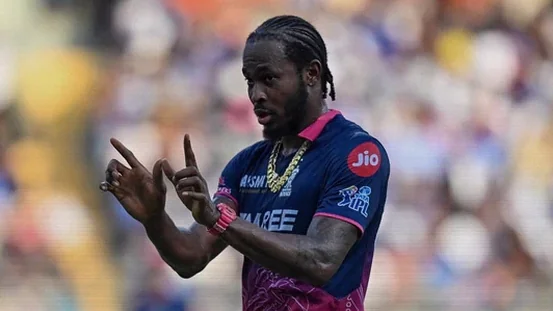
Foreign stars in the Indian Premier League often don’t get the spotlight they deserve, and that’s largely because the tournament naturally leans toward Indian performers—whether they’re long-established match-winners or newcomers grabbing their first big moments. Yet every so often, a player’s impact is so substantial that it becomes hard to ignore. Jofra Archer has been one of those defining forces this season, producing a haul of 21 wickets in 14 matches. By his own standards his economy has hovered around the nine mark, but the bigger story has been his knack for taking wickets, and doing it at the most dangerous time for opponents. Time and again, he has struck in the Powerplay, and on Sunday at the Wankhede Stadium he once again broke through in the first six overs—removing Mumbai Indians batters Rohit Sharma and Naman Dhir.
Archer’s role isn’t a simple one. He’s an out-and-out pace bowler, and in India’s heat the job becomes even more demanding—having to hit the 145 km/h mark and still maintain control ball after ball is no easy feat. This is where his attitude stands out: he consistently delivers without blinking, and that mindset alone makes him such a valuable asset for Rajasthan Royals. Against Mumbai, Archer’s influence wasn’t limited to bowling either; he also delivered the most crucial batting spell when his team needed it most.
Rajasthan’s chase had turned uneasy, with the side wobbling at 119/5 in the 13th over when Archer walked in alongside South African batter Donovan Ferreira. The match situation demanded composure, and Archer showed he understood exactly what was required. The early phase of his innings made the intention obvious—he wanted to keep Ferreira on strike, and he did so even after being promoted ahead of a far more seasoned option in Ravindra Jadeja. There was a clear plan being followed. In his opening six deliveries, Archer managed only four runs, but once Ferreira departed in the 16th over, Archer dropped the restraint and took the attack to the bowlers.
By the time the Englishman was dismissed in the 18th over, he had hammered 32 runs off 15 balls, and Rajasthan’s momentum improved dramatically to reach 175/8. The visitors then pushed on to post 205, and Archer’s efforts didn’t stop at the batting crease. Back with the ball, he returned to the Powerplay and delivered a pressure spell of three overs, conceding just 14 runs. It was the kind of spell that suffocated the Mumbai batting unit and set the tone for the contest. When the time came to bowl his final over, Archer picked up right where he left off.
At that stage, Mumbai required 59 runs from 30 balls, but Archer restricted them further—allowing just three runs in the over. More importantly, he also removed Hardik Pandya, a wicket that swung the contest back toward Rajasthan and kept the game alive for them. In total, Archer finished with 12 dot balls, a stat that underlines the control and discipline he brought throughout his spell.
Archer then added even more moments of impact in the field. In the very next over, he slid to stop a ball that was struck straight, saving a boundary and turning it into precious runs not conceded. In the 18th over, he nearly grabbed a diving catch after a solid burst of movement, showing his willingness to chase every ball despite the risk. Being injury-prone is part of his profile, and with Test matches for England coming up, it would have been easy to manage his workload. Instead, he chose the immediate job—he wanted Rajasthan to win, at any cost.
After everything he contributed, Rajasthan had little reason to fear the outcome. With Archer driving the swing points in both phases of the game, there was no way they were going to lose a knockout-style match that mattered enormously for their progression. His contribution, in every sense, couldn’t be overstated—proper high-class stuff that directly shaped the result and helped Rajasthan stay in the hunt for the playoffs.
