
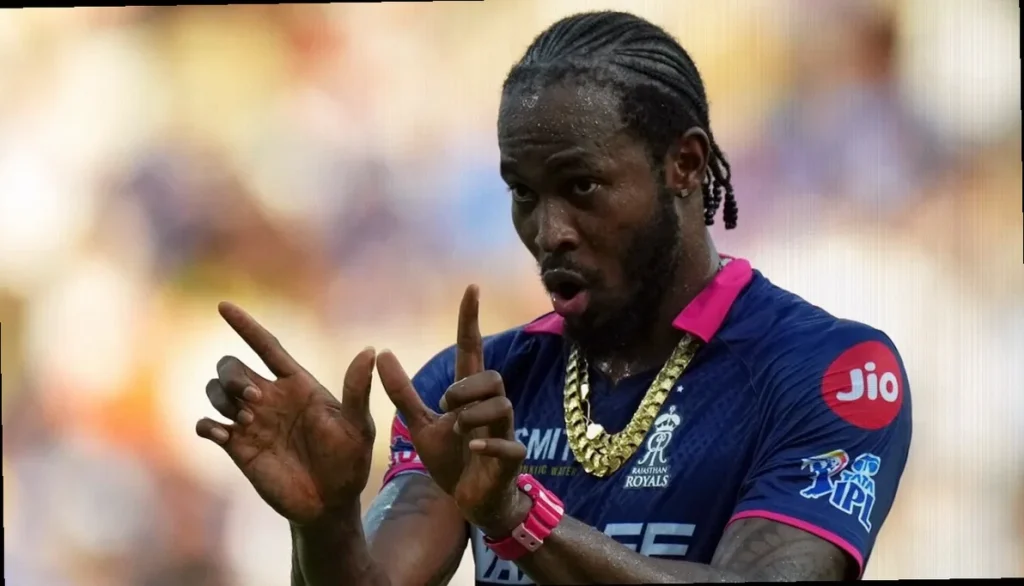
Jofra Archer’s name often brings to mind three things: blistering pace, pinpoint control, and the kind of athletic fielding that can swing momentum in a heartbeat. On Sunday, those strengths were stitched together into a single, decisive show for Rajasthan Royals (RR) in a now-or-never IPL 2026 contest at Wankhede Stadium in Mumbai—an outing that underlined why he can change games in more ways than one.
Key takeaways
- Archer arrived at No. 7 when RR were reeling at 119 for 5 in the 13th over, then produced his top IPL score in the knock.
- With the ball, he struck twice in the powerplay and also returned in the middle overs to break a dangerous partnership.
- His batting featured a rapid burst that included three sixes, helping RR build a platform as the innings progressed.
- RR’s approach to using Archer was influenced by a wrist concern involving Ravindra Jadeja, which prompted the promotion in batting order.
- Archer’s all-round impact was especially valuable with RR needing results to secure their playoffs position.
A rare full-spectrum masterclass
Across 66 IPL matches, Archer has delivered moments of brilliance, particularly with the ball. Still, this performance stood out because it combined several match-altering skills into one complete package—batting when RR needed stability and bowling when the game required control.
He came in at No. 7 with RR under pressure—119 for 5 in the 13th over—and made the most of the opportunity. After reaching his highest total in IPL cricket, he added a further impact with two wickets during the powerplay. As the match shifted into the middle overs and RR’s advantage looked fragile, Archer returned at the crucial moment and disrupted a partnership just as the contest threatened to slip away from his side.
Why RR trusted him higher up the order
For much of Archer’s T20 career, big-hitting has been viewed more as occasional danger than a consistently reliable part of his game. RR have tested him in unusual batting roles over the years, with him appearing at No. 7 or above eight times for the franchise—four of those coming in 2018. One such experiment even saw him promoted to open, though it ended with a four-ball duck.
On Sunday, RR moved him in at No. 7 after Dhruv Jurel’s dismissal. The decision was later linked to a wrist problem for Ravindra Jadeja, which forced the change. RR were prepared to gamble even if Archer only managed a brief acceleration. Early on, it seemed that might be all they’d get: he attempted to hit aerial early but couldn’t strike cleanly. Then his innings evolved into a smarter counterpunch—he started selecting his moments, attacking with clarity rather than rushing the tempo.
Speaking after the match, RR’s cricket director Kumar Sangakkara praised the way Archer approached the situation. He said the pitch was a little slow at the start, but Archer’s batting had been outstanding. Sangakkara added that Archer is more than just a tailender mindset—when he commits, he becomes a proper batter with both power and judgment. He also highlighted that the surrounding context mattered, pointing to Jadeja’s return and the calm execution that followed.
The six-hitting burst that changed the tempo
Archer’s first six arrived off his seventh delivery, a powerful strike off Deepak Chahar that cleared long-off. In the following over, he took on Corbin Bosch with another short-ball hit for his second six. His third six came off Shardul Thakur, struck with authority in front of square. Between those big shots, he kept the innings moving with sharp singles and forceful running twos, ensuring the scoreboard kept rising instead of stalling.
By the time he was dismissed in the 18th over, Archer had made 32 from 15 balls—an innings that did far more than simply inflate the total. It added a late-stage momentum swing that helped RR in the context of a must-win scenario.
RR will likely view this as more than a one-off. With playoffs looming, the newly “unlocked” Archer batting option could matter in a season where RR’s middle order has not always clicked with consistency.
Sangakkara also explained that Archer has been discussed as a candidate for batting higher when the team is in trouble. He noted that Archer can handle pace and spin, and that kind of versatility is valuable in a squad. Sangakkara compared it to the role that Ravi Ashwin used to play for RR—one that often produced game-turning outcomes—and said that on this day, it was Archer’s turn.
Archer the bowler: still decisive, even after a tough patch
Then came the more familiar Archer—the fast bowler who can dismantle batting line-ups almost by himself. Yet even that aspect hasn’t been trouble-free this season. RR felt the effects during a mid-season slump: 13 of his 21 wickets in the campaign have come in victories. While 11 of those wickets arrived in the powerplay at an economy rate of 9.27, his last few matches in that phase were less effective. Across the previous three games, he had gone wicketless in the powerplay while conceding runs at 13.66, often looking erratic.
Against Mumbai Indians (MI), though, Archer reasserted his most dangerous form and attacked the top order with two deliveries that highlighted both pace and precision. Rohit Sharma fell first, lured into a drive away from his body against a 145 kph ball that took the edge and carried to the keeper. In the next over, Archer produced a sharper strike: the ball jagged through the air and then straightened after pitching, beating Naman Dhir’s swipe and crashing into the middle stump. He mixed hard lengths with full deliveries and finished his powerplay overs with figures of 2 for 14.
Sangakkara reflected on the mental pressure that can come with a bowler of Archer’s reputation. He suggested there was pressure on him to take wickets constantly, and that at times Archer may have pushed too hard. Sangakkara pointed out that even in the previous match, Archer had conceded around 20 in his first two overs before producing a dramatic turnaround by bowling the final two for a very low total—emphasising that their conversations had focused on the powerplay process: hold the lines, hold the lengths, stay composed, and keep attacking those areas. He added that when batters try too hard against Archer’s pace and skill, wickets often follow—and that was exactly what happened on the day.
Adapting his bowling plan
After the game, Archer revealed that he was instructed to lean into his strengths rather than overcomplicate his approach with too many pace-off deliveries. He said the message from the coach after the first two matches was that he should stop trying to bowl slower balls—“I don’t care what you do, I don’t want any more pace off from you”—and that he was simply following those instructions now. Archer explained that the margin for error is wider when bowling pace-on, because while a bowler may have to accept a few edges, the safer option more often leads to breakthroughs.
When RR needed a breakthrough in the chase
With Suryakumar Yadav and Hardik Pandya threatening to chase down RR’s 220, RR leaned on Archer earlier than expected, turning to him in the 16th over. This time, he returned to the pace-off option. The change proved decisive: a 116 kph short-of-a-length delivery hurried Hardik into a mistimed pull. The shot ballooned off the top edge towards long-on, effectively extinguishing MI’s hopes. Archer showed little celebration as he trudged back through the draining Mumbai heat—because while the wicket was decisive, it also signalled the completion of RR’s path to playoffs.
Fielding impact and a season turning point
Alongside the batting and bowling contributions, there were also moments of sharp athleticism in the field. Archer dove enthusiastically when he fielded at long-off, saved boundaries on more than one occasion, and maintained intensity even in demanding conditions.
Explosive batting cameos and faster bowling spells may have happened more often in other stages of Archer’s career, but this display reflected the full range of what he can offer. For RR, perhaps the biggest value is timing: Archer is finally managing a sustained run of matches without interruption—something that has been rare in a career repeatedly disrupted by injuries.
