
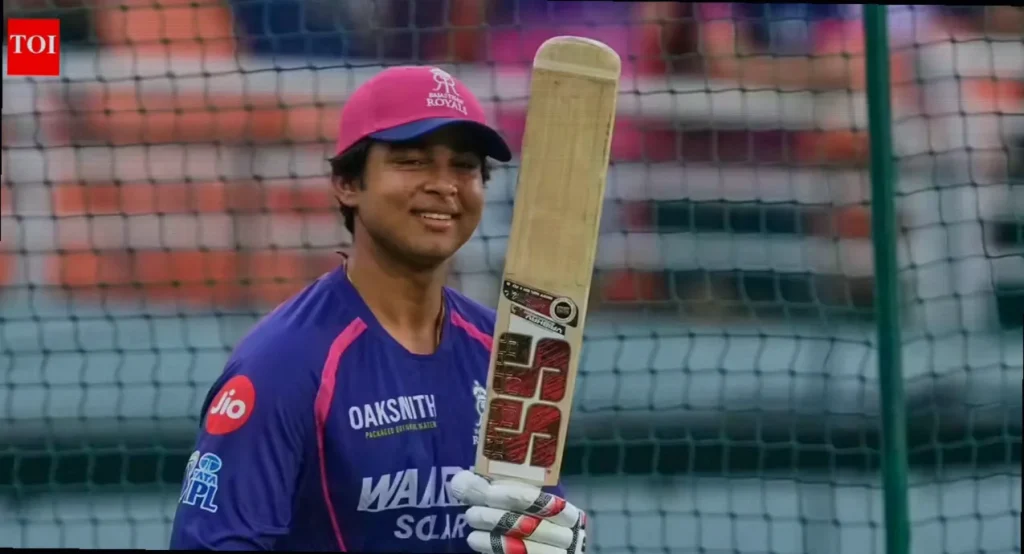
Ravichandran Ashwin has backed Vaibhav Sooryavanshi’s push toward Test cricket, arguing that the teenage Rajasthan Royals star should consider the red-ball format even if the wider cricket “ecosystem” is steering young players toward shorter, faster versions of the game. The former India off-spinner’s comments came as Sooryavanshi continues to rewrite what many people expect from a modern white-ball batter.
Ashwin backs red-ball ambition for Sooryavanshi
Speaking at the Cricinfo Honours Awards 2026—where he was also honoured among the 25 Greatest Men’s International Cricketers of the 21st Century—Ashwin discussed whether the 15-year-old should be encouraged to move into Test cricket.
His message was clear but nuanced: in Ashwin’s view, Sooryavanshi should play Tests for the “larger good of the game”, yet there are limits to what can be forced onto players as they develop. Ashwin also suggested that when the sport itself indicates a path, it can be wiser to follow that guidance than to impose a single route.
Why Ashwin believes youngsters won’t be “pushed” into Tests
The former India all-rounder also pointed to how aspirants are thinking differently now. He argued that no coach or system can compel a particular facet of cricket to become a young player’s main goal, even if Test cricket remains the pinnacle.
Drawing on his long experience in grassroots coaching, Ashwin said he does not see emerging talents showing up eager to master red-ball cricket. In his assessment, many young batters will try to survive a phase first, then quickly want to learn the shots that help them avoid getting out—an approach that, in his view, doesn’t naturally align with the demands of longer formats.
Sooryavanshi’s rise: IPL numbers that set records
Ashwin’s observations arrive as Sooryavanshi’s momentum has become one of the defining narratives in world cricket. Earlier in 2026, the teenager was named Player of the Tournament as India won the Under-19 Men’s Cricket World Cup.
He then carried that form into IPL 2026 with Rajasthan Royals, producing a campaign that elevated him into the group of the sport’s most exciting young prospects. His fearless batting and season-long consistency stood out as major reasons he became one of the tournament’s standout performers and further strengthened his reputation.
- Sooryavanshi ended IPL 2026 with 776 runs, striking at 237.30.
- He became the first player in IPL history to hit 72 sixes in a single season.
- That haul surpassed Chris Gayle’s previous record of 59 sixes set in 2012.
- His scoring spree also earned him the Orange Cap.
- He was named Player of the Tournament as well.
Ashwin’s own legacy honoured at the same ceremony
While discussing Sooryavanshi, Ashwin also saw his own career recognised at the awards event. He was ranked 25th among the greatest men’s international cricketers of the 21st century, and he has been out of international cricket since December 2024.
By the time he retired, Ashwin had taken 765 wickets across formats. That total is noted as the second-highest tally by an Indian, behind Anil Kumble’s 953.
In Test cricket specifically, Ashwin finished with 537 wickets, again placing him second only to Kumble among Indian bowlers. The awards also highlighted his distinctive standing in the game’s history: he is the only player to combine more than five Test centuries with over 500 Test wickets.
Ashwin’s six Test hundreds were cited as a reminder that, although his reputation was built mainly on his match-winning spin, his batting contributions were also a significant part of his overall value—helping define him as one of the most complete Test cricketers of his era.
- Ashwin retired from international cricket in December 2024 with 765 wickets across formats.
- His 765 wickets rank as the second-highest by an Indian, behind Anil Kumble’s 953.
- In Tests, Ashwin took 537 wickets, second only to Kumble among Indian bowlers.
- He is the only player to record over five Test centuries and more than 500 Test wickets.
- His six Test hundreds underlined his batting value alongside his role as a match-winning spinner.
