
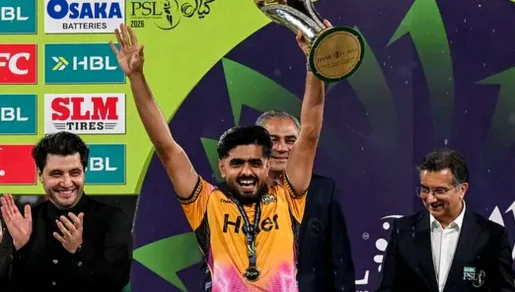
The Pakistan Super League 2026 wrapped up on Sunday, May 3, with the final being staged at Lahore’s Gaddafi Stadium. One franchise lifted the title with a sense of relief and celebration, while the runners-up and the rest of the field went home knowing the next season will bring fresh chances. Even though the build-up promised a high-intensity showdown between top-ranked Peshawar Zalmi and Hyderabad Kingsmen, the contest turned lopsided after Zalmi, led by Babar Azam, opted to bowl first and then chased down a relatively small target of 130 with nearly five overs still remaining.
For Babar, the triumph capped a standout campaign. He guided Peshawar Zalmi to their second league championship in only the competition’s 11th year since its launch, and he finished the tournament as the Green Cap winner. His overall form in T20 cricket came with a noticeable shift after a difficult stretch earlier in the year, when he struggled to make a strong impact for the Sydney Sixers in the Big Bash League, followed by another disappointing phase that ended with Pakistan failing to advance beyond the Super 8 stage of the T20 World Cup 2026. That major international event took place before the PSL season, running from February into March.
In the post-match media session after Zalmi’s dominant victory over the Kingsmen, Babar was asked to address a broader question: whether he would prioritise a particular format. During a journalist’s query, he responded firmly, arguing that a player should remain open to all styles of cricket rather than limiting themselves. He stressed that both white-ball and red-ball games contribute to a more rounded skill set, and that participating across formats can sharpen different aspects of a batter’s game.
“Tension na lein, teeno format kheloonga (Don’t stress, I will play in all three formats),” Babar said, adding a light touch to his message.
He continued by making the point that the decision should not be framed as a “selection” problem for players, but instead as part of their responsibilities. In his view, a batter’s job is to play, and the learning gained from different formats supports better performance across the board. He also explained why he believes red-ball cricket matters even for T20 roles: it helps a batter develop the ability to construct innings and cultivate patience, while multi-day and domestic competitions provide experience in building longer spells of batting and sustaining concentration through “long” runs.
“It’s not for the player to decide [which format to skip]; a player’s job is to play. In my opinion, every player should play every form of cricket. You shouldn’t focus only on the white ball or T20s. Red-ball cricket gives you immense experience. It teaches you how to build an innings and gives you patience. When you play four-day cricket or any domestic circuit, you gain the experience of scoring ‘long’ runs. You should play all three formats because each one helps the other. Red ball helps you in T20s and ODIs. When you play Test matches, the patience and mindset you develop – the art of playing a long innings – benefit you significantly in white-ball cricket.”
Babar’s message amid scrutiny on strike rate
Babar’s comments arrive at a time when his strike rate in the shortest format has come under increased scrutiny. The Pakistan captain is often praised for his technical strengths, including his fluent cover drives and his ability to steady an innings when the situation demands control. Still, the debate around his T20 tempo has made his emphasis on red-ball cricket even more prominent.
In PSL 11, that patience and game-management approach stood out in measurable ways. Babar became the only batter to hit two centuries during the season, illustrating how his longer-format mindset translated into sustained batting in the middle overs and beyond.
He finished the campaign with 588 runs across 11 innings, posting an exceptional average of 73.50. That tally placed him joint-top among the leading run-getters for a single PSL edition, matching Fakhar Zaman’s landmark return from 2022.
Beyond PSL, Babar’s overall record also underlines his value across formats. Having played more than 61 Tests, he has been a key pillar for Pakistan, scoring close to 4,500 runs at an average around 43. His ODI contributions are equally notable, with a batting average of roughly 54 and more than 6,500 runs accumulated in 137 innings. With the cricket calendar now shifting toward the World Cup 2027—co-hosted by South Africa, Zimbabwe and Namibia—those numbers are expected to carry significant weight for Pakistan’s planning and selection.
