
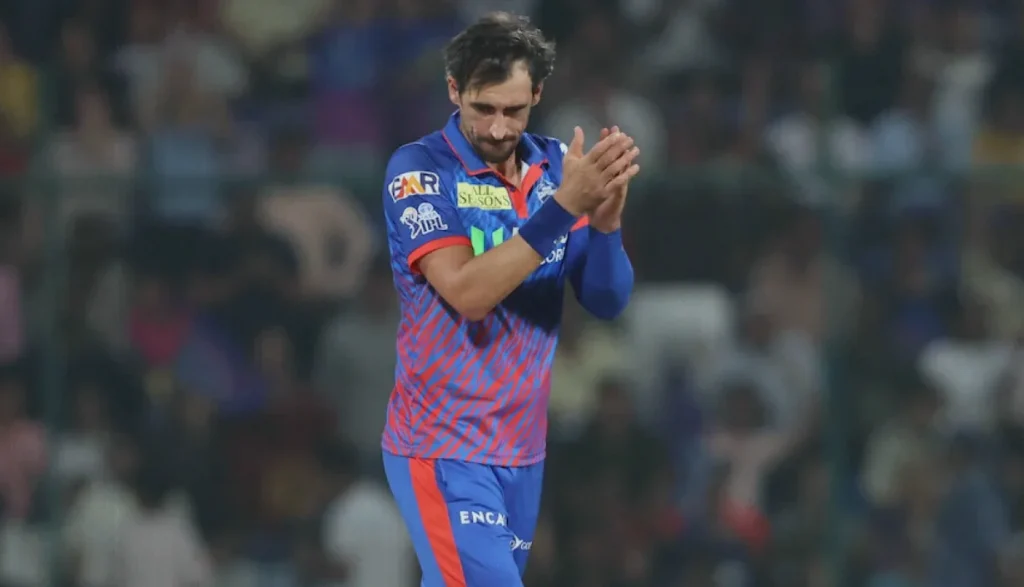
Mitchell Starc’s late arrival at Delhi Capitals in IPL 2026 has quickly turned into one of the league’s most striking turnaround stories. After joining the franchise only in May, the left-arm quick played his first match on May 1 and has since taken nine wickets across five games, including two three-wicket hauls. On Sunday in Delhi, he delivered his most decisive spell yet as the ball began to reverse, finishing with figures of 4 for 40 to help DC beat Rajasthan Royals and keep their playoffs chances very much alive.
Key takeaways
- Starc made his IPL 2026 debut for DC on May 1 and has since claimed nine wickets in five matches, with two three-wicket hauls.
- In the Sunday contest in Delhi, he ended with 4 for 40 as reverse swing played a major role in the outcome.
- DC’s success in the key middle overs included multiple breakthroughs, with Starc striking again in the 19th over.
- Hemang Badani praised Starc’s professional standards, pointing to his preparation and training as reasons for sustained effectiveness.
- Sanjay Bangar highlighted the importance of the ball “tailing in” and the “air speed” of Starc’s pace-on deliveries.
Badani hails Starc’s standards and leadership
After DC’s win, the franchise’s head coach Hemang Badani spoke at length about why Starc has remained such a reliable force. He said Starc’s approach stands out for its discipline—work ethic, planning before games, and training habits that he believes are “above par.” Badani added that he does not see the same level of consistency from many younger players, and suggested that this is a major reason Starc has sustained success for so long.
Badani also referenced Starc’s impact in international cricket. He pointed to the recent Ashes, saying Starc “single-handedly” played a decisive role, and noted the absence of Pat Cummins and Josh Hazlewood during that stretch—framing it as evidence of what the bowler can deliver when the match demands it.
The coach then shifted to the way Starc contributes to team culture beyond match days. Badani said Starc is constantly speaking to younger players, sharing knowledge on how to execute reverse swing, manage bowling lengths, and adjust when a batter is pressing hard. He also described discussions around whether to chase wickets aggressively or adopt a more controlled, defensive approach, calling the level of conversation Starc brings “immense.”
How Starc’s spell unfolded in DC’s win over RR
Sunday’s innings did not start smoothly for Starc. In the opening over, Yashasvi Jaiswal struck him for two boundaries. The trouble continued as Vaibhav Sooryavanshi and Dhruv Jurel punished him in the next phase, with 16 runs coming off the second over of the innings (the third over overall), including a six and two fours.
From there, the story changed. Starc’s rhythm returned later in the spell, bringing pace, cutters, and reverse swing into play—described as the “full monty” by those watching the turnaround. He struck in a sequence that tightened the contest: Riyan Parag was dismissed after being taken at long-on by Axar Patel, Donovan Ferreira fell off the second and third balls, and Ravi Singh was removed on the fifth ball. That run of wickets came in the 15th over, setting up further pressure.
Starc then added another blow in the 19th over, with Dasun Shanaka holing out off him, completing a spell that turned the match in DC’s favour. The combination of his variations and the ball’s behaviour helped him take control after the early damage.
Rayudu and Bangar explain the mechanics behind the turnaround
Ambati Rayudu, discussing the match on ESPNcricinfo’s TimeOut show, said Starc’s start with the new ball was not ideal. However, Rayudu credited the comeback to two key factors: the ball tailing in and Axar Patel’s sharp catch. He suggested the catch helped set up Starc’s best work, and added that once the ball began to reverse, Starc knows exactly what to do and which variations to use—calling it a strong comeback.
Sanjay Bangar also pointed to the ball tailing in as a crucial element of Starc’s effectiveness across formats. Bangar further explained that for left-arm quicks, “air speed” matters just as much as the ball’s movement off the pitch. He said that when a batsman is trying to line up a shot and the ball is reversing, the direction a batter intends to hit—whether it’s a shot Parag might look for or the angle challenges faced by Ferreira when he goes across—becomes significantly harder to execute.
Why Starc arrived late: shoulder and elbow issues
DC’s planning challenge was not just tactical—it also involved availability. Starc’s absence at the start of the tournament was described as a setback for the side. He had to spend time away from the team to address shoulder and elbow concerns, and Cricket Australia set a firm return timeline after a demanding Ashes schedule. In that Ashes, Starc played all five Tests and was named Player of the Series.
Badani said he expects key players to be available from the opening days and that Starc is one of the biggest names in his squad. He added that the franchise has invested in him and views him as a match-winner. At the same time, Badani stressed that some decisions sit outside a coach’s or franchise’s control—particularly where governing bodies and associations determine release windows.
He said DC could not do much if Cricket Australia did not release Starc, noting that the situation was similar for Hazlewood (Royal Challengers Bengaluru) and Pat Cummins (Sunrisers Hyderabad). Badani concluded by expressing hope that a solution could be found in the future so that franchises can access such players from day one.
