
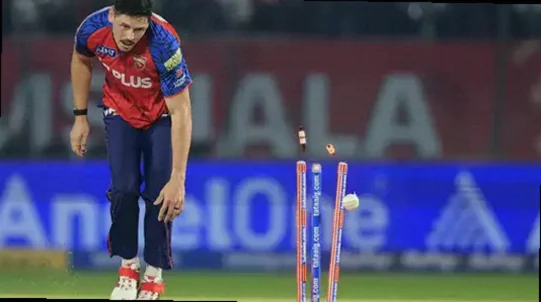
Punjab Kings have endured a tough run, suffering a fourth straight defeat after looking well set in the earlier stages of the season. Even with their latest setback to Delhi Capitals on Monday, May 11, they are still mathematically in the hunt for a top-four finish. Spin coach Sairaj Bahutule admitted the mood is “disappointed”, but insisted the franchise won’t “overthink or overanalyse” as it turns its focus to the remaining matches.
Quick facts
- Punjab Kings’ latest loss came against Delhi Capitals on Monday, May 11.
- PBKS have now lost four games in a row.
- Punjab remain in contention for the Playoffs/top four.
- Spin coach Sairaj Bahutule cited missed execution in the final five overs.
- Captain Shreyas Iyer previously said the side was “short on planning”.
- On the day, PBKS and DC used no spin bowling at all.
Bahutule’s message was simple: move on quickly. He pointed out that the team has experienced “ups and downs”, and that there are moments when a win is almost within reach before slipping away. In this match, Punjab felt they had control—especially when David Miller departed in the 17th over during Delhi’s chase of 211.
At Dharamsala, the contest swung sharply after Miller’s dismissal. By the end of the 17th over, Delhi still needed 36 runs off 18 balls, but they found momentum through quick contributions from Ashutosh Sharma, Madhav Tiwari and Auqib Nabi. Those cameos ultimately carried the chase to completion, sealing a three-wicket victory for DC.
Bahutule acknowledged that PBKS had the game, but said they “didn’t execute their skills” during the closing phase. He described how the last five overs became the defining stretch, with Delhi slipping through the gap. Speaking in the post-match press conference, he urged the squad to set the result aside and concentrate on the next three fixtures.
When asked where the match could have been turned, Bahutule suggested PBKS may have left runs behind. His view was that they could have added roughly 15–20 more in the final over, which would have taken the total beyond 240—an outcome that would have been tougher for Delhi given the strong start Punjab had built.
Captain Shreyas Iyer, however, offered a slightly different angle on the target. He argued that 210 was “30 runs more on the wicket”, highlighting how the ball was behaving with seam movement and changeable bounce. In his assessment, the pitch conditions supported the bowlers when they were sharp with their line and length.
Bahutule also raised the impact of fielding moments. He said it was unfortunate that PBKS dropped a few catches at crucial times, implying that cleaner chances could have changed the outcome. His reasoning was that if two catches had been taken, Delhi’s chase would likely have become far more difficult—possibly tilting the result by a wide margin.
Spinless strategy on a seam-friendly pitch
A notable first in IPL history came with both sides choosing to bowl no spin at all during the match. With the surface offering movement, PBKS and Delhi leaned entirely on quick bowling, trusting pace and seam to do the work. When Iyer was asked whether he would have introduced an over of spin, he said the idea crossed his mind at one point.
He explained that he considered giving Yuzvendra Chahal a chance, but felt the ball was still seaming and helping the fast bowlers. In his view, wickets could have been extracted if PBKS had executed their lengths and lines with greater precision. The captain’s conclusion was that, despite the tactical thought, the execution still fell short.
Bahutule later backed the decision to stick with pace. He said the conditions were suitable for fast bowling, and that during the time-out the choice to persist with the quicks was made spontaneously. He added that the strategy paid off early on, with Punjab getting wickets before the match narrowed in the final overs.
Iyer also defended the bowling plan for the end of the innings. He argued that in the closing overs, repeatedly bowling into the surface—rather than going for yorkers and limiting the batters’ options—can create chances, particularly when a new batter is arriving. His point was that “hard length” and “short of hard length” are often the most effective areas, since repeated deliveries raise the risk of a mis-hit and can lead to wickets.
He reiterated that PBKS were “short on planning”, tying it back to the inability to carry control through the last phase. The captain’s theme was that the team had the tools, but the execution—especially when the game was on the line—was not consistent enough.
Ben Dwarshuis in, Bartlett out
Another key talking point was the bowling reshuffle. PBKS kept Xavier Bartlett out after his productive first half of the season, making way for Ben Dwarshuis for the first time. Bahutule said the selection was about bringing another left-arm seamer into the attack, particularly on a pitch that was assisting seamers.
He noted that Lockie Ferguson was not available for the match, and that the team wanted to give Ben that opportunity. Bahutule also referenced Dwarshuis’ work in training, saying he had been bowling well in the nets and performing strongly alongside the group. He added that while Bartlett had been doing well, the combination chosen was believed to fit the demands of this particular wicket.
Looking ahead, PBKS are set to play their next three matches against Mumbai Indians, Royal Challengers Bengaluru and Lucknow Super Giants. Two of those opponents are already eliminated and sitting at the bottom of the table, but Punjab’s focus remains unchanged: they need to start converting their promising spells into results to keep their Playoffs chances alive.
