
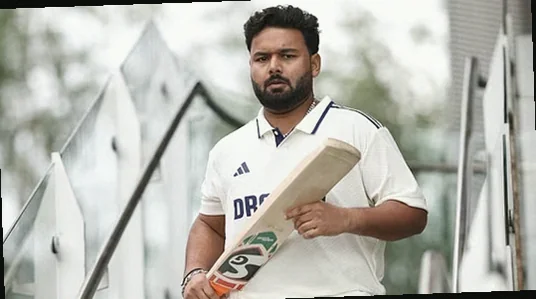
Rishabh Pant is being squeezed from two directions at once. As captain and batter of the Lucknow Super Giants, his IPL campaign has been far from convincing, and the franchise’s season has already ended. Meanwhile, in India’s international set-up, his standing is also looking less secure. The situation worsened after the BCCI removed him as India’s vice-captain, following a warning from the chairman of selectors. A demotion in Test cricket, coming on the back of that disruption, has only added to the pressure at a time when Pant can least afford to lose momentum.
It is not hard to understand why Pant appeared to be rattled after two off-moments in the spotlight, including a sudden F-bomb during a conversation with Ian Bishop last evening. Barely an hour before the toss, Pant learned that he had been replaced as Shubman Gill’s deputy by a player with considerably more seniority. That short window between changes and big-stage expectations seems to have compounded his mental fatigue. Between 11 difficult IPL matches, the added weight of being the tournament’s highest-priced player, and batting struggles under the constant attention of an ownership group whose track record is hardly comforting, Pant appears to have absorbed far more strain than usual.
The Afghanistan tour was supposed to be a breather from the grind of the IPL, a chance to return to the format he prefers and in which he has been at his most effective. Instead, the squad announcement has only intensified the sense of uncertainty around him.
Why Pant’s Test case is still strong
There are clear reasons Pant’s Test credentials remain difficult to ignore. Over the last four years, he has been India’s most reliable batter in the longest format, posting averages that sit above those of his peers. Even if one brackets out his iconic 2021 Border-Gavaskar Trophy performance, the broader trend has been exceptional. After missing an entire year due to a life-changing road accident, Pant has returned with an extraordinary run of form since 2022, amassing 1,885 runs in just 23 Tests at an average of 80.34. During that stretch, he has converted starts into five hundreds and 11 fifties.
In total runs, he sits fourth in the same period behind Yashasvi Jaiswal (2,511), Shubman Gill (2,285), and Ravindra Jadeja (1,900). However, the comparison is not fully fair because Jaiswal, Gill and Jadeja have all played substantially more matches than Pant—28, 30 and 32 respectively—while Pant’s workload has been shaped by his recovery timeline.
Just as important is the question of replacement. The BCCI’s options to cover Pant’s specific role in the lower middle order are limited. While the challenges of top-order batting can be more visible—like Jaiswal facing the new ball in demanding conditions in Australia or England—batting at No. 6 carries its own complexities. When India’s batting struggled, Pant still produced 99, 60 and 64 even as New Zealand’s spinners dismantled the side during a 3-0 whitewash. With seven dismissals in the 90s, Pant also reinforces a philosophy associated with Gautam Gambhir: team outcomes first, and individual milestones only if they come along.
Pant’s consistency across series
Pant’s stability in Test cricket has been another major reason he continues to be valued. In his most recent seven Test series, his averages underline how consistently he has adapted to different opposition and conditions. Against Sri Lanka, he averaged 61.66. Versus Bangladesh, his numbers read 49.33 and 53.66 across two separate series. Against New Zealand he averaged 43.5, despite India suffering a home defeat. Last year, against England, Pant produced a remarkable 68.42.
There has been only one clearly below-par sequence in the recent stretch, and it came in Australia, where—apart from Jaiswal and Nitish Reddy—nearly every Indian batter found it difficult. Even in the most recent Test run against South Africa, where Pant’s average dropped to 12.25, the pattern felt closer to an isolated off series than a sign of a longer decline.
His captaincy has not always attracted universal admiration, but one aspect that rarely comes under question is his commitment. With Virat Kohli and Rohit Sharma no longer in the mix, India’s Test setup has at times lacked flamboyant, larger-than-life personalities. Pant, though, provides energy behind the stumps—his presence is lively and purposeful. There is also the memorable example of him batting with a broken foot, with his fifty helping India narrow the deficit and eventually secure the crucial draw at Manchester. In the Anderson-Tendulkar Trophy, he was India’s fourth-highest run scorer with 479 runs, and if he had not missed a match, the gap between him and the top run-getters might have been much tighter.
Let him breathe—and get the communication right
At this stage, Pant does not need to feel unwanted. Ajit Agarkar has reiterated that Pant remains part of India’s Test thinking, and replacing him with a 34-year-old KL Rahul does not appear to be a logical move. Gill, who is currently leading the side, is not going anywhere unless something goes seriously wrong. If a change were to be made in the role Pant usually occupies, the better candidate—by age and long-term planning—would arguably have been the younger Yashasvi Jaiswal. Giving the responsibility to Rahul risks sending the wrong message and can also reflect a lack of faith in the next wave of India’s batting talent.
Pant’s absence in 2023 was the result of multiple injuries he suffered on December 30, 2022. His recovery and return to elite cricket have been nothing short of remarkable. Having already missed the 2023 World Cup, he is expected to fight hard for a place in India’s squad for the 2027 edition. Still, he knows that securing a spot in the ODI group will be a tougher task—particularly with Rahul and now Ishan Kishan included in the mix.
That is exactly why Pant cannot afford to feel even slightly sidelined in Tests. Communication, in this kind of phase, is critical. Not the type of direction Pant appeared to receive during the Down Under tour, where he often looked unsure about his approach. Instead, he needs the kind of guidance that Rahul Dravid or Ravi Shastri would have provided—clear, consistent, and role-specific. Without that, Indian cricket runs the risk of doing long-term damage to one of the finest talents it has produced across generations.
