
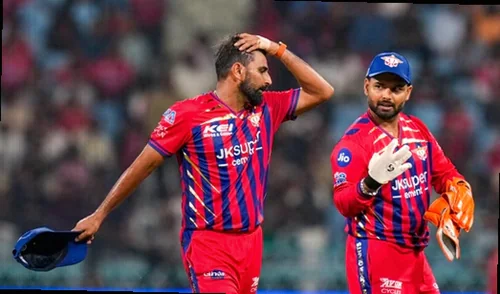
Mohammed Shami’s relationship with the Board of Control for Cricket in India (BCCI) appears to be strained, with the fast bowler’s most recent India outings coming during last year’s Champions Trophy in Dubai. Since then, he has not featured in either T20Is or Tests—missing action since February 2025 in the shortest format and since June 2023 in the longer version. In the meantime, Shami has kept working through domestic cricket and also turned out in the Indian Premier League, where Lucknow Super Giants—his sixth IPL franchise to date—have benefited from his craft in the ongoing 19th edition.
Why the Shami–BCCI rift is in focus
There is no doubting Shami’s ability with the seam—his bowling style is natural and the wickets often follow. Yet the larger issue remains that he does not appear to be “indispensable” for India, and his career has also been shadowed by disciplinary concerns. The former India quick, the narrative goes, prefers to stick to his own routines: his own lifestyle choices, his preferred food, and his preferred training plan. In short, he operates with independence, and that can become a problem when a team environment demands strict alignment.
The discussion also points to moments when his value dipped sharply in the eyes of selectors and leadership. A notable turning point is the 2021 T20 World Cup in the UAE, when India’s campaign ended in the first round. While the entire unit struggled, doubts began to form when Shami’s impact looked limited—particularly in his bowling against Pakistan—suggesting that India might need to rethink their reliance on him.
Recent international setbacks that shaped perceptions
Even though moving on from a player is rarely simple without an immediate replacement, Shami still found a place in India’s plans for later tournaments. He played in the 2022 T20 World Cup in Australia and, again, was involved in a crucial semifinal against England. That match became another painful reference point: Shami conceded 39 runs in his three overs, and India went on to lose by 10 wickets.
When it matters most, the returns haven’t always arrived
The recurring theme in the debate is that Shami has not consistently delivered in the games that define tournaments. During the 2023 World Cup, he delivered strong spells and helped move through stages until the final. However, after India posted 240 and needed him to make the decisive difference, he was unable to produce the kind of impact demanded in the event’s biggest match.
His World Test Championship final earlier in 2023 against Australia at The Oval is also cited as evidence that big-stage outcomes did not always swing in India’s favour. In that final, Shami returned figures of 2/122 and 2/36. While it would be unfair to pin those defeats solely on one bowler, those numbers still fed the argument that his performances were not consistently “special” when the margin was smallest.
Fitness, fitness controversies, and IPL form
The piece frames the situation as more than lifestyle preferences—it leans heavily on inconsistency and fitness concerns. Shami underwent heel surgery in early 2024, and since then, the BCCI’s support has not been viewed as strong enough. A controversy arose when Shami told the media that the board had asked him to play certain matches even though he was not sure about his fitness.
From there, the gap between the two sides is said to have widened. Shami’s decision-making—refusing to follow the board’s preferred way of functioning—became the flashpoint. The argument concludes that the board ultimately governs the sport and holds the authority to make decisions on players, whether those calls are viewed as correct or incorrect. In the same breath, it adds that a player can be sympathetic, but the final verdict often depends on availability, readiness, and performance.
Even in tournaments where he showed moments of quality, doubts lingered. In the Champions Trophy, Shami did manage some good spells, but he appeared slightly overweight. In the recently concluded Ranji Trophy and now in the IPL, the perception, at least in this telling, has not improved—if anything, he looks worse.
- Shami is described as a natural wicket-taker with the ball and can still produce impact, including in his outing versus SRH.
- In that match, he recorded figures of 2/9 in his four overs.
- Despite that, fitness is presented as a non-negotiable requirement—especially because modern fast bowling demands sharp fielding and reliable catching, not just bowling spells.
Age, competition, and the case for BCCI accountability
Fitness concerns are also linked to Shami’s age. He is set to turn 36 in September, and given his recent fitness history, it is suggested that a return in India colours is unlikely. The competition for pace is also framed as intense: Jasprit Bumrah, Mohammed Siraj, Prasidh Krishna, Akashdeep Singh, and Arshdeep Singh are named among the fast-bowling options available to the BCCI, creating a sense that the board has multiple choices.
The article also argues that the BCCI should share some blame for how Shami has been handled. It acknowledges that, during his roughest period—when he had a fallout with his estranged wife Hasin Jahan amid allegations— the board stood by him and helped him move forward. However, it suggests that things are not the same anymore.
