
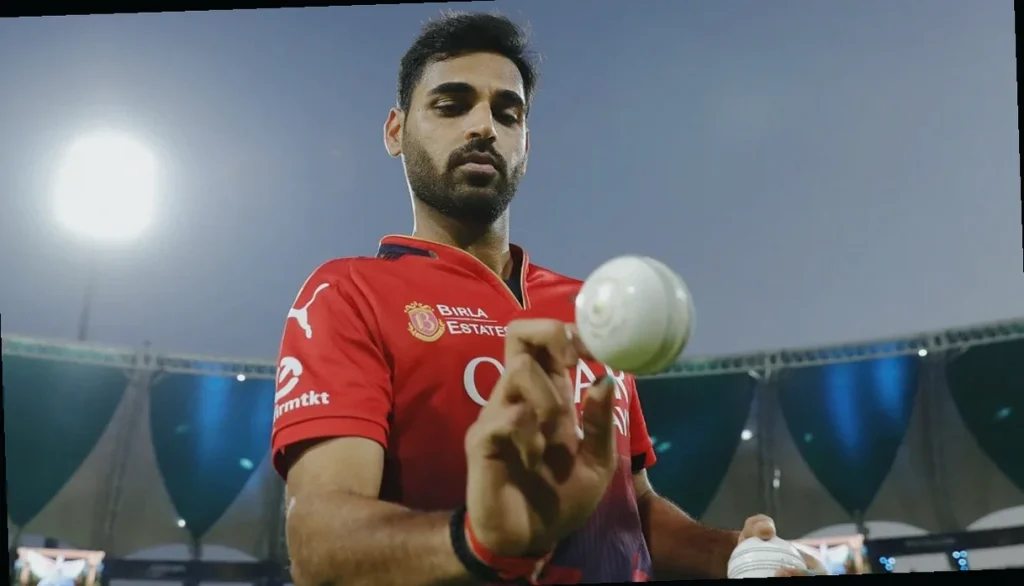
Royal Challengers Bengaluru (RCB) are set to welcome Chennai Super Kings (CSK) at the Chinnaswamy Stadium, and one of RCB’s key strike options is closing in on a landmark. The milestone is not Josh Hazlewood’s; it belongs to Bhuvneshwar Kumar, who is one wicket short of joining the select group of IPL bowlers with 200 career dismissals—only the second overall, and the first fast bowler to reach that mark. It’s a figure that underlines both his durability and his ability to keep evolving in a format that punishes inexperience.
When Bhuvneshwar first arrived, he was known primarily for movement through the air, with swing doing most of the heavy lifting. Even at 36, he remains among the more dependable options during the opening six overs, but the biggest storyline has been his growth at the end of innings. Over time, he has added the knuckle-ball approach and pinpoint yorkers to complement his length-and-swing craft, making his death-over spells increasingly difficult to negotiate.
Quick facts
- Bhuvneshwar Kumar is one wicket away from 200 IPL wickets; he would be the second bowler overall and the first fast bowler to do so.
- In IPL 2025, he took 17 wickets in 14 matches for RCB.
- Last season, Bhuvneshwar claimed seven wickets in the death overs, one more than Hazlewood.
- His decisive 17th over in the final vs Punjab Kings included the wickets of Nehal Wadhera and Marcus Stoinis.
- In IPL 2026’s opener vs Sunrisers Hyderabad, he conceded 31 runs while bowling overs 2, 4, 18 and 20.
- He has dismissed Sanju Samson four times in the IPL.
IPL 2025 belonged to Hazlewood in the headlines, with his hit-the-deck style playing a central role in RCB lifting their first-ever IPL title. Still, Bhuvneshwar’s contribution was quietly substantial: he finished the campaign with 17 wickets from 14 games. While his new-ball overs remained a regular source of breakthroughs, his finishing overs were just as sharp, highlighted by seven death-over wickets last season—one more than Hazlewood managed in that phase. In the final against Punjab Kings, his double-wicket effort in the 17th over proved crucial to RCB’s success, as he removed Nehal Wadhera and Marcus Stoinis in the same over.
With Hazlewood unavailable for the opening stretches, Bhuvneshwar entered IPL 2026 as RCB’s leading pace threat and struck quickly. In the tournament opener against Sunrisers Hyderabad, he was used at overs 2, 4, 18 and 20, and conceded only 31 runs despite the batters going after every ball. That kind of control across different stages of an innings is exactly what makes him a match-winner when conditions tighten.
Even in training, Bhuvneshwar’s presence has been hard to miss. On the eve of the opening match, Phil Salt and Virat Kohli were hitting the bowlers with plenty of authority at the Chinnaswamy Stadium, but neither managed to get the better of Bhuvneshwar. His mix—hard lengths, cutters, and yorkers—offered a steady stream of discomfort, even to established hitters.
Now the focus shifts to CSK, where Bhuvneshwar will be looking at two targets at once: a key wicket and the prospect of reaching wicket No. 200. Sanju Samson sits in the spotlight as well, with Bhuvneshwar having dismissed him four times in IPL history. If he can extend that record, it would also help break a batter’s rhythm at an important moment.
Bhuvneshwar is the sort of bowler who rarely needs to announce himself. He operates both in the powerplay and in the death, tends to land among the wickets regularly, and generally keeps his run rate under control. One example that stands out is the IPL meeting between RCB and Pune Warriors India in 2013. The match is often remembered for Chris Gayle’s 175 and RCB’s huge total, but the quieter stat was Bhuvneshwar’s—his four overs went for just 23 in the middle of all the scoring chaos in Bengaluru.
His IPL journey is typically viewed in phases. He spent two seasons with RCB, in 2009 and 2010, but did not feature in IPL matches during that stint. After that, he moved through three comparatively uneventful campaigns with Pune before making the shift to SRH, where his career truly took off.
From 2014 to 2017, Bhuvneshwar reached his peak form. Across those four seasons, no other bowler took more wickets than his 87, and his economy rate sat at 7.25. He also won the Purple Cap twice—back-to-back in 2016 and 2017—remaining the only bowler to achieve consecutive Purple Cap honours, while also becoming a regular presence in the India setup.
After that came a leaner period. Between 2018 and 2022, he managed 43 wickets across 56 innings, and although his economy stayed respectable at 7.64, the wickets were harder to come by. The next phase demanded a reset, and it arrived. Since IPL 2023, Bhuvneshwar has already taken 45 wickets in 45 innings. His economy rate has climbed to 8.97, but that’s a trade-off many teams have had to accept as IPL scoring rates continue to rise.
As a powerplay operator, he still rates among the elite. No one has more wickets in the first six overs than Bhuvneshwar, with 80 strikes and an economy of 6.52—third-best among bowlers who have completed 100-plus powerplay overs. He has also registered a dot-ball percentage of 57.3, reflecting how often he forces batters to play without payoff. At the other end of the innings, his death record remains strong too: 93 wickets in that phase, only behind Dwayne Bravo’s 102, while holding an economy of 9.5.
At his very best, watching Bhuvneshwar run in, swing the ball both ways, and punish batters was a pleasure. There have been stretches where he drifted away from that exact peak impact, but at 36 he has reinvented himself again. If he can secure his 200th wicket on Sunday, he won’t just complete a personal milestone—he’ll also grab some of the spotlight in what promises to be a high-profile RCB versus CSK contest.
