
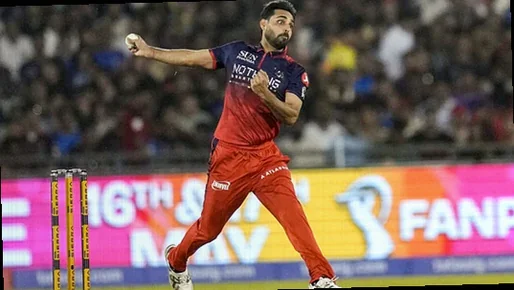
IPL 2026 has taken T20 batting to another level, with teams racking up 200-plus totals at a rapid pace and six-hitting frequency reaching fresh highs. The league’s overall economy rate is sitting at 9.67, the poorest mark in IPL history, reflecting how tough it has become for bowlers to slow the scoring. Yet in the middle of the run-flood, Bhuvneshwar Kumar has been a standout exception—delivering rare control and wicket-taking in the same spell.
Key takeaways
- IPL 2026 is producing 200-plus scores far more often, with totals of that size now appearing almost three times every two matches.
- The league’s current average economy rate is 9.67, the worst figure ever recorded in IPL history.
- Bhuvneshwar Kumar is the only bowler (among 38 who have bowled at least 25 overs) with an economy below eight and a strike rate under 15.
- In 11 innings this season, Bhuvneshwar has taken 21 wickets at an economy of 7.46, striking once every two overs.
- In the powerplay this season, Bhuvneshwar has 12 wickets and concedes at 7.0 economy, with dot balls making up 51.4% of his powerplay deliveries.
Bhuvneshwar’s numbers: control plus breakthroughs
Bhuvneshwar has been exceptional in a tournament where margin for error is shrinking for every bowler. With at least 25 overs delivered, he stands apart from the rest of the group: his economy remains under eight and his strike rate stays below the 15 mark, an unusually effective combination in modern T20 cricket.
Across 11 innings, he has scalped 21 wickets while keeping his run flow tight, conceding just 7.46 per over. His strike rate of under two overs per wicket underlines how frequently he is creating dismissals rather than only restricting runs.
A major highlight came against Mumbai Indians in Raipur, where he picked up four wickets. He struck early by removing Ryan Rickelton, Rohit Sharma and Suryakumar Yadav with the new ball, before returning later to dismiss Tilak Varma. Those wickets reinforced how well he has adapted to the game’s aggressive tempo.
From earlier IPL taper to a full reinvention
Bhuvneshwar’s reputation has always been tied to white-ball craft, particularly swing bowling. However, between 2018 and 2022—his most recent period before he last played for India—his IPL output began to level off. Even though he continued to bowl at an economy rate of 7.46, his wicket haul dropped to 43 scalps in 56 innings.
Since 2023, the transformation has been clear. In the Impact Player era, with batting totals exploding, Bhuvneshwar has added more bite to his spells. He has taken 65 wickets in 55 innings while still holding his economy rate below nine—showing that his control has not come at the cost of wickets.
While he remains known primarily as a swing bowler, he has become one of the tournament’s strongest powerplay options. More than 40% of his IPL wickets—92 in total—have arrived within the first six overs, which is the most by any bowler in league history. That early phase wicket-taking has been a key reason his bowling has remained relevant even as batters have started attacking from ball one.
This season specifically, he has collected 12 powerplay wickets, second only to Kagiso Rabada’s 13. He has also conceded at a significantly stronger economy of seven in that phase. Even more striking, 51.4% of his powerplay deliveries have been dot balls, a critical stat in a league where teams are scoring at around 10 runs per over during the opening overs.
Death-overs evolution: knuckleballs and yorkers
Where Bhuvneshwar has quietly expanded his reputation is at the end of matches. His knuckleball variations and pinpoint yorkers have added another dimension that suits the final overs, when batters look for maximum impact and errors are punished immediately.
In IPL 2026, seven of his 21 wickets have come in the final overs, and he has conceded at just 7.8 per over in that crucial section of the innings. That effectiveness at the back end was visible last year as well, during his first season with Royal Challengers Bengaluru, when he took seven wickets in the death phase. One of those spells included a decisive double-wicket over in the last against Punjab Kings.
Why an India return still looks complicated
Talk of a potential India comeback naturally resurged after his Sunday performance against Mumbai Indians, especially given that he also finished the chase with a match-winning six. On pure numbers, Bhuvneshwar’s case looks difficult to ignore.
However, selection is rarely just about current form. India’s T20 planning is now built around the 2028 Olympics and the following T20 World Cup later that year. By then, Bhuvneshwar will be 38, and with a fast bowler’s track record often shaped by injury management, it becomes hard for selectors to justify a long-term investment in a role that depends on sustained availability.
There is still a path where India could treat him as a short-term bridge option. With Jasprit Bumrah likely to focus on ODIs and Tests leading into the 2027 ODI World Cup, the value of T20 experience may matter. Even Ian Bishop has mentioned Bhuvneshwar as part of an alternate India T20 group during a discussion, which suggests he remains on the radar for squad depth.
Still, the comparison to Dinesh Karthik’s return in 2022 does not fully translate. Back then, India were urgently searching for a specialist finisher with only a few months left before a World Cup, making the need immediate and highly specific. For fast bowlers—especially those in their late 30s—the selection equation is far more delicate.
That is why, despite the brilliance of his IPL campaign, Bhuvneshwar is more likely to be viewed as a reserve or emergency option rather than a central part of India’s long-term T20 plans, unless another standout season forces a reconsideration.
