
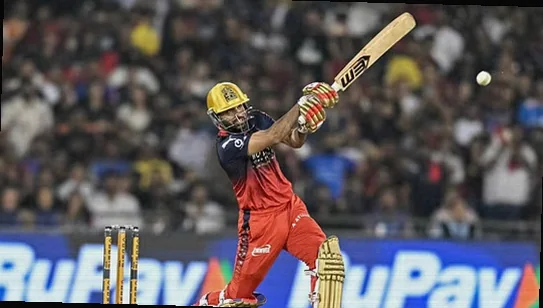
Bhuvneshwar Kumar came out to bat for Royal Challengers Bengaluru when the chase was already wobbling: RCB were eight down, Romario Shepherd had been dismissed, and Mumbai Indians had restricted the equation to 9 runs needed from the final three balls. Raj Angad Bawa had the last over under control for a brief spell, and RCB were forced to rely on a bowler rather than a recognised finisher—yet the danger still felt close enough to turn. At that stage, the analytical model placed RCB’s chances at 51.49%, a figure that captured how close the match was to slipping either way. The target looked reachable, but it still required a boundary from an unlikely source.
- Bhuvneshwar struck the first real blow of the finish, clearing the ropes for six to reduce the requirement to 3 off 2.
- With that shot, RCB’s win probability rocketed to 99.38%, effectively turning a fragile chase into a near-certain conclusion.
- Rasikh Salam finally completed the last run on the final ball, but the defining momentum shift had already been created by Bhuvneshwar’s strike.
The model also assigned the six a headline monetary impact of close to ₹99 lakh, reflecting how the shot cut through multiple layers of pressure at once: it improved the scoreboard position immediately, reduced the risk associated with the lower-order phase, and undermined MI’s plan for the last over. In cricket terms, it transformed RCB’s pursuit from a boundary-dependent scenario into a finish that could be managed with composure.
For a player primarily selected to take wickets rather than close chases, the control shown in that moment was unusual and decisive. The delivery carried a batting impact of 19.88 raw points in the model, while the same ball recorded a bowling impact of -17.56 for Raj Bawa, with both figures influenced by timing, role difficulty, and the match state.
The chase context: why one six mattered so much
A six in the middle overs can boost momentum, but a six when 9 are required from 3 balls carries a different weight. Bhuvneshwar landed the shot at the exact point where every run had become more expensive because the match had entered its final three deliveries with RCB eight down. When the requirement was 9 off 3, RCB still needed either a boundary or a mistake from MI. Once it became 3 off 2, the chase shifted toward execution rather than improvisation, and MI’s margin for error practically vanished.
At that stage, Bawa could no longer protect the boundary with comfort because singles and twos were enough to change the finish. MI’s last-over strategy began to fall apart as soon as the ball went over the rope, and the win-probability jump quantified just how brutal that change was: RCB moved from 51.49% to 99.38% on a single delivery. The nearly 48-percentage-point rise gave the shot its analytical weight, while the rupee estimate supplied the scale of its “value” in the model’s terms.
That is why the six—coming from a specialist bowler—forced the chase to be read differently. Bhuvneshwar wasn’t merely adding tail-end runs; he was purchasing the safest possible version of the finish from that position, turning a risky equation into something RCB could close.
Bhuvneshwar’s overall match value: built with the ball, finished with the bat
The importance of the six becomes clearer when set against what Bhuvneshwar had already done earlier in the same contest. His central contribution came through his bowling spell, where he took four wickets and steadied RCB’s position in a match that kept swinging under pressure. In the model’s monetary layer, his match value ended at around ₹5.20 crore, while his match “cost” was estimated near ₹0.77 crore—producing an estimated match profit of roughly ₹4.43 crore.
That return is described as elite because the bowling spell created most of the value, and the late batting moment added a sharp final-over spike. The six did more than alter the scorecard—it provided a story strong enough to outlast the numbers.
In short, the unusual beauty of the moment was that Bhuvneshwar had already delivered the role expected of him earlier. The final over demanded work beyond that usual remit, and he responded with the most valuable batting action of the chase.
How Bawa’s control slipped in one ball
Raj Angad Bawa’s final over briefly reopened the door for MI. Shepherd’s dismissal had pulled RCB into trouble and offered Mumbai a route to drag the contest into a last-ball squeeze. The over contained everything that makes finishes tense—pressure, wickets, the need to defend runs, and a lower-order batter on strike.
The equation softened when the wide came in, and then the six shattered what remained of MI’s control. Once Bhuvneshwar cleared the boundary, Bawa was suddenly tasked with defending 3 from 2 as the match slipped away. The shift was severe because a bowler’s authority in the last over depends on controlling scoring options. With 9 needed from 3, Bawa could still deny the boundary and keep the field set for containment. With 3 needed from 2, even minor errors became fatal: a single could hurt, a two could finish it, a misfield could seal it, and a clean hit would end it.
Bawa had succeeded in taking a wicket and reopening the match, but Bhuvneshwar closed the opening before MI could breathe inside it.
Role shock: why the same shot carried more value
The six landed even harder in the model because it arrived from the “wrong” profile for that moment. RCB did not have a top-order batter or a recognised specialist finisher at the crease. Instead, the challenge faced by Bawa came from a veteran seamer dealing with a young bowler while the match was still alive.
That mismatch in roles sits at the centre of the shot’s value. A specialist batter hitting a last-over six comes with expectation; a bowler doing it brings surprise, additional pressure, and hidden resistance—the kind of context that inflates the impact beyond the raw runs scored. Bhuvneshwar did not need a long innings to influence the chase; he needed one clear swing and one decision strong enough to remove the most dangerous part of the equation. He found the boundary exactly where RCB could not afford a dot ball.
It also altered the emotional shape of his night. Bhuvneshwar’s IPL reputation is built on swing, seam positioning, control, and wickets—moments that usually begin with the ball in his hand. This one began with the bat, and it came from a position where failure would have been immediate and public. That is why the six is expected to be remembered.
Season consequences: two outcomes decided by the same hinge moment
The match result carried consequences beyond a single win. While RCB’s victory strengthened their standing near the top of the table, it ended MI’s playoff pursuit. In that sense, a lower-order six from Bhuvneshwar became a hinge point for both storylines.
Krunal Pandya provided the innings that made the chase possible, and Bhuvneshwar’s bowling spell gave RCB the control that kept the target within reach. The six then supplied the final rupture: RCB were dragged into danger, then rescued by a player whose primary job had already been completed. MI created one last opportunity and then saw it disappear in a single strike.
The numbers give the shot its force: nearly ₹99 lakh in model value. The probability curve gives it its scale: 51.49% to 99.38%. And the match gives it its memory—Bhuvneshwar Kumar, known for swing, delivering a swing with the bat that ended MI’s season and carried RCB home.
Method note: This valuation is based on a cricket impact model designed exclusively by the author. The model evaluates a player’s match contribution across batting, bowling, fielding, match situation, phase pressure, and role difficulty, then converts that impact into a rupee value using the player’s auction price and expected season usage. It is not a salary calculation or an official IPL metric, and the figures should be treated as model-based estimates rather than exact financial earnings.
