
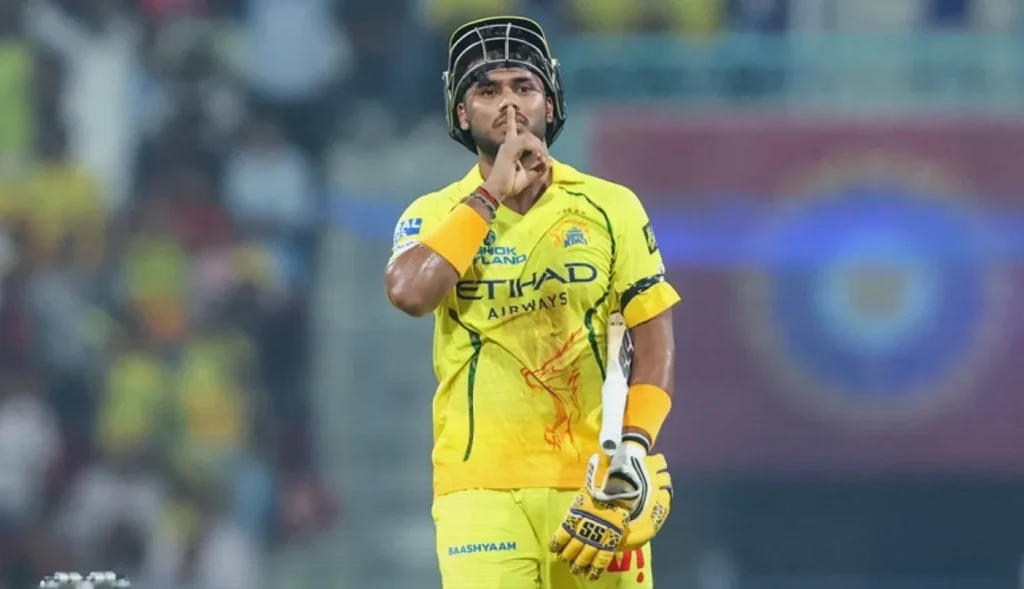
After Kartik Sharma launched a thumping sixth six over extra-cover off Mohammed Shami to bring up his fifty against Lucknow Super Giants (LSG), the usually reserved Stephen Fleming was seen applauding from the dugout. Kartik’s confidence clearly rubbed off around him as well—his close friend Prashant Veer, who was snapped up by the franchise for INR 14.2 crore at the mini-auction, rose to his feet in recognition.
It wasn’t just the fifty that turned heads. Even before Kartik reached 71 from 42 balls on a surface that offered plenty of movement and bounce, Chennai Super Kings’ (CSK) batting coach Michael Hussey had already identified him as a potential “five-to-ten-year” prospect for the team. With Kartik only 20 years old—having turned 20 last month—his latest showing added weight to that belief.
The wicket in Lucknow played differently from the familiar T20 strips. The ball tended to rise sharply from a good or hard length, forcing batters to pick their spots with care. Yet Kartik looked comfortable in the middle overs, showing the range CSK were hoping to unlock. He began in a measured fashion, reaching just 24 off 21 at one stage, but then exploded—almost tripling his tally in the next 21 deliveries.
Kartik arrived in the IPL with a clear reputation as a spin-hitter. During the domestic season, he had taken on Shreyas Gopal and R Sai Kishore, and during CSK’s pre-season camp in Chennai, his lofted shots off spin had quickly become a talking point across social media. In this Lucknow innings, he leaned into those strengths and took control against Shahbaz Ahmad’s left-arm fingerspin. His back-foot swat, timed to perfection off a delivery that was only marginally short, carried a familiar feel reminiscent of Ambati Rayudu. He didn’t stop there—he also found the boundary against the electric pace of Mayank Yadav, stepping away and cutting through the cover-point region for four.
With Rayudu having retired three years earlier, CSK appear to have finally settled on a long-term option for the No. 4 slot. Over that span, the franchise tried as many as 12 different players at that position, with Shivam Dube standing out as the most productive, tallying 385 runs in 13 innings at a strike rate of 174.20. Ravindra Jadeja sits next on the list, collecting 250 runs in eight innings at a strike rate of 136.61.
For CSK, Dube’s role has increasingly looked like that of a finisher—an assignment he also carries for India—while Jadeja now plays his cricket for Rajasthan Royals. In that context, Kartik’s emergence at No. 4 matters, because in only four innings in that spot he has already slotted in behind Dube and Jadeja for CSK, compiling 186 runs at a strike rate of 139.84.
What makes Kartik’s profile especially intriguing is how adaptable his shot-making looks. He is comfortable batting on both sides of the wicket and, even as an IPL rookie, his variety of strokes stands out. ESPNcricinfo’s ball-by-ball logs show that he has already used 18 distinct types of shots this season, including the scoop and the ramp. Just as importantly, he disrupts bowlers’ plans with the way he uses the crease and chooses when to stay put or leave. Those are classic traits of a middle-order batter with a high ceiling.
The early phase of the IPL, though, didn’t mirror that promise. Kartik spent time at three separate batting positions between Nos. 5 and 7 during his opening games, scoring 58 runs across five innings. His average during that stretch was 11.60, with a strike rate of 118.36. The lack of momentum could be linked to the pressure that comes with a high price tag, or perhaps it was simply a matter of settling after injury concerns from the domestic season—ring rust that takes time to shake off.
Once he moved up to No. 4, the transformation looked immediate. Nikhil Doru—the former Rajasthan wicketkeeper-batter who now works as Kartik’s batting coach in domestic cricket—believes Kartik’s skill set is better suited to building an innings than simply closing it out. Doru explained that while Kartik hadn’t started quickly in the tournament, he expected runs once the role demanded the right kind of tempo. He pointed to Kartik’s game awareness, noting how he understands when to attack, when to hold back, when to take singles, and how to remain composed under load.
Doru also highlighted Kartik’s temperament from a young age. He recalled spotting him during Under-14 cricket for Rajasthan and being impressed with both his calmness and the breadth of his strokeplay. “I first saw Kartik when he was around 13 in the Challenger Trophy for Rajasthan,” Doru said, explaining that Kartik had been the top run-getter in that tournament and that he had already signalled that the youngster was ready for Ranji Trophy and higher-level cricket. Doru felt Kartik stood out because his scoring was driven by skillful batting, not just form.
Though Kartik is still relatively new to senior cricket—only 38 matches old—his development suggests he’s becoming an all-format batter. CSK have long valued batters who can adapt to different situations, even as many other franchises have increasingly leaned toward pure T20 power-hitters. Last November in Jaipur, during a Ranji Trophy match, Kartik struck 139 off 192 balls and spent close to 60 overs at the crease alongside Deepak Hooda against a Mumbai bowling attack featuring Shardul Thakur, Tushar Deshpande, Shams Mulani and Himanshu Singh, a bowler who resembles R Ashwin in style.
Reflecting on that hundred, Doru described it as an exceptional innings and underlined that even within it, Kartik maintained a strong strike rate of 72.39. “Scoring runs against Mumbai is always very good,” he added, framing it as evidence of how Kartik can perform when conditions demand patience and application.
Even with the upward trend in IPL, the step up still has areas that Kartik is working to iron out. One notable concern is his dot-ball percentage of 39.41, which ranks third-highest among middle-order batters—those batting at Nos. 4 to 7—after a minimum of 100 balls faced. The pathway to making his innings more decisive, as the data suggests, is fairly clear: he needs to locate gaps more consistently rather than getting tied down by field placements.
Rayudu, discussing Kartik on ESPNcricinfo’s TimeOut show, echoed the idea that improvement will come with confidence and experience. He said that Kartik will learn his single and double options on different pitches, and that once those fine details become second nature, his strike rate should naturally rise. Rayudu also stressed how quickly Kartik seems to be learning, noting that he has already batted at No. 6 and No. 7 during the early part of the tournament—positions that are not always easy to settle into. In his view, once Kartik received a clearer runway at No. 4 or No. 5, his performances began to look far more settled and effective.
With CSK’s playoff route still uncertain this season, Kartik’s certainty at No. 4 is at least one encouraging constant. If he continues to translate his temperament and shot variety into consistent impact, he could become the young backbone around which CSK shape their middle order for years to come.
