
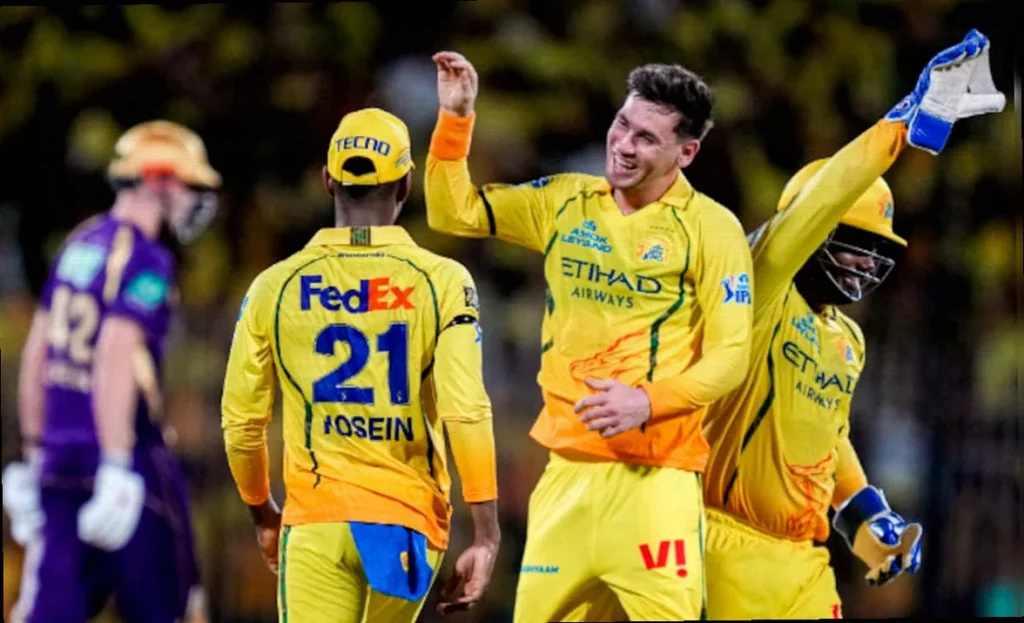
Kolkata Knight Riders’ IPL campaign has sunk further after Chennai Super Kings produced a ruthless display to win by 32 runs on a surface that rewarded control and punished sloppy batting. The defeat in Chennai laid bare weaknesses in Kolkata’s planning under head coach Abhishek Nayar and highlighted skipper Ajinkya Rahane’s increasingly predictable batting patterns. On a wicket that offered two distinct phases, CSK raced to 72 in the powerplay and then finished with 192 for five, a total that may have been about 20 short of an ideal par score but still proved decisive. In reply, KKR managed only 160 for seven in their 20 overs.
CSK’s defence: Noor Ahmad strikes at the right time
- KKR’s chase never gained real momentum because left-arm wrist-spinner Noor Ahmad delivered a decisive spell, taking 3/21 in four overs.
- Early on, wickets began to fall in clusters, and Noor’s penetration cleared the middle order with precision.
- On a track where the ball gripped, Noor removed Rahane, Rinku Singh (6) and Cameron Green (0), swinging the contest as KKR slipped from 79 for two to 90 for six.
- Left-arm spinner Akeal Hosein added further pressure with 1/26 in his four overs, keeping batters tied down and sustaining the run restriction.
- Rahane made 28 off 22 balls and Raghuvanshi struck 27 off 19, but their 50-run partnership in just over five overs arrived too late to fully repair the damage.
- KKR ended up with a chase that began to resemble an outdated approach—one that plays for the “old” style of power-hitting targets rather than the demands of a two-paced Chennai wicket.
- The final outcome was sealed because the late momentum never materialised; impactful hitters Rovman Powell (31 off 22) and Ramandeep Singh (35*) only arrived after the game’s shape had already shifted.
Rahane and Raghuvanshi’s positions in KKR’s batting order have repeatedly failed to deliver consistency, and this latest setback adds weight to a troubling trend for the Shah Rukh Khan-owned franchise. KKR have now lost four of their first five matches, and the responsibility for that slide has increasingly been pinned on the team’s overall structure and execution under Nayar.
CSK’s powerplay set them up; spinners controlled the middle
CSK were quickly back in rhythm after the powerplay, and the nature of their innings showed how they adapted to the wicket. Rahane was visibly unhappy when asked about his powerplay batting, but CSK captain Ruturaj Gaikwad exploited a long-standing weakness: Rahane’s vulnerability against slower bowling. CSK also benefited from key breakthroughs by pacers Anshul Kamboj and Khaleel Ahmed, who removed Finn Allen (1) and Sunil Narine (24 off 17 balls)—wickets that made the chase harder from the outset.
- Sanju Samson (48 off 32) and Ayush Mhatre (38 off 17) pushed CSK to 72 for two by the end of the powerplay.
- After that burst, KKR’s bowlers tightened the screws: Narine (1/21 in four overs), Anukul Roy (1/21 in three overs) and Varun Chakravarthy (0/26 in three overs) combined to concede only 68 runs across the next 10 overs while taking two wickets.
- In the 14 overs following the powerplay, CSK managed 120 runs at under nine runs per over, largely because KKR’s spin unit maintained control and slowed the run rate.
- At the death, Kartik Tyagi (2/35 in four overs) brought pace in the high 140s and also used slower deliveries outside the batter’s scoring arc, disrupting clean hitting and making the final overs expensive.
- Dewald Brevis flashed real class with 41 off 29, while Sarfaraz Khan (23 off 18) again showed his “smart cricket” by contributing to a partnership that lifted CSK beyond the purely defensive range.
How CSK built momentum: Samson’s start and Mhatre’s statement
- CSK began aggressively, with Samson striking three boundaries, including a streaky hit off Vaibhav Arora in the opening over.
- Ayush Mhatre, the U-19 World Cup-winning captain, immediately raised the tempo with back-to-back sixes off Cameron Green, along with a couple of additional boundaries.
- The most eye-catching moment came in the form of a Kapil Dev-style Nataraja shot played behind square, followed by another open-chested six over mid-wicket.
- Mhatre’s impact gave CSK the momentum they needed, even though Samson’s innings was not entirely smooth and largely played second fiddle during that phase.
- Samson did still show glimpses of quality, including a straight six off Kartik Tyagi, but Tyagi later returned with a sharp off-cutter recorded at 148.1 kph to break Samson’s defence.
The Chepauk wicket itself set the tone: it behaved like a two-paced track, with occasional grip and balls arriving late onto the bat. After the powerplay, KKR’s trio of Anukul Roy, Narine and Chakravarthy found enough purchase to control the scoring, with Tyagi complementing their work by adding pace and variation whenever CSK tried to accelerate.
